A round-up of the latest and best insight on the rise of illiberalism in the public discourse:
John Rosenthal: Welcome to Online Censorship 2.0
At The American Mind, John Rosenthal argues that modern censorship isn’t outright restrictions on speech, but more subtle limitations on reach—how many people see your content. We saw this during the pandemic as platforms like Facebook and Twitter throttled content deemed “misinformation,” but now the practice is being codified into hate speech regulations around the world:
Much of the ostensible “hate speech” prosecuted under German law consists not, say, of speech considered to be racist, sexist, or homophobic, but merely of personal insults. Hence, much of the speech that German sources reported to online platforms under the Digital Services Act (DSA), the E.U.’s flagship online censorship law, undoubtedly consists of such insults as well. The activities of the German organization HateAid, which enjoys the status of an officially certified “trusted flagger” of illegal content under the DSA, make this clear.
Under the DSA, European sources may flag any online content in any language posted anywhere in the world. A German organization like HateAid may not only flag German content for removal—it can also target Americans.
…
The ruling is highly significant for the application of the DSA, which requires online platforms to remove illegal speech, at least in the jurisdiction where it is illegal. (Given the complexities and costs involved in tailoring content moderation to different markets, this requirement can often result in global takedowns.) But the law also explicitly permits platforms to meet their DSA obligations not by removing content outright, but by restricting its visibility and hence reach.
This idea was popularized by Elon Musk in November 2022 when, shortly after completing his acquisition of Twitter, he announced a new policy of “freedom of speech, but not freedom of reach.” But long before Musk adopted it, European Commission officials were already using the freedom-of-speech-is-not-freedom-of-reach mantra to try to reconcile the obvious censorship the DSA requires with the freedom of expression that is, after all, guaranteed by the E.U.’s own Charter of Fundamental Rights. (See Věra Jourová’s December 2021 remarks to Politico, where the E.C.’s then-vice-president for values and transparency uses the same expression.)
Mark Judge: Classic ‘Rolling Stone’ and the Cowardice of Today’s Media
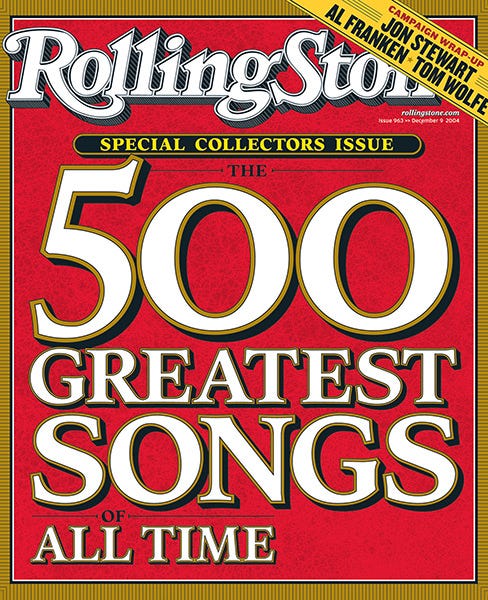
Rolling Stone may be a shell of its former self today, but the magazine was once enormously influential. What made it so great? Free speech. Co-founder Jann Wenner wasn’t afraid to hire journalists who would challenge authority—whether it be politicians, rock stars or even Rolling Stone’s leadership. Mark Judge explains at Chronicles:
Jann Wenner who, along with Ralph J. Gleason, co-founded Rolling Stone in 1967, may have been an egomaniac, control freak, and a bit of a jerk. But, as author Charles L. Ponce de Leon shows, Wenner was also ambitious and wise in his stewardship of the magazine. His vision and even humility allowed him to hire the best people and let them flourish, even if they disagreed with him.
This produced a magazine of surpassing excellence that was always engaging. Hiring people who were allowed to criticize its founder, willing to take on sacred cows (even if they were rock stars), and demanding high standards while taking on challenging subjects in new ways—these are all things that today’s version of the magazine has lost the courage to do.
…
Rolling Stone succeeded because Wenner had the courage to hire people with real talent—even when those people would criticize Wenner himself.
…
Then there was Greil Marcus, who was hired to be the editor of the record review section. Marcus took the job on the condition that Wenner not interfere with his decisions. Wenner agreed.
…
Marcus said he “felt debate and conflict within the section was good—that it was a version of how people actually argued about albums.” He made it clear to writers that they could be critical. “I said to people over and over again, ‘Be as mean, as tough, as angry as you want to be. If something insults your intelligence or is a betrayal of somebody’s talent, say so. Don’t hold back.’”
Robert Corn-Revere: An Open Letter to FCC Chairman Brendan Carr
Former FCC Chief Counsel Robert Corn-Revere has some advice for the agency’s current chairman, Brendan Carr: stop threatening news outlets for airing coverage the FCC doesn’t like. It’s illegal, and it will not accomplish Carr’s “transparent political objectives”:
Dear Chairman Carr,
…
You have recently threatened to revoke the licenses of broadcasters who air what you call “fake news,” which apparently includes any skeptical reporting about the war in Iran—something you know you cannot do legally.
…
As you may recall, shortly after you were named to head the Federal Communications Commission, I offered you some unsolicited advice in the form of an open letter entitled “A Plea for Institutional Modesty.” I suggested you should be circumspect in your assertions of power over broadcasters because “you don’t have as much power as you may think,” and flexing your regulatory muscles would conflict with both the Communications Act and the Constitution.
But as was clear from your initial acts as chairman and statements you made while campaigning for the job, your quest for political advancement overrode any previous commitment to First Amendment values.
Gone were the days when, as a commissioner, you said things like “a newsroom’s decision about what stories to cover and how to frame them should be beyond the reach of any government official, not targeted by them,” or that “inject[ing] partisan politics into our licensing process” is “a deeply troubling transgression of free speech and the FCC’s status as an independent agency.”
…
Unlike some of the comically unqualified appointees in this Administration, you know better. You have been an FCC commissioner for nearly a decade, and once upon a time you practiced communications law. So, you know your Bizarro World social media post gets what “the law is clear” about exactly backwards.
The law is clear that the First Amendment bars the government from dictating news coverage or punishing editors or publishers for reports the president thinks are “false.” And it also is clear that broadcast licensees who operate under the public interest standard are shielded from this kind of government interference as well.
You have repeatedly referred to the Communications Act’s public interest standard as if it vests the FCC with authority to act as a super editor for the nation, but this is the very same law you used to say does not empower the Commission to be the broadcast speech police. And you never mention Section 326 of the Act, which prohibits the FCC from engaging in “censorship” or “interfer[ing] with the right of free speech.”
Around X
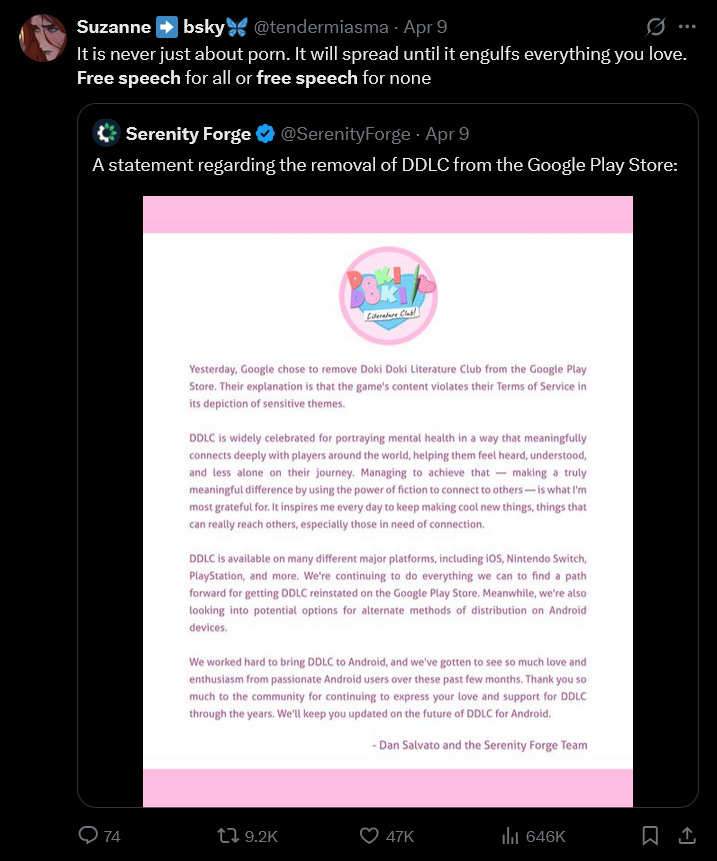
Google recently removed Doki Doki Literature Club (DDLC) from its app store. The “visual novel,” so we’re told, contains depictions of suicide and other disturbing imagery—violating Google’s terms of service. Some X users fear the game’s removal is only the first step in a broader censorship campaign.
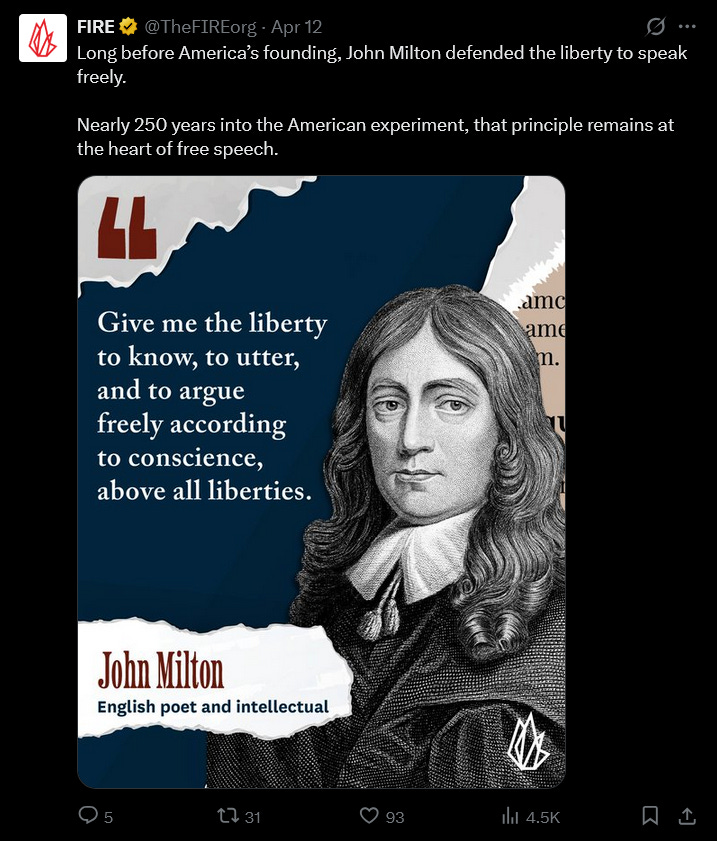
Free speech: still the most important right we posses. Lest you’re tempted to forget, here’s a reminder from the legendary poet John Milton:
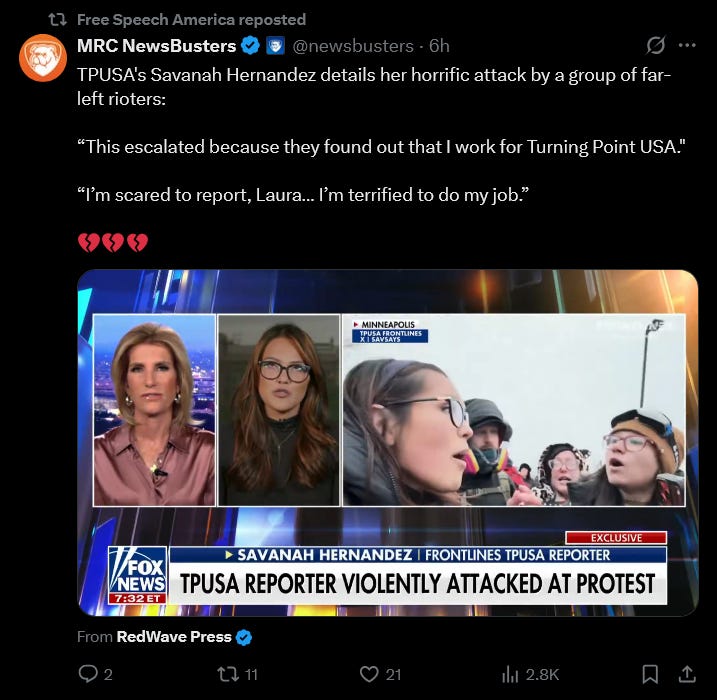
Turning Point USA reporter Savanah Hernandez says she’s afraid to do her job after being pushed to the ground by 250-pound man during a recent anti-immigration protest. Suffice it to say, having the "wrong" politics shouldn't put anybody in danger.