A round-up of the latest and best insight on the rise of illiberalism in the public discourse:
Nathan Cofnas: How I Became the Scapegoat in the Jason Arday Affair
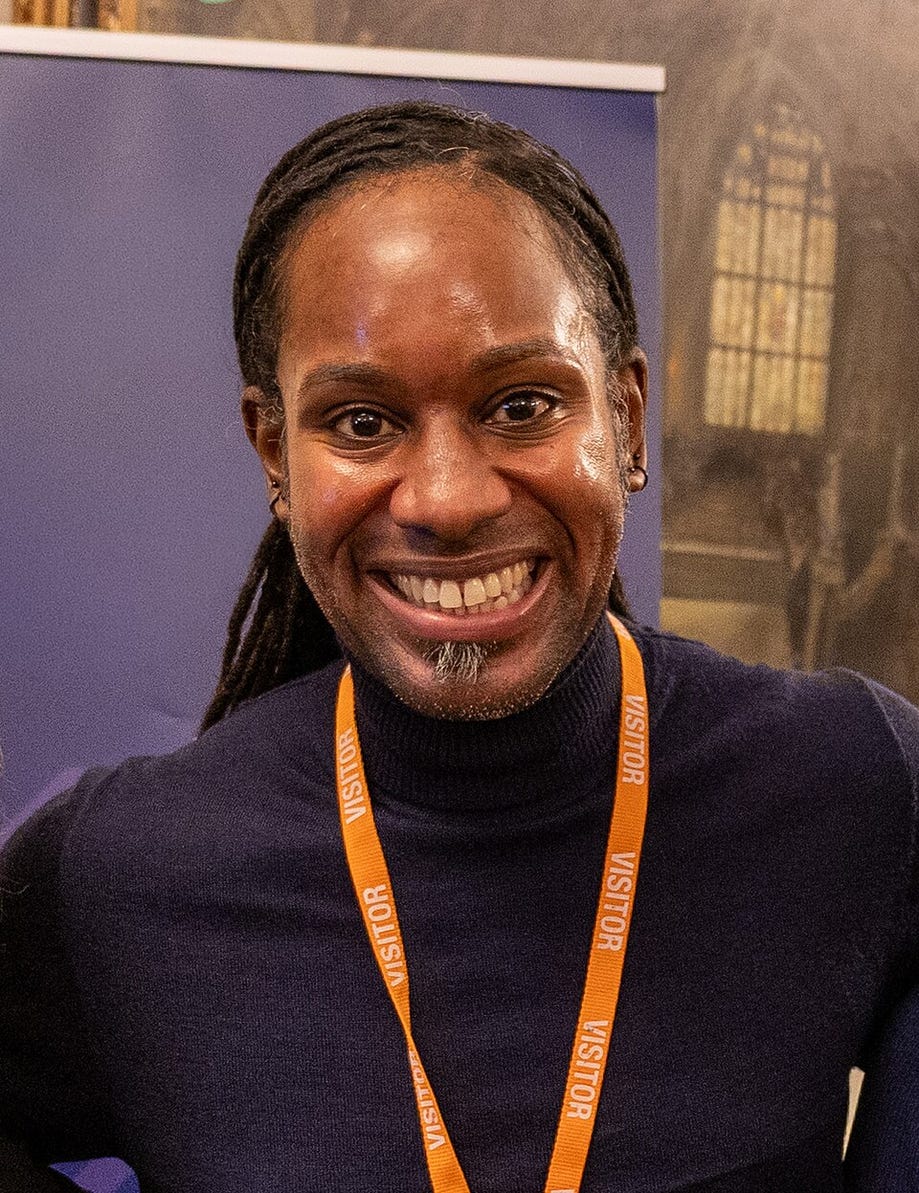
Philosopher Nathan Cofnas broke the story last month that Jason Arday — hired with great fanfare as the youngest Black professor in Cambridge’s history — had plagiarized extensively and fabricated much of his life story. Within weeks, Arday had resigned and ended his life. Now Cofnas says he’s the one being made to pay for it.
At the Wall Street Journal, Cofnas writes that Cambridge knew about the fabrications for years and chose to protect Arday rather than confront the problem, and that he’s since been flooded with death threats and denounced by name at a public vigil:
I have been smeared as a racist and threatened with violence. My university suspended me. All I did was tell the truth.
Cofnas argues the controversy was never really about Arday. It was about a DEI system that mismatches qualifications and position, and about who gets blamed when that system produces a tragedy: the institution that ran the cover-up, or the person who told the truth about it.
Joe Murphy: Florida’s FWC Spied on Citizens Who Dared to Speak Up

Florida likes to call itself “the free state,” but its wildlife agency has spent years quietly treating its critics like suspects. Joe Murphy lays out how the Florida Fish and Wildlife Conservation Commission repeatedly pulled the driving and vehicle records of citizens — retirees, teachers, documentary filmmakers — who showed up to public meetings and criticized the agency’s policies.
The searches ran through a restricted state database reserved for actual criminal investigations. Murphy’s read on what these people actually did:
They were treated as criminals.
Murphy’s bigger point is that accountability has to start at the top, not the middle — FWC’s leadership skipped the chance to address the scandal head-on at its own commission meeting, while line staff and officers take the reputational hit.
Sam Skove & Rishi Iyengar: State Department to Partner With Palantir, Anduril, Bitcoin Policy Institute on Free Speech Initiative
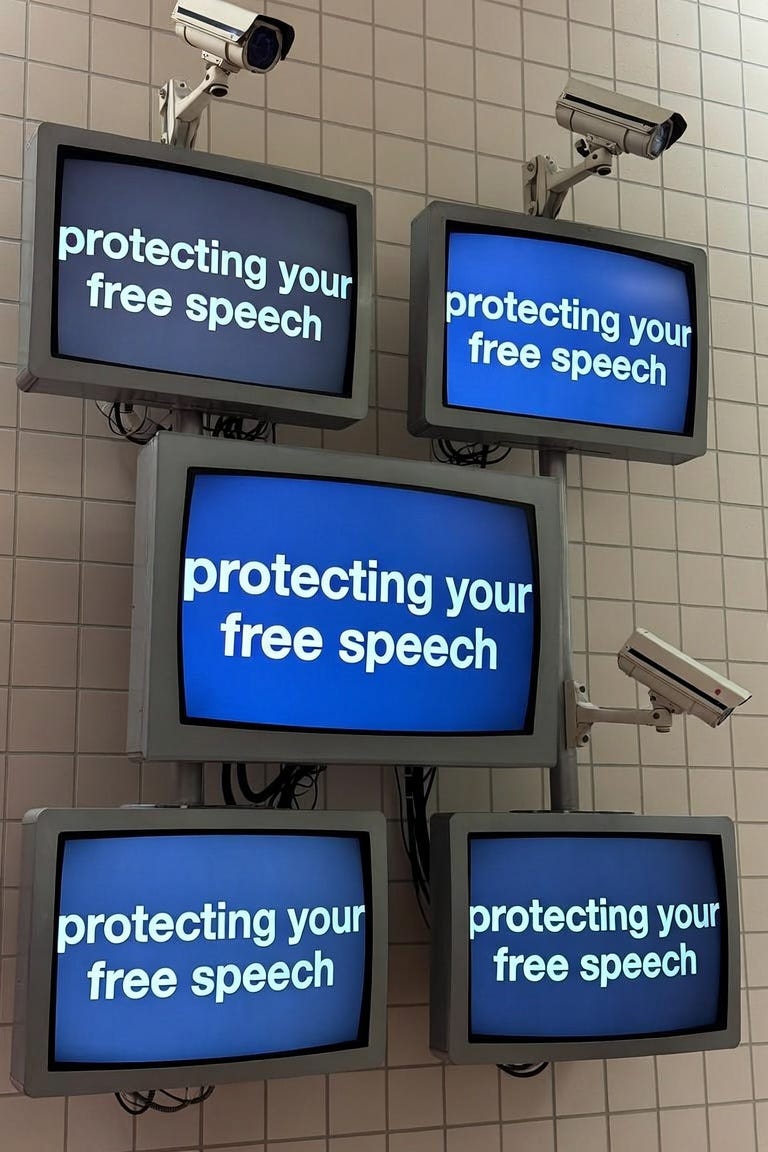
In the “who thought this was a good pairing” category: the State Department has launched the Freedom Tech Excellence Program, embedding private-sector staff from Palantir and Anduril — two firms best known for building government surveillance and defense infrastructure — to advise on “freedom of expression protections in the digital age” and “countering unlawful digital surveillance.”
Sam Skove and Rishi Iyengar report that the initiative, while short on specifics about what the partner companies will actually do, is:
raising eyebrows among some experts.
The irony writes itself: firms whose business model depends on surveillance and data aggregation are now formally tasked with helping the U.S. government think through how to protect people from surveillance online. The Bitcoin Policy Institute and the Victims of Communism Memorial Foundation round out the founding partners, giving the program a strange mix of crypto-libertarian and defense-contractor DNA.
Around X
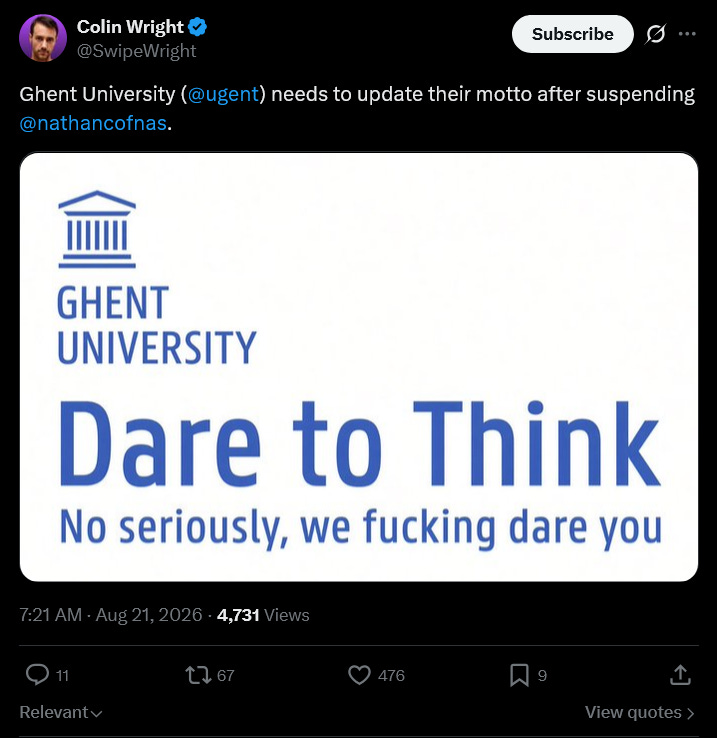
Colin Wright thinks Ghent University might want to revisit its motto after the school suspended Nathan Cofnas over the backlash to his Cambridge reporting.
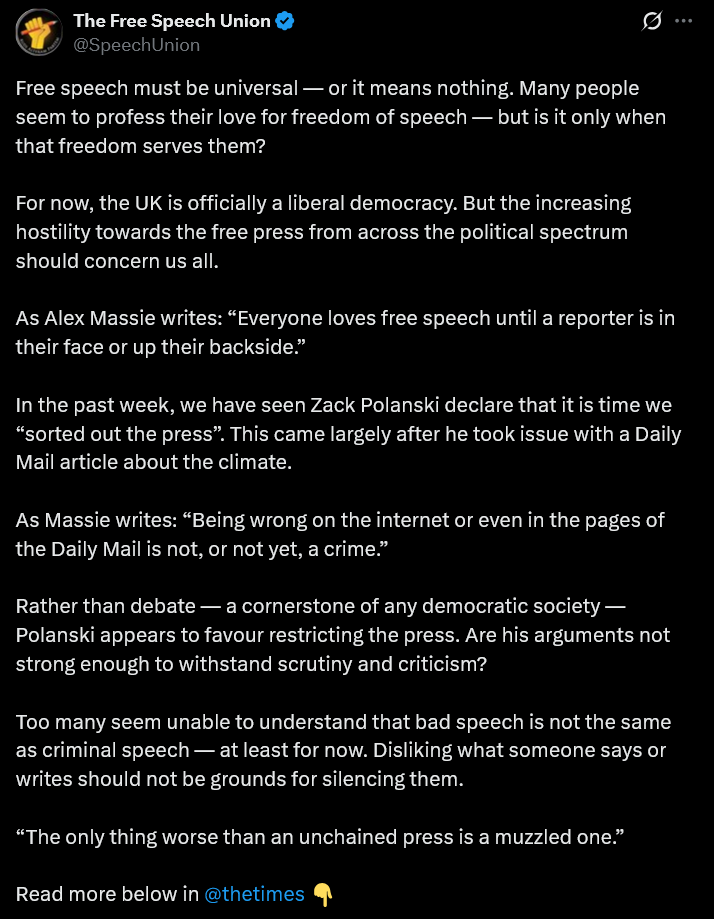
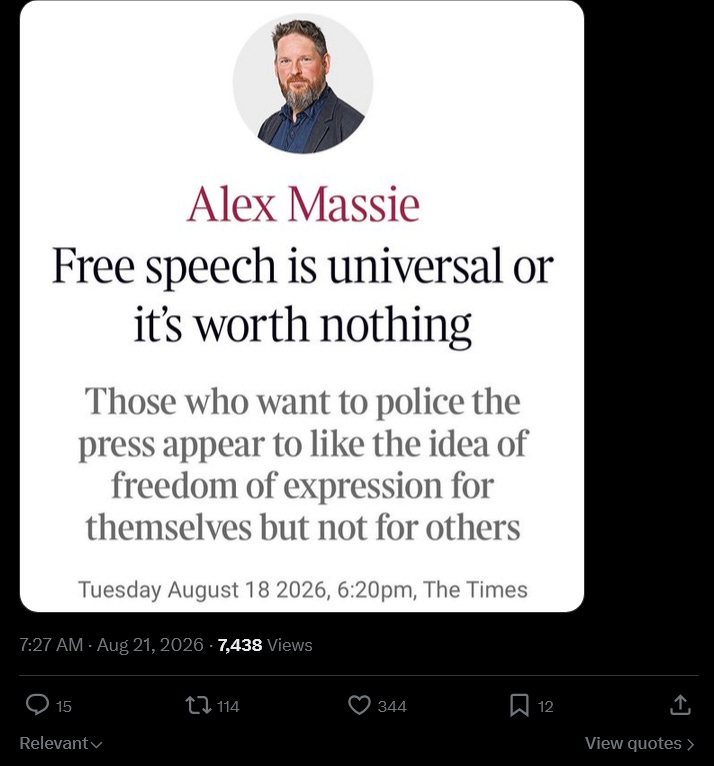
The Free Speech Union flags a warning from Alex Massie: free speech only means something if it applies to people you’d rather not hear from, and Britain’s growing hostility to an open press should worry anyone who claims to believe in it.
And Greg Lukianoff revisits the core idea behind The Coddling of the American Mind, that a free society depends on people who can tolerate being offended.