A round-up of the latest and best insight on the rise of illiberalism in the public discourse:
Frederick Hess: Anti-Racist Education Was Neither

Revisiting his insightful 2020 essay “Anti-Racist Education Is Neither,” Frederick Hess reminds us that liberalism is the true cure for the DEI-fueled “racial essentialism” that has infected America’s universities. If we want people to treat each other as individuals, we must teach them to treat each other as individuals:
“Five years ago this month, Grant Addison and I published “Anti-Racist Education Is Neither.” It’s been on my mind as I reviewed Adam Szetela’s tale of identity-driven, anti-racist cosplay in That Book Is Dangerous!, and as Nick Fuentes and his fellow Groypers have drawn mainstream notice for their raw, unapologetic racism.
Half a decade on, we’ve yet to put the identity-based caricatures of 2020 behind us. At Indiana University, social work students are still taught that “colorblindness” and the “celebration of Columbus Day” are hallmarks of “covert white supremacy.” The University of Minnesota still boasts a website tagged “Whiteness Pandemic” (flagging “White families” as “one of the most powerful” forces behind “systemic racism”), supported by a fellowship funded by the National Institute on Mental Health.
The NEA still offers training to combat “white-dominated, white-identified, and white-centered” norms and insists that bargaining campaigns “must dismantle white supremacy.” Education Minnesota, the North Star State’s largest teachers union, still provides professional development on “Interrupting Whiteness.”
…
This isn’t complicated. If you want people to treat each other as individuals and not caricatures, you teach them to see individuals and not caricatures. If you’d like people to value character rather than pigmentation, you teach them to value character rather than pigmentation. Each time some ranting Orwellian anti-racist rejects such truisms as unsophisticated, they drag us further into the darkness. Oh, and they embolden wannabe Nazis and other maladjusted, attention-seeking losers to rise in defense of “whiteness.” Good job, gang.
If you wanted to custom design a movement to help a motley crew of identity-fueled bigots rise to prominence on the populist right, you couldn’t have come up with a more effective foil than anti-racist education. Five years on, I feel safe predicting that the toxic, self-serving reign of the anti-racists will be remembered as one of the most self-destructive episodes in the long history of American schooling.”
Daniel Nuccio: ‘Extraordinary intrusion’: Calif. professors demand halt to cybersecurity surveillance software
University of California faculty are ferociously resisting a digital security protocol that will allow school officials to remotely monitor their web history, delete files, and shutdown their devices. The College Fix outlines the latest insanity from the left coast:
An ongoing battle is being waged between University of California professors and system IT leaders over a cybersecurity surveillance software program that faculty argue is far too intrusive and “brings the risk of warrantless surveillance.”
Professors across the state are being told to install a software program called Trellix that monitors scholars’ computers for threats, but also provides potential access to UC information technology officers on what professors are up to on their devices.
An October memo from UC faculty union leaders called for a halt to the program’s rollout, arguing it enables “the distinct risk of warrantless governmental access to sensitive academic materials.”
“Once installed, Trellix EDR software grants unrestricted administrative or root-level access to faculty computers, enabling unchecked, comprehensive, and invasive monitoring, extraction, alteration, and even deletion of files without user consent or notification,” the memo states.
“This is an extraordinary intrusion into the privacy, right to freedom of expression, and intellectual security of faculty, which constitute core principles of the university’s educational and research missions.”
Chris Hoofnagle, faculty director of the Berkeley Center for Law and Technology, told The College Fix that computer security “is often a contest between different values and risks.”
Noel Yaxley: Americans Should Reject the British Precedent on Free Speech
The UK set an alarming censorship precedent in 2023, empowering regulators to effectively control access to online information across the country—and sometimes abroad. Naturally, this was done under the guise of protecting children. Whatever Britain’s motivation, Noel Yaxley says Americans would be foolish to react to this approach with anything but hostility:
It would be wise for Americans to approach this legislation and anything modeling itself after it with hostility rather than mere suspicion, however. Contrary to Starmer’s suggestions to the contrary, Britain does not have a proud tradition of free speech, particularly in the realm of online speech regulation. The potent combination of the Malicious Communications Act of 1988 and the Communications Act of 2003 has resulted in an average of 30 arrests per day in the UK for online speech deemed “grossly offensive.” The OSA is a censor’s charter—and when the state attempts to legislate on matters said to give offense, the consequences often extend beyond and even work against what was originally intended (i.e., the protection of children).
The OSA is a cynical attempt by lawmakers to appease social conservatives, who have always opposed pornography for moral and religious reasons. Arguments that appeal to emotion, such as the phrase “think of the children,” often serve as Trojan horses. It has been used by generations of the meddling and well-connected to stifle free speech. Tipper Gore’s war against hip hop and Mary Whitehouse’s campaign against horror movies come to mind. Sadly, Boomers are once again being forced to acquiesce to censorship.
It’s already affecting journalism. Due to the subjective interpretation of these restrictions, legitimate political discussion has been suppressed. When British Conservative MP Katie Lam spoke in Parliament about the sexual crimes of grooming gangs, the ensuing video on X was age-gated. The recent video allegedly showing IDF soldiers sexually assaulting Palestinian prisoners may be suppressed, thereby limiting the ability to expose war crimes.
Unfortunately, when it comes to online regulation, Britain appears to have set a precedent. Nineteen U.S states have passed verification laws said to be designed to protect children from harmful content. At the federal level, the Kids Online Safety Act, introduced in Congress in 2022 with bipartisan support, seeks to impose a duty of care on tech companies to block material that may harm minors, such as online bullying. The legislation was reintroduced earlier this year.
Around X
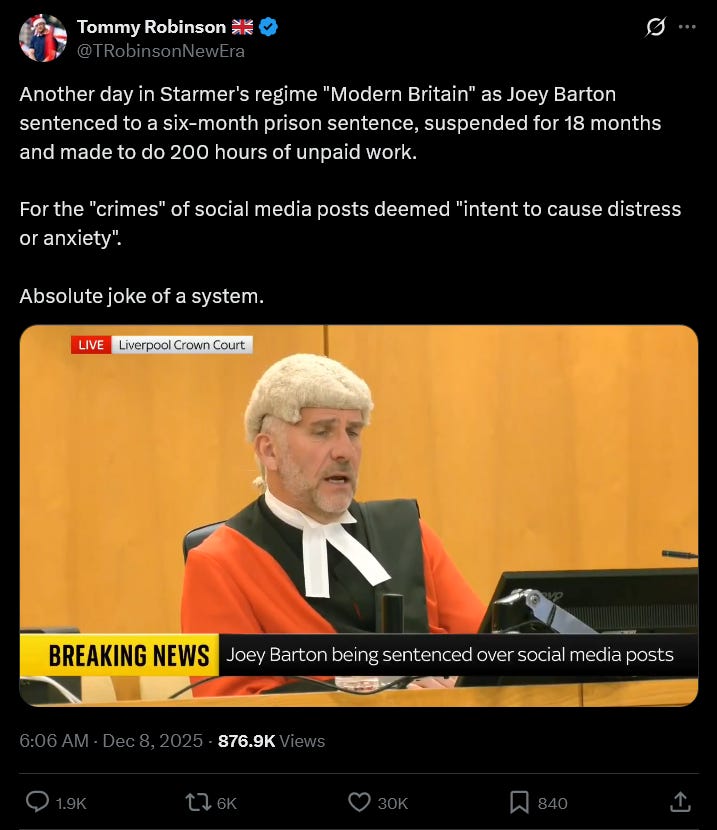
In case you weren’t convinced of Britain’s insensibility on speech, a UK court just handed down a six-month suspended prison sentence to a man for posting social media comments intended “to cause distress or anxiety.”
Free speech isn’t faring any better across the English channel in Europe. German police are confiscating the computers of private citizens accused of posting “hate speech” on social media. We won’t make the obvious historical comparison this scenario calls for. But we will say the lack of self-awareness in Deutschland is tragically hilarious.
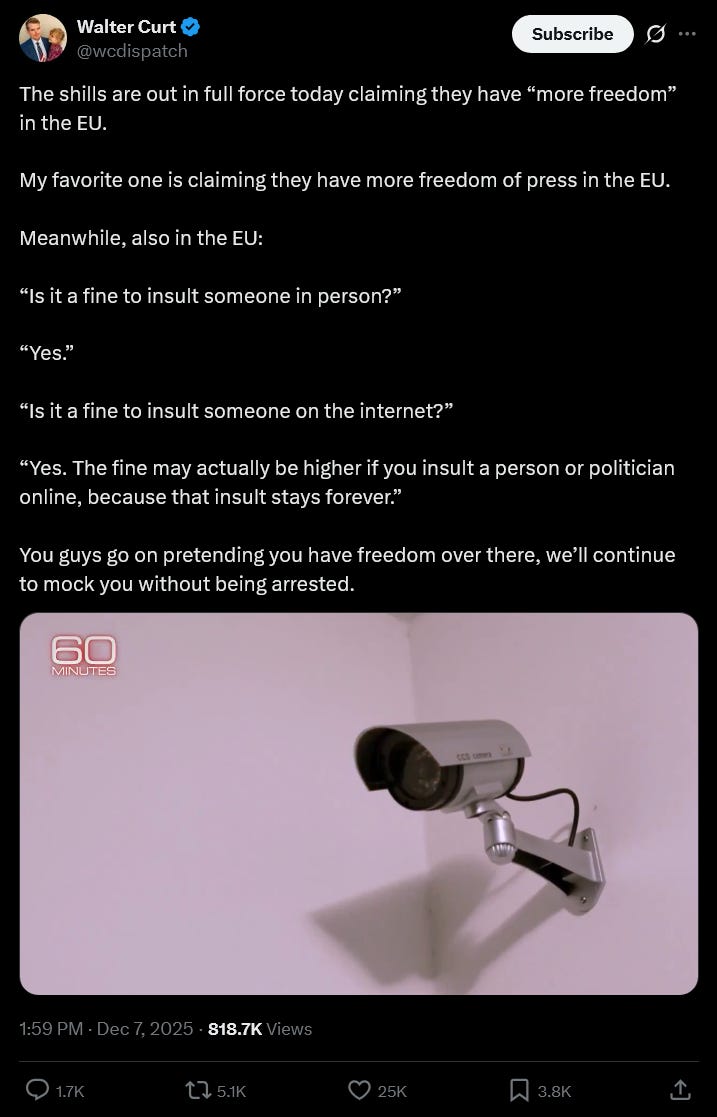
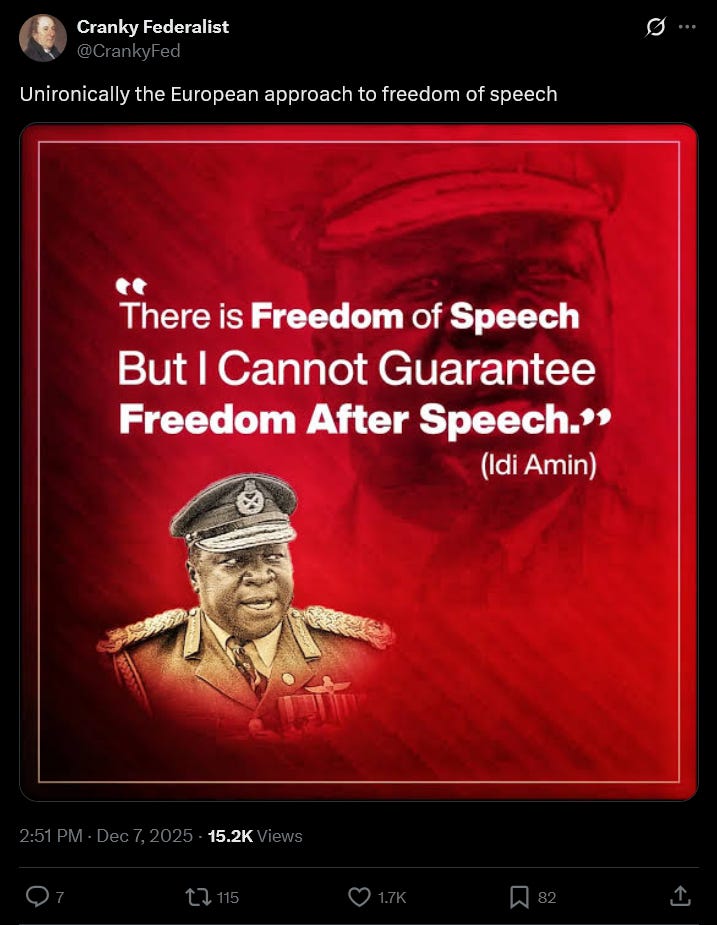
Some constructive criticism for the EU: you’re doing it wrong when the internet compares you to a Ugandan military dictator.