A round-up of the latest and best insight on the rise of illiberalism in the public discourse:
CBS News: Federal court blocks Michigan ban on conversion therapy on free speech grounds
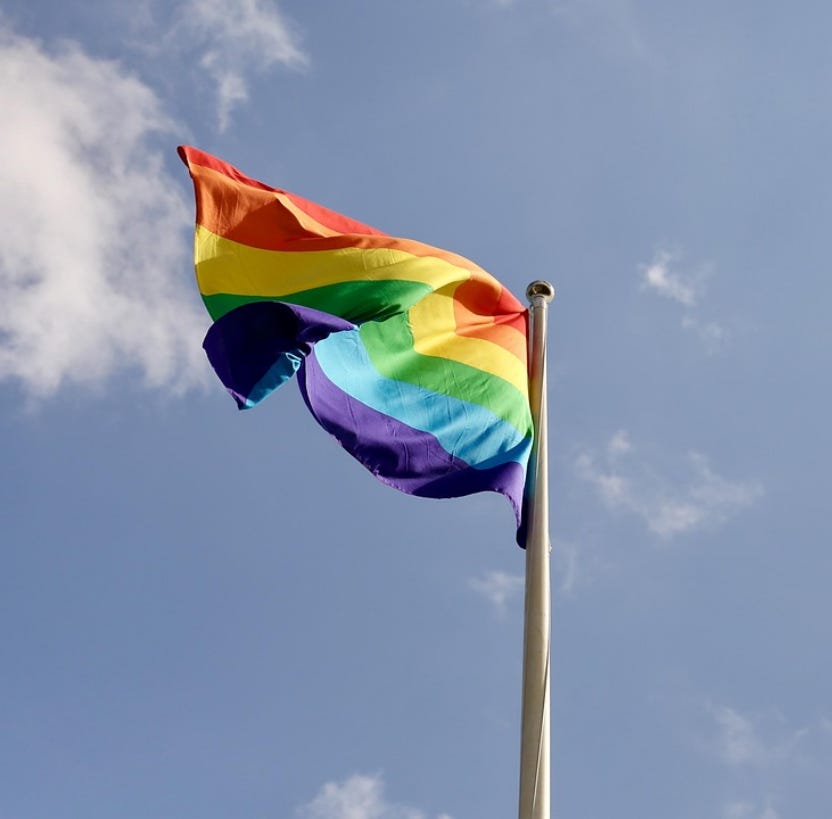
A federal court has ruled that Michigan’s 2023 ban on conversion therapy for minors infringes on the free speech rights of therapists. CBS News reports:
In a 2-1 opinion, the court said the law illegally restricts speech that reflects the moral beliefs of therapists. It set aside a lower court’s ruling and granted a preliminary injunction sought by Catholic Charities of Jackson, Lenawee and Hillsdale Counties.
“The Michigan law discriminates based on viewpoint — meaning the law permits speech on a particular topic only if the speech expresses a viewpoint that the government itself approves,” Judge Raymond Kethledge wrote, joined by Judge Joan Larsen.
They noted that the law permits counseling that helps someone undergoing a gender transition.
The court’s decision comes more than two months after the U.S. Supreme Court heard arguments in a Colorado case that could resolve the issue nationwide.
Damon Root: Yes, the First Amendment Applies to Non-Citizens Present in the United States
If you think the First Amendment applies only to US citizens, think again, argues Damon Root. Both history and legal precedent refute that assumption:
The First Amendment says that “Congress shall make no law…abridging the freedom of speech.” But one prominent conservative judge, whose name has been mentioned as a possible U.S. Supreme Court nominee by President Donald Trump, thinks that protection against government censorship may not apply to non-citizens who are present in the United States.
Is the judge right?
Writing for himself in the recent case of United States v. Escobar-Temal, Judge Amul Thapar of the U.S. Court of Appeals for the Sixth Circuit asserted that “neither history nor precedent indicates that the First Amendment definitively applies to aliens.”
Yet in Bridges v. Wilson (1945), the Supreme Court unambiguously stated that “freedom of speech and of press is accorded aliens residing in this country.” That case centered on an Australian immigrant and labor union activist named Harry Bridges. He faced deportation because of his alleged “affiliation” with the Communist Party. “It is clear that Congress desired to have the country rid of those aliens who embraced the political faith of force and violence,” the Court said. But “the literature published by” Bridges and “the utterances made by him,” the ruling noted, revealed only “a militant advocacy of the cause of trade-unionism” and “did not teach or advocate or advise the subversive conduct condemned by the statute.” The otherwise lawful speech of this non-citizen was thus “entitled to that [First Amendment] protection.”
Thapar’s appeal to history is also suspect. “The application of the Alien and Sedition Acts to resident foreigners,” Thapar claimed, “suggests that the founders did not understand the First Amendment to extend to aliens.”
The Alien and Sedition Acts of 1798 are not normally cited favorably when freedom of speech is being discussed. And with good reason. The Sedition Act notoriously made it a crime, punishable “by imprisonment not exceeding two years,” to write, print, utter, or publish “false, scandalous and malicious” statements with the intention of bringing the federal government, members of Congress, or the president, “into contempt or disrepute.” This censorial statute applied equally to citizen and non-citizen.
The Federalist administration of President John Adams promptly used the Alien and Sedition Acts to punish its political enemies, including by securing the imprisonment of several journalists. A number of American citizens were thus locked behind bars for the supposed crime of criticizing their own government.
James Madison detailed the many constitutional defects of the Alien and Sedition Acts in his “Report of 1800.” As Madison pointed out, “the power over the press exercised by the sedition act, is positively forbidden by one of the amendments to the constitution.” Madison was of course referring to the First Amendment.
Ryan McMaken: How Religious Freedom in America Was Founded on Privatization and Decentralization

Many people today believe that religious freedom was enshrined in the Constitution and handed down to us by the founders. But that popular understanding is wrong, argues Ryan McMaken at the Mises Institute. The campaign for religious freedom actually predates the Bill of Rights and was run at the state level to create a kind of free market for religious liberty:
Much of this myth is premised on the idea that the spread of religious freedom in America was a top-down process. In this narrative, the process was guided by non-Christian secularists like Thomas Jefferson who were especially influenced by the ideology of the French Enlightenment.
This historical narrative is wrong in nearly every way. For example, it is not at all the case that the First Amendment was central to the process of disestablishment—the process of abolishing the “official” churches who held favored positions within most state governments. Rather, this process was carried out overwhelmingly in the state legislatures—and some of this was done before the First Amendment was even written
...
After all, there never was any established national Church in America at all. Consequently, there is no process of disestablishment at the federal level to describe. Rather, the First Amendment was largely the product of anti-federalists and other decentralists who wanted guarantees that the federal government would not intervene at all in state laws related to religion. This is why the First Amendment states that “Congress shall make no law respecting an establishment of religion, or prohibiting the free exercise thereof.” It is only the national legislature, Congress, that is limited by this text. This established that policy related to the churches was to be exercised outside the purview of the federal government.
Around X
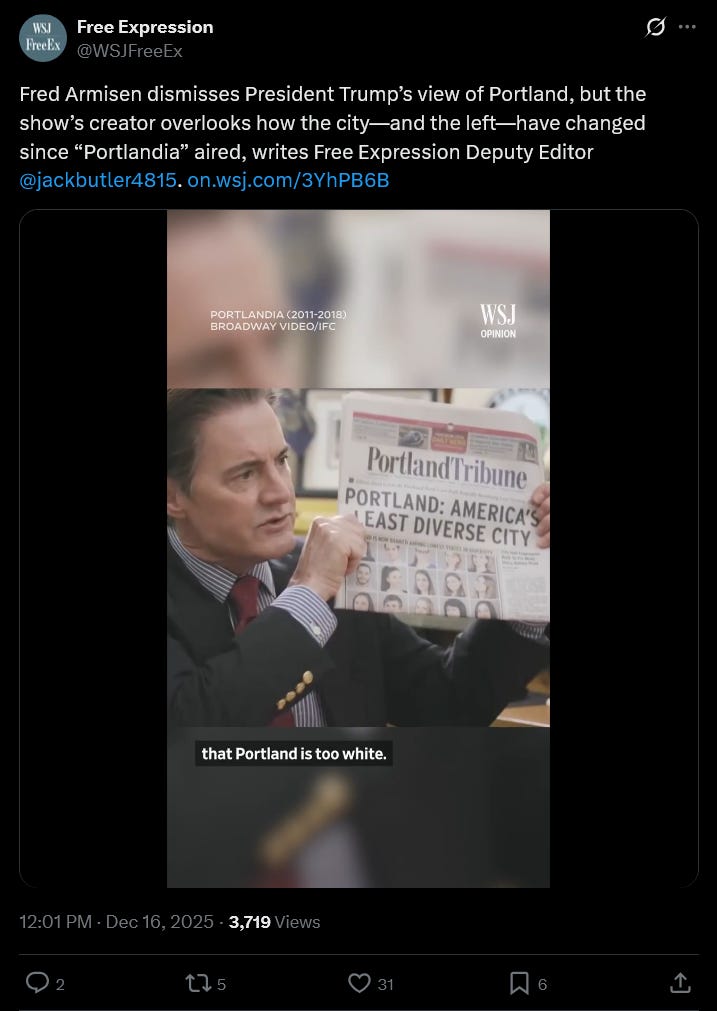
The hit series “Portlandia” poked fun at Portland, Oregon’s, sillier progressive tendencies: the city’s self-consciousness about being the “whitest big city in America,” for example. The show is proof the left once knew how to laugh at itself—an ability it appears to have lost in recent years (click for video).
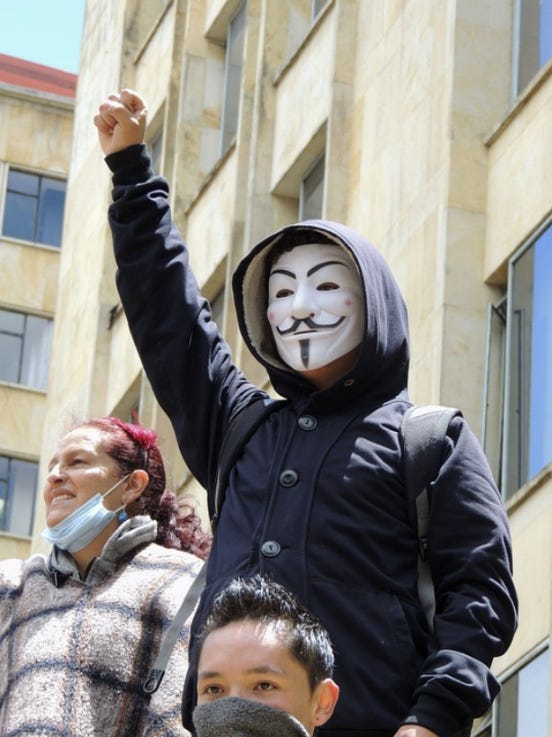
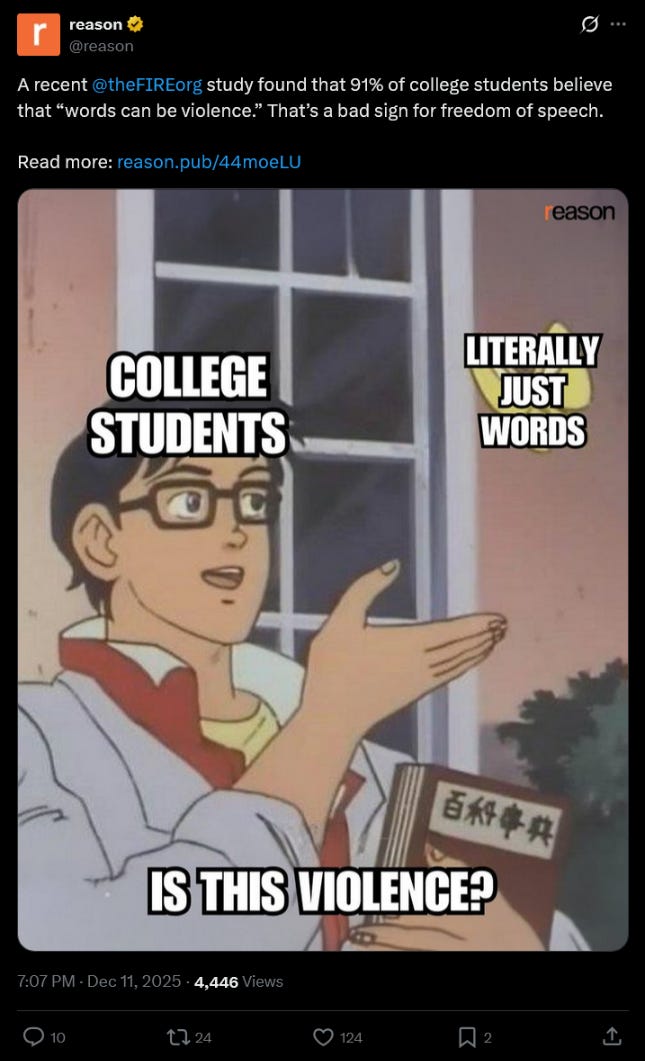
Words aren’t violence, but that fact hasn’t prevented the vast majority of college students from believing they are. Reason magazine says that’s a worrisome development for the future of free speech.
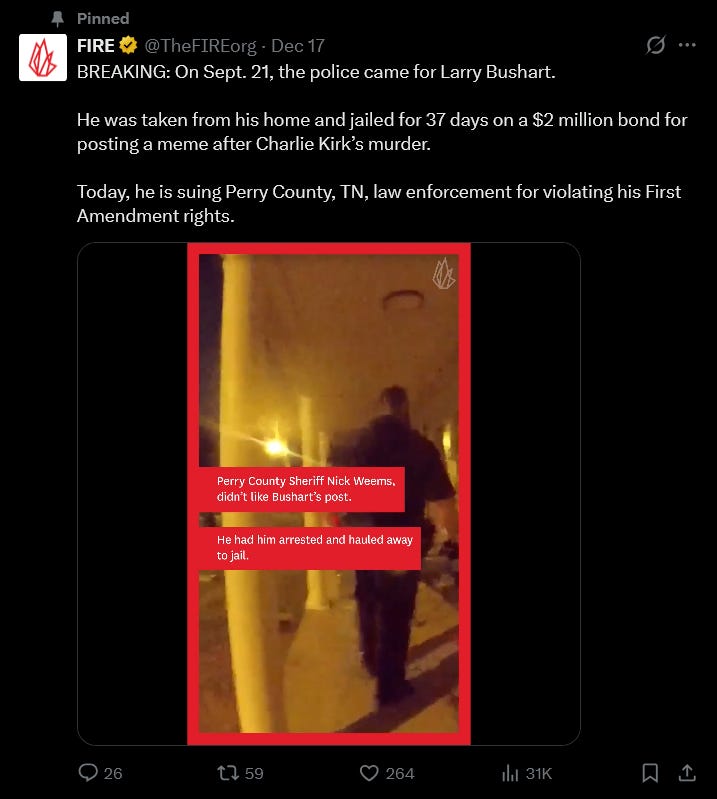
The Foundation for Individual Rights and Expression (FIRE) recounts the story of a Tennessee man who was arrested for posting an offensive meme in the wake of Charlie Kirk’s assassination. The charges were ultimately dropped, though the case is a stark reminder that we must constantly protect our free speech rights (click for video).