A round-up of the latest and best insight on the rise of illiberalism in the public discourse:
Andrea Picciotti-Bayer: What the Founders Understood About Faith and Freedom
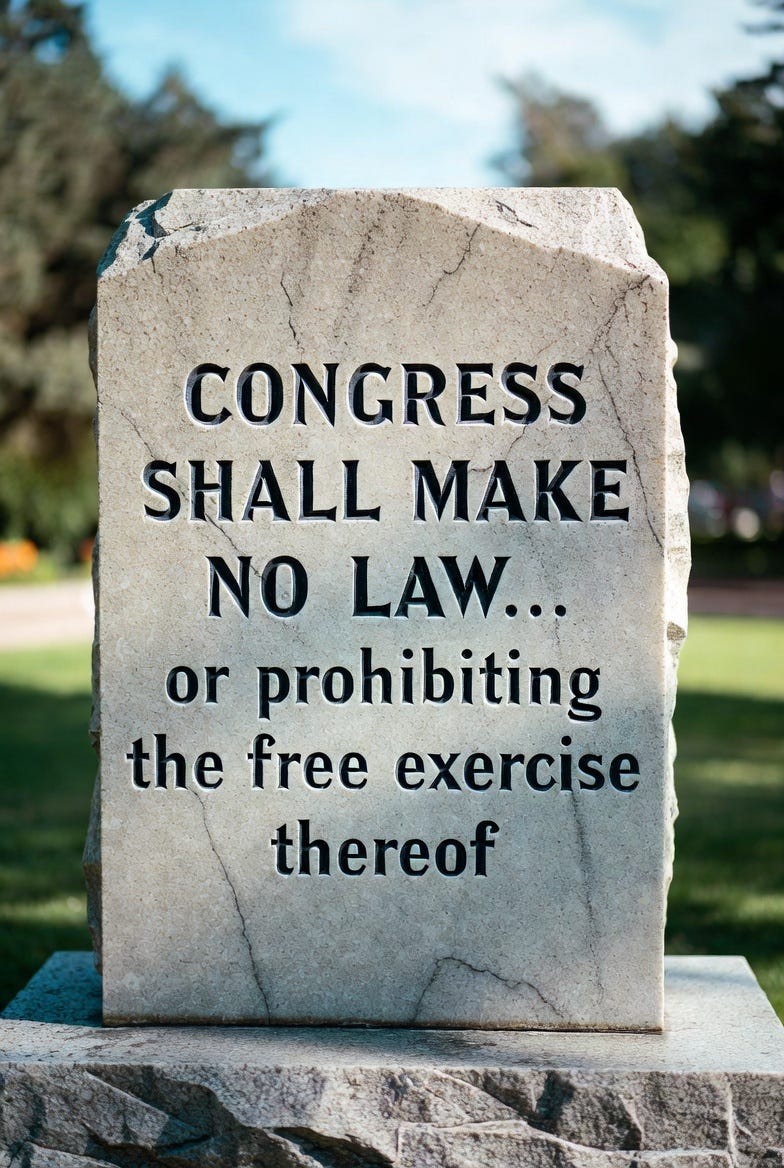
At National Review, civil rights attorney Andrea Picciotti-Bayer says the Supreme Court is starting to reverse unconstitutional restrictions on religious liberty imposed by federal courts over the last 50 years. These are encouraging developments, she notes, though the real question is: will the Court fully restore First Amendment protections for religious Americans?
Each December, my children and I hang lights on our house and set up a big Nativity scene in our front yard. Like many Americans, we feel comfortable expressing our faith in public. The Founders recognized this reality as well. They understood that freedom of religion should not just be permitted, but that it was essential to a flourishing society and provided a moral foundation for self-governance.
Yet for decades, courts have treated public expressions of faith with suspicion, even hostility, as if the Constitution demands that religion be hidden away. Thankfully, the U.S. Supreme Court has begun correcting this error, restoring an understanding of religious freedom more faithful to the First Amendment’s design.
As a civil rights lawyer focused on religious liberty, I am watching closely two cases moving through the courts that will test whether this course correction endures — whether the robust protection of religious freedom secured by the Constitution’s religion clauses will be consistently applied.
…
Beginning with the Supreme Court’s Lemon v. Kurtzman decision in 1971, courts applied a three-pronged “Lemon test” to evaluate whether government action constituted an unlawful establishment of religion. In practice, this test created a presumption of hostility toward religious expression in public settings, and it departed dramatically from our nation’s founding principles.
In 2022, the Supreme Court changed direction. In Kennedy v. Bremerton School District, the Court threw out the Lemon test and its progeny when it vindicated a high school football coach who was fired for his brief, personal prayers on the field. The message was clear: The Constitution doesn’t require hostility toward religion. It forbids the government from establishing an official church or coercing religious observance. It doesn’t ban every religious expression from public view.
Now comes the test of whether courts will apply this principle consistently.
Aaron Terr: City Club of Cleveland rejects illiberal calls to disinvite speaker
The City Club of Cleveland, a legendary venue known for hosting presidents, baseball legends and civil rights leaders, recently caught flak for inviting Aaron Baer, president of the Center for Christian Virtue, to participate in a panel discussion.
Baer’s organization has been labeled a “hate group” by the Southern Poverty Law Center, which prompted calls for the event’s cancellation. To their credit, the City Club flatly refused to cancel or modify the planned discussion. The Foundation for Individual Rights and Expression (FIRE) reports:
In November, the City Club announced it will host a conversation with Aaron Baer, president of the Center for Christian Virtue. City Club CEO Dan Moulthrop is set to moderate the event, which includes an unscreened audience question-and-answer period.
The announcement triggered immediate calls to cancel the event from critics of CCV’s views and advocacy on LGBT issues. The City Club’s Facebook page was flooded with complaints. “We don’t support those who give hate groups platforms,” read one. “Promoting hate speech should never be the goal. Do better,” read another.
Central to the backlash is the Southern Poverty Law Center’s designation of CCV as an “anti-LGBTQ+ hate group.” The label appears to stem in part from the organization’s role in advancing an Ohio law banning medical treatments intended to assist minors with gender transition and excluding transgender girls and women from women’s K-12 and college sports.
…
Moulthrop’s response to the pushback was unequivocal:
“We’re not canceling, and we have never had any intention of canceling this. We’re gonna continue to do what we always do, and have done for 113 years, which is convene conversations of consequence that help democracy thrive and do that with the leadership of relevant organizations who are shaping our communities.”
That’s exactly the right response from an institution dedicated to free speech and civic dialogue.
Moulthrop told me the City Club’s mission “necessarily means making the platform available to diverse points of view and people with political influence — people who, if they’re not shaping policy, they have the ear of people who are.” So it made sense to book Baer for the Friday Forum, a “luncheon program devoted to significant national and regional concerns.” The event description notes that under Baer’s leadership, CCV “has emerged as one of the most influential nonprofit advocacy organizations in the state of Ohio, notching legislative victories on school choice and building coalitions with state government leaders.”
The City Club is not endorsing Baer’s views any more than it has endorsed the views of other speakers it has hosted. It is allowing attendees to engage with ideas that, for better or worse, have gained purchase in society. Notably, the executive director of the LGBT Community Center of Greater Cleveland, who criticized the event by arguing that free speech “should never be used to legitimize rhetoric that undermines the safety, dignity, and well-being” of LGBT people, was herself a City Club speaker just two months ago.
John Aziz: The New Information Wars
When it comes to protecting children from the darker corners of social media, the censorious cure could be worse than the disease. So argues John Aziz at Quillette. Aggressive restrictions on information access are infamously imprecise, he claims. Even worse, they tend to turn kids into passive subjects when they need to become discerning citizens:
Astonishing recent advances in generative AI mean that in a matter of seconds, with a prompt and a few clicks, anyone can generate a fabricated news story, a convincing deepfake video, or an audio recording of a politician saying something they never actually said. What once needed a coordinated effort by teams of skilled propagandists can now be achieved by a mischievous teenager with a laptop, or indeed any non-technical person with an axe to grind.
But the response to this new wave of disinformation may itself pose an iatrogenic danger. Across the democratic world, governments are racing to pre-empt the chaos of a supposedly post-truth media landscape, not only by requiring that platforms flag or remove falsehoods, but by engineering systems that filter, shape, and curate what citizens see online. Under the banner of “information integrity,” we are drifting toward a regime of censorship.
Australia offers one of the clearest illustrations of this paternalistic instinct. In November 2024, the government passed a world-first law banning all Australians under the age of sixteen from having social media accounts, which will come into effect on 10 December. The stated aim was child safety. Tech platforms were ordered to prevent under-16s from creating or running accounts, or face fines of up to fifty million Australian dollars.
…
But excluding a whole demographic from the digital public square is clumsy. Minors are being banished not only from the toxic corners of the internet, but from the primary channels through which teenagers today express themselves and participate in culture. Instead of trying to distinguish between healthy and unhealthy patterns of engagement, or to support parental supervision, the law is a blanket prohibition, criminalising all sorts of normal and healthy behaviours.
YouTube, in a submission to lawmakers, warned that the ban might backfire by forcing teens to browse logged-out, thus enabling them to evade the safety filters, parental controls, and moderation tools designed for signed-in youth accounts. The company also argued that it should be exempt from the law due to its educational content and restricted mode, and warned creators that the legislation could disrupt their audiences. Many tech-savvy teens will likely skirt the ban altogether by browsing from behind a foreign VPN.
But the deeper issue is that the Australian ban treats young people not as developing citizens capable of learning how to navigate the internet and avoid its dangers, but as passive subjects to be shielded from it. Like so many recent digital safety proposals, it reflects a growing impulse to replace discernment and parental responsibility with blanket restriction.
Around X
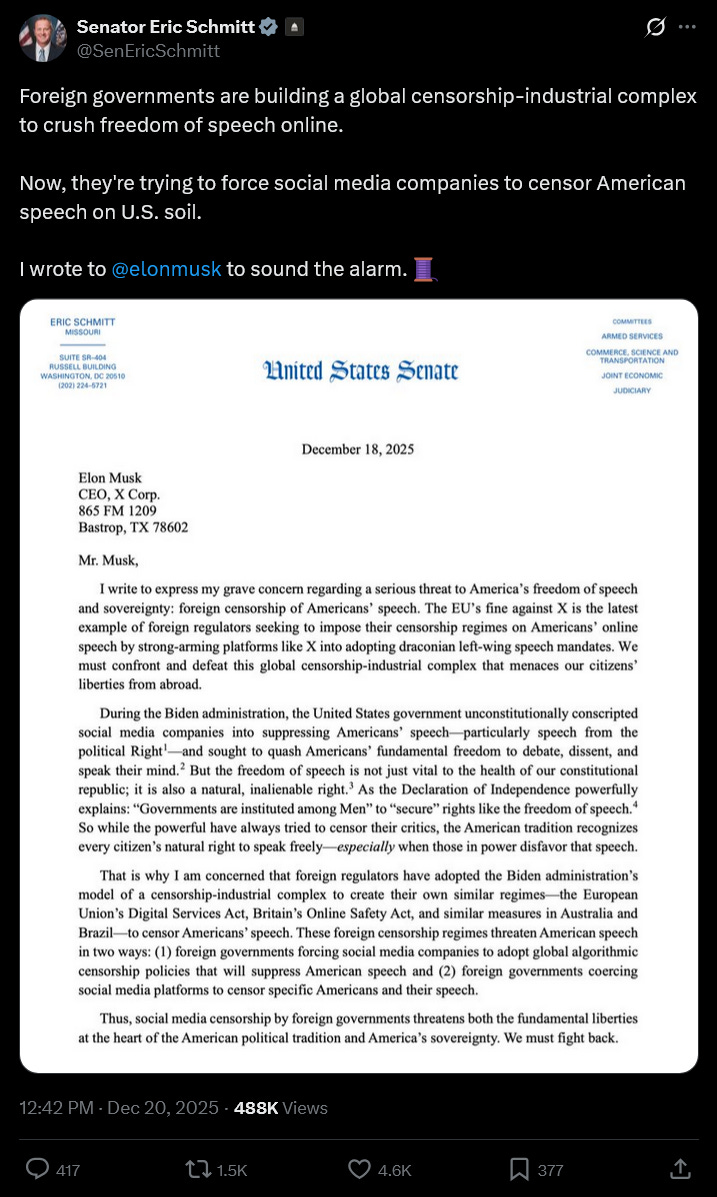
Senator Eric Schmitt calls out the EU, UK, Australia and other governments for trying to censor the speech of American citizens through the backdoor.
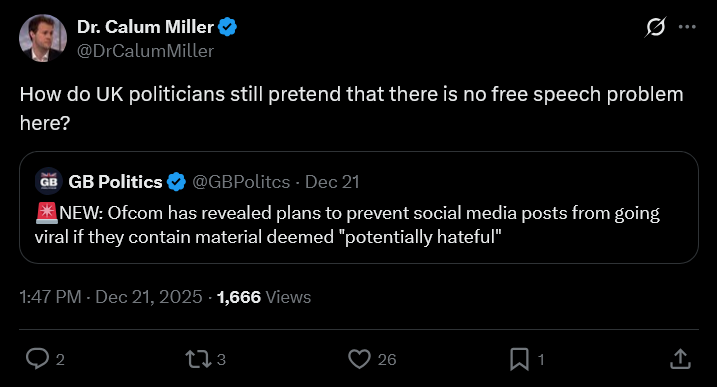
UK-based physician Calum Miller asks a question we’ve posed many times.
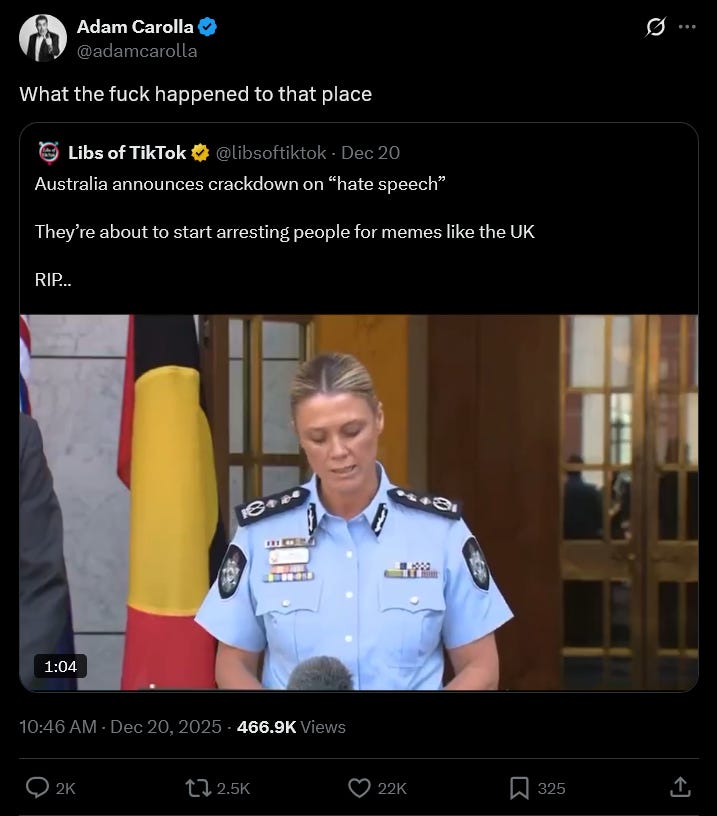
Ever the gentleman, Adam Carolla has a related question about Australia.