A round-up of the latest and best insight on the rise of illiberalism in the public discourse:
Joseph A. Wulfsohn: CBS denies it blocked Colbert from broadcasting Talarico interview after host claimed network lawyers halted
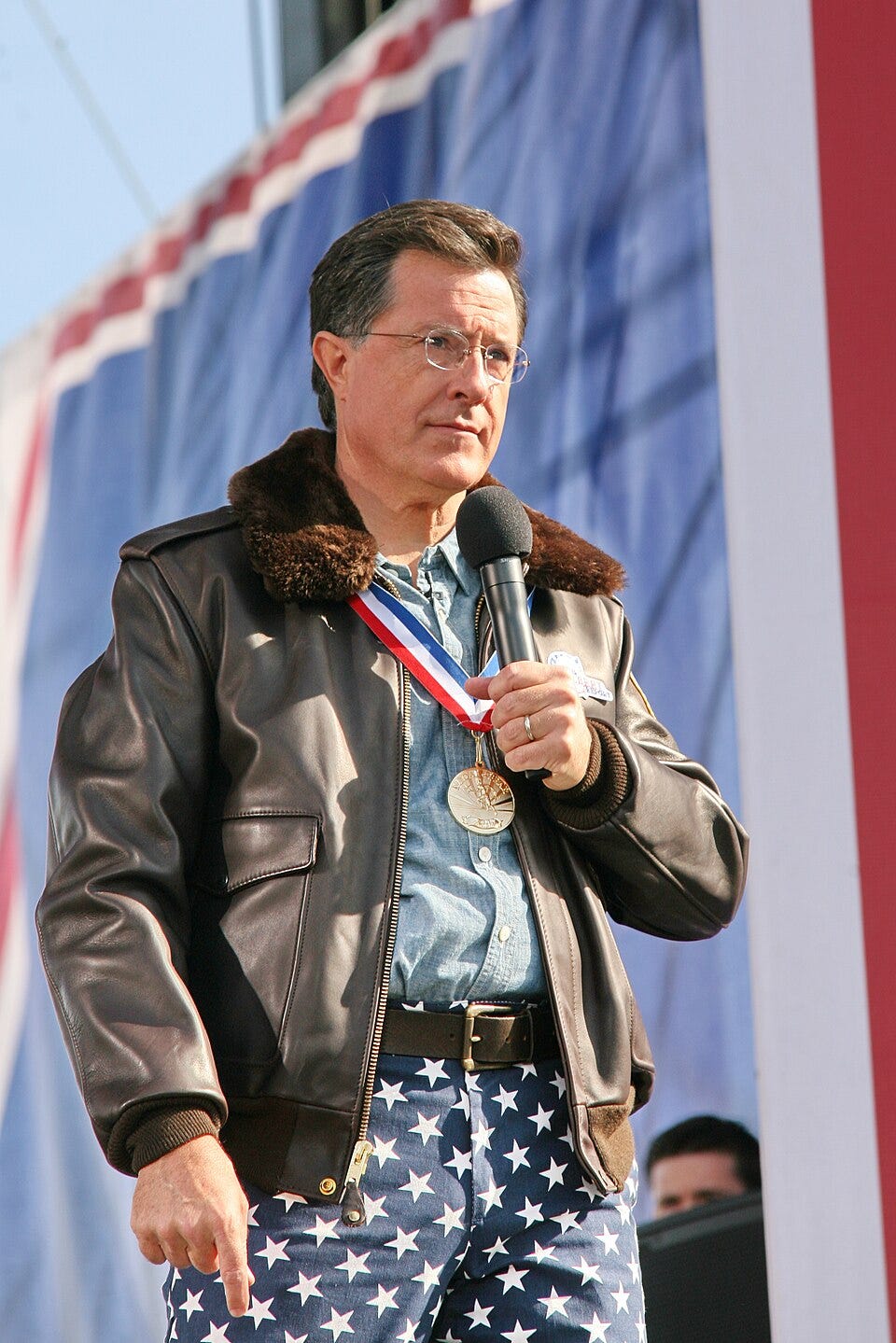
Late-night host Stephen Colbert has alleged that CBS prohibited him from airing his viral interview with Texas state representative James Talarico. CBS pushed back on the censorship allegation, claiming it was only complying with FCC broadcast regulations. Joseph Wulfsohn reports for Fox News:
CBS is denying Stephen Colbert‘s claim that it blocked his interview with Texas Democrat James Talarico from airing.
“THE LATE SHOW was not prohibited by CBS from broadcasting the interview with Rep. James Talarico,” the network told Fox News Digital in a statement Tuesday.
The statement continued, “The show was provided legal guidance that the broadcast could trigger the FCC equal-time rule for two other candidates, including Rep. Jasmine Crockett, and presented options for how the equal time for other candidates could be fulfilled. THE LATE SHOW decided to present the interview through its YouTube channel with on-air promotion on the broadcast rather than potentially providing the equal-time options.”
A representative for “The Late Show” did not immediately respond to Fox News Digital’s request for comment.
On Monday night, Colbert asserted that network lawyers had halted him from airing his Talarico sit-down.
“He was supposed to be here, but we were told in no uncertain terms by our network’s lawyers, who called us directly, that we could not have him on the broadcast,” Colbert told viewers.
Colbert’s interview with Talarico was shared on the show’s YouTube page, which has gotten more than 2.2 million views.
Hamit Coskun: I burnt a Quran. Now I may have to flee Britain
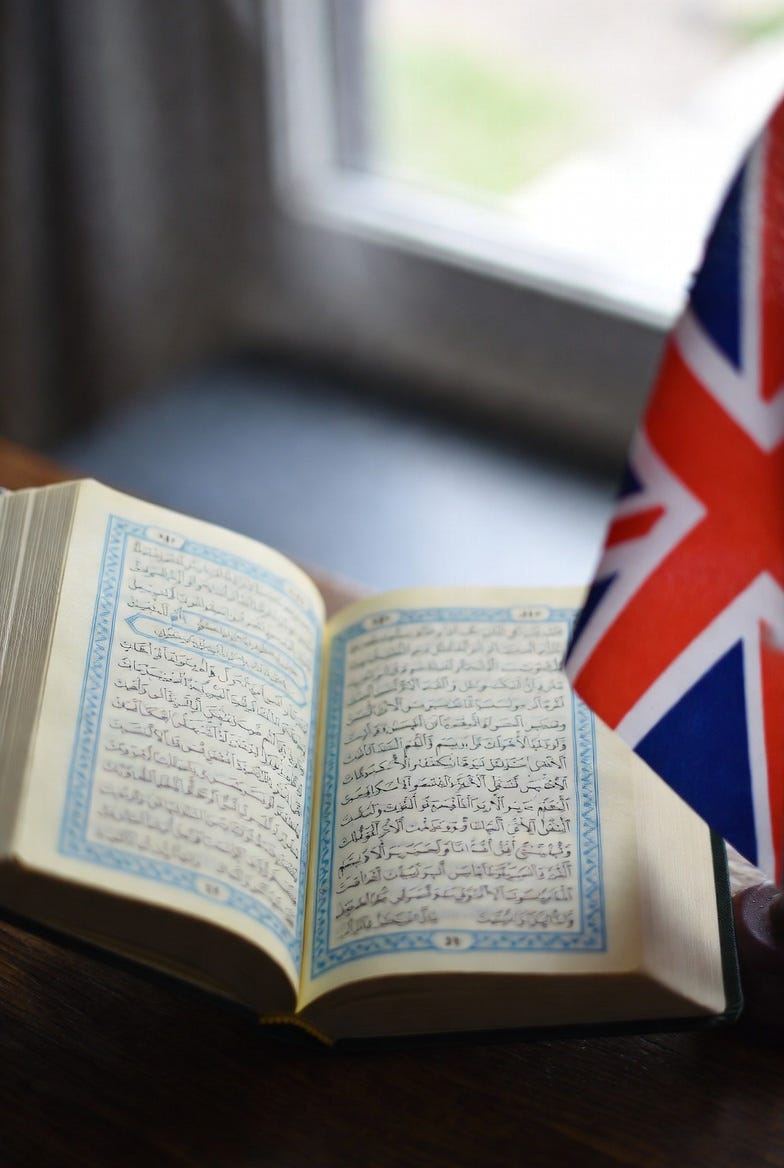
After burning a Quran in front of the Turkish consulate in London, Hamit Coskun was attacked by a man with a knife. In response, the UK government charged Coskun for committing a “religiously aggravated public order offense.” The conviction was overturned, but the Crown Prosecution Service is appealing the acquittal. Coskun defends his incendiary conduct at The Spectator, and outlines the broader free speech consequences of his case:
My name is Hamit Coskun and last year I was convicted in a British court of religiously aggravated public order offense. My “crime”? Burning a copy of the Quran outside the Turkish consulate in London. Moments later, I was attacked in full view of the street by a man. I was hospitalized. Then I was arrested and convicted in Westminster Magistrates Court.
I managed to get that conviction overturned, with the help of the Free Speech Union and the National Secular Society, but now the Crown Prosecution Service is appealing my acquittal, with the case being heard tomorrow in the High Court. Now I am in discussions with the White House about claiming asylum in America in case the decision goes against me.
Some may say that book-burning is a poor substitute for reasoned debate. I would counter that it was a symbolic, non-violent form of expression intended to draw attention to the ongoing move from the secularism of my country of birth to a regime that embraces hardline Islam.
As I told Westminster Magistrates’ Court in London, what I did constituted political protest and the law, as I understood it, was on my side. Crown Prosecution Service guidance makes clear that legitimate protest can be offensive and at times must be, if it is to be effective. In that spirit, Article 10 of the European Convention on Human Rights protects not just polite speech but speech that offends, shocks or disturbs. Political expression, above all, is meant to enjoy the strongest protection.
Jacob Sullum: A Federal Judge Explains Why Trump Can’t Jail Legislators for Producing a Video That Offended Him
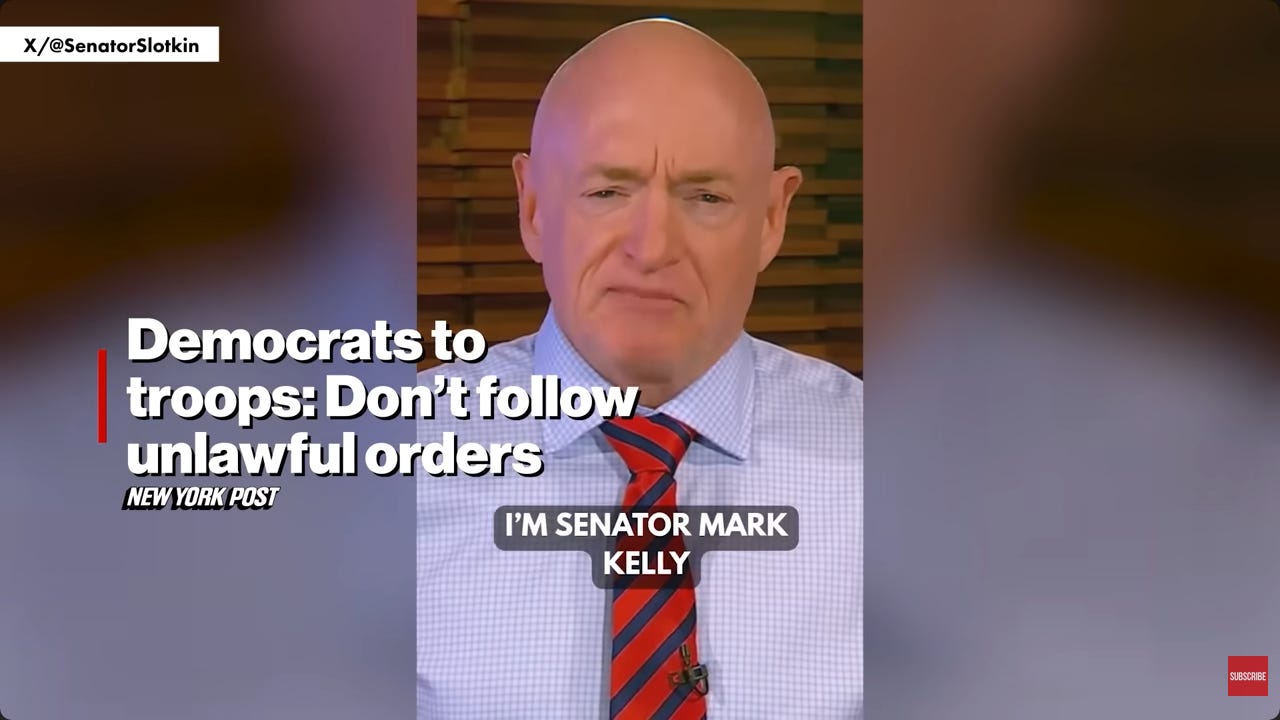
Encouraging soldiers to defy unlawful orders is constitutionally protected speech, a district judge recently declared. The ruling temporarily blocks Defense Secretary Pete Hegseth from penalizing Senator Mark Kelly (D–Ariz.), a retired Navy Captain, for appearing in a now-viral video aimed at the US military. Jacob Sullum reports for Reason:
When Sen. Mark Kelly (D–Ariz.) reminded U.S. military personnel that they “can refuse illegal orders,” a federal judge in Washington, D.C., ruled on Thursday, his speech was “unquestionably protected” by the First Amendment. U.S. District Judge Richard J. Leon, a George W. Bush appointee, granted Kelly’s request for a preliminary injunction that temporarily bars Defense Secretary Pete Hegseth from pursuing penalties against the senator, a retired Navy captain, based on public comments that Hegseth deemed “prejudicial to good order and discipline in the armed forces.”
Leon concluded that Kelly, who in November joined five other Democratic members of Congress in producing a video about the duty to disobey unlawful military orders, was likely to prevail in his claim that Hegseth had retaliated against him for his constitutionally protected speech. The video irked President Donald Trump, who said the six legislators “should be ARRESTED AND PUT ON TRIAL.” Although the Justice Department has tried to deliver on that threat, a federal grand jury this week rejected a proposed indictment. Leon’s opinion explains why any such prosecution would be blatantly unconstitutional.
All of the lawmakers whom Hegseth dubbed “the Seditious Six” had served in the armed forces or intelligence agencies. But Kelly was the only one who had retired with a pension, making him potentially subject to discipline under the Uniform Code of Military Justice. On January 5, Hegseth issued a letter of censure against Kelly, saying he had “engaged in a sustained pattern of public statements that characterized lawful military operations as illegal and counseled members of the Armed Forces to refuse orders related to those operations.”
Kelly’s statements, Hegseth said, constituted “conduct prejudicial to good order and discipline in the armed forces and conduct unbecoming an officer.” The evidence, he said, was sufficient to “reopen the determination of your retired grade,” a process that could reduce Kelly’s rank and pension. Hegseth warned Kelly that “you may subject yourself to criminal prosecution or further administrative action” if “you continue to engage in conduct prejudicial to good order and discipline.”
Around X
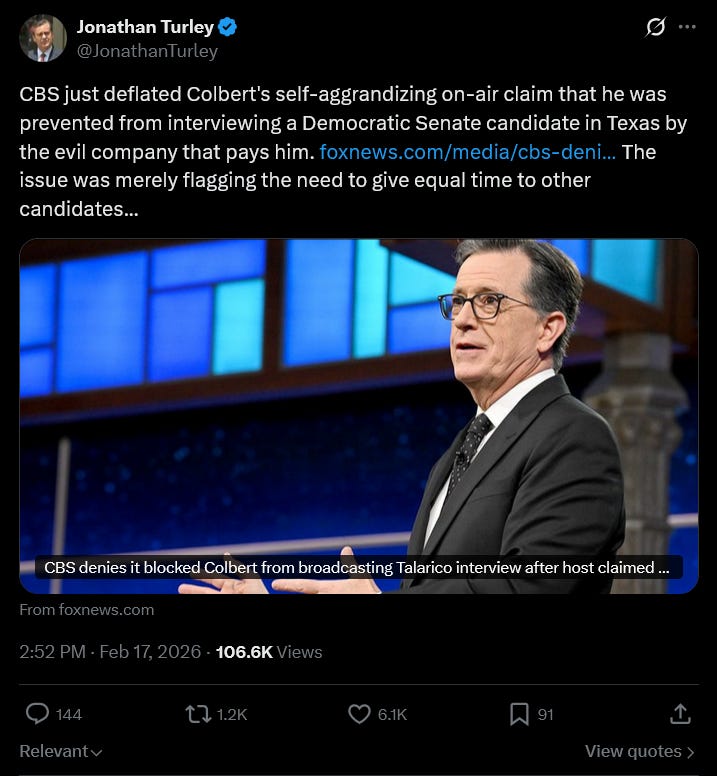
Jonathan Turley doesn’t buy Colbert’s censorship accusation against his employer, CBS.
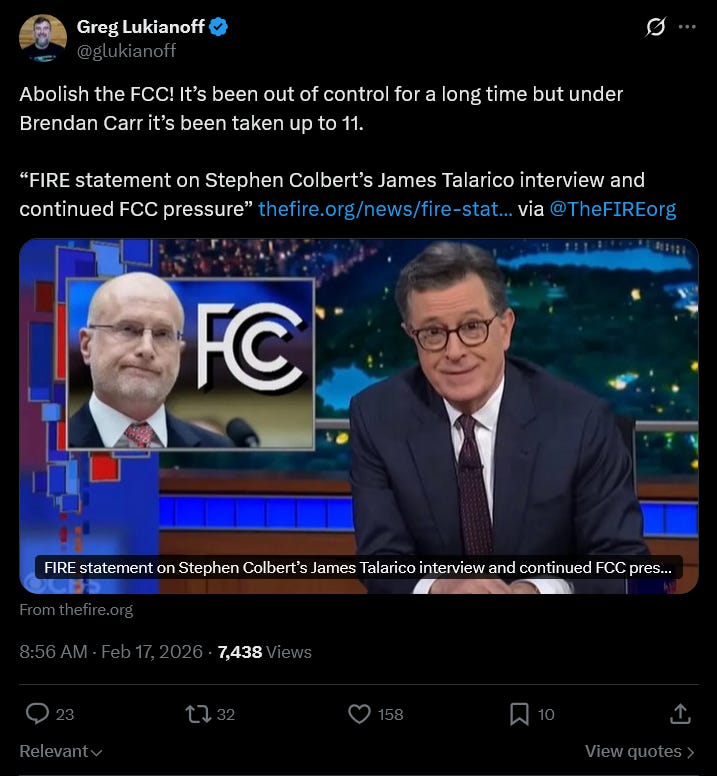
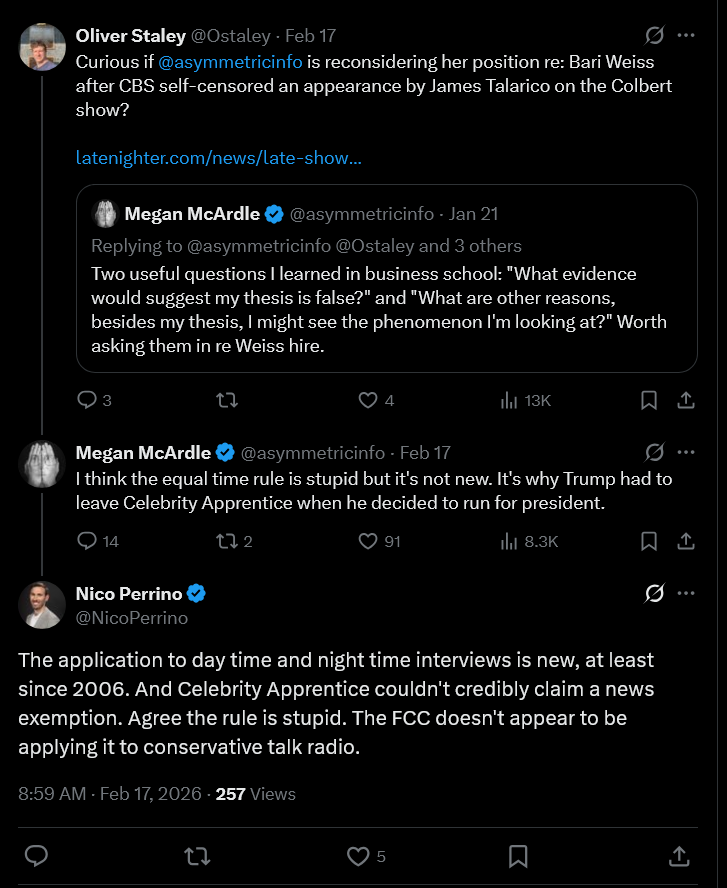
But not all free-speech advocates agree, including Nico Perrino of the Foundation for Individual Rights and Expression (FIRE). The FCC rules CBS enforced may not be new, but their application in this case is, he claims.
Greg Lukianoff ups the ante, arguing we should just abolish the FCC. If there’s no agency, there’s no squabbling over this or that specific regulation.