A round-up of the latest and best insight on the rise of illiberalism in the public discourse:
Jack Nicastro: Anthropic CEO Refuses Pentagon Demands To Remove Safeguards on Military AI

Anthropic—maker of the latest, greatest large language model, Claude—is refusing the Pentagon’s demand to remove privacy protections from its AI. Company CEO Dario Amodei says his refusal is about protecting Constitutional rights. Jack Nicastro reports for Reason:
A battle is brewing inside the Pentagon that could determine the future of American military strategy.
On Tuesday, Defense Secretary Pete Hegseth pledged to cut ties with Anthropic—one of the two AI providers authorized by the Pentagon for classified use—unless the company removed all safeguards from Claude by Friday. This comes after a January memo, in which Hegseth directed the department to only “utilize [AI] models free from usage policy constraints that may limit lawful military applications.” On Thursday, Anthropic CEO Dario Amodei refused Hegseth’s ultimatum.
In a statement published Thursday night, Amodei said Anthropic would not accommodate the Department of Defense’s request to remove the safeguards on its AI model because, “in a narrow set of cases, we believe AI can undermine, rather than defend, democratic values.”
In his letter, Amodei grants that “the Department of War, not private companies, makes military decisions.” However, Amodei refused to capitulate to Hegseth’s demands, saying that “frontier AI systems are simply not reliable enough to power fully autonomous weapons,” and “mass domestic surveillance is incompatible with democratic values.”
Robyn Urback: According to the B.C. Human Rights Tribunal, offensive posts can cost you $750,000
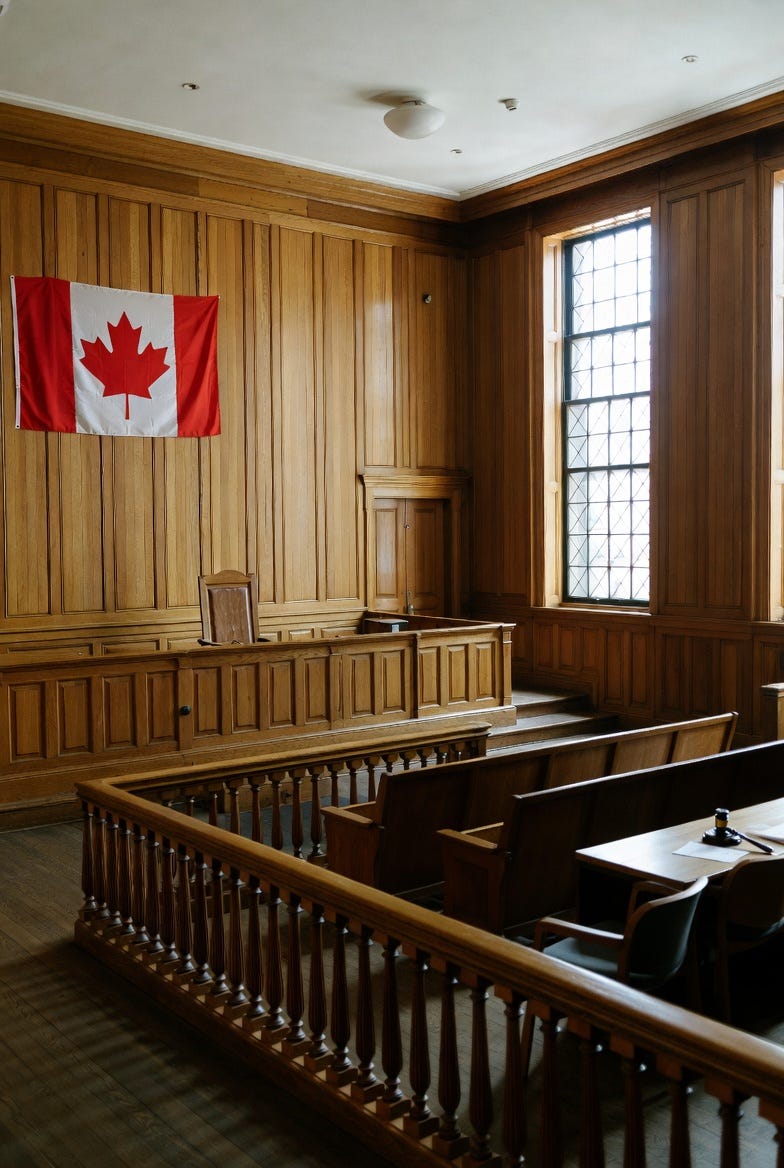
An elected public school trustee in Canada has been ordered to pay three-quarters of a million dollars for some offensive statements he made on social media. At The Globe and Mail, Robyn Urback makes the case that the incendiary nature of his comments is really beside the point: the man’s statements were perfectly legal:
This case started back in 2017, when the B.C. government introduced resources to be used in schools that foster inclusivity based on sexual orientation and gender identity (SOGI). In October of that year, Mr. Neufeld, who was an elected school trustee, made a Facebook post calling SOGI resources a “weapon of propaganda” and that “allowing little children to choose to change gender is nothing short of child abuse.”
Mr. Neufeld continued posting: including some unhinged claims, such as that he has been “thrown into the role of a prophet” forced to speak out as “society slouches toward Gomorrah;” offensive claims, including that “the trans agenda is eugenics” and that “snakes are everywhere;” and defensible arguments, including that “children should be gently encouraged to be comfortable with their own bodies, to accept their own biology.”
In early 2018, the British Columbia Teachers’ Federation (BCTF) and the Chilliwack Teachers’ Association (CTA) filed a joint complaint to the B.C. Human Rights Tribunal.
The tribunal assessed 30 of Mr. Neufeld’s posts and publications, and determined that the majority were in violation of Section 13 of the B.C. Human Rights Code, which prohibits discrimination in employment based on a protected identity, and that other posts violated sections 7(1)(a) and 7(1)(b), which respectively prohibit the publication of a statement that “indicates discrimination or an intention to discriminate against a person or a group or class of persons” and “is likely to expose a person or a group or class of persons to hatred or contempt.”
…
It is true that Mr. Neufeld is uncouth in much of his writing. Indeed, there is a clear difference between soberly expressing concern about the unintended effects of certain SOGI materials in schools, and doing what Mr. Neufeld did, which was rant about the “insidious new teaching” being thrust on children by a “powerful lobby group” of gay and trans people. In one particularly deranged post, he suggested the government will take children and put them in homes where they are “encouraged to explore homosexuality and gender fluidity.” But being deranged is not against the law; nor is being uncouth, or offensive, or even bigoted.
David Inserra: The Future of Online Expression and Innovation Depends on Robust Section 230 Protections
The internet just wouldn’t be the same without robust protections for online speech. At the Cato Institute, David Inserra argues that Section 230 of the Communications Decency Act provides exactly the sort of safeguards the digital world requires:
The US has the world’s most vibrant online speech industry. This industry has arisen from the incredible innovation of new products and platforms and resulted in a drastic increase in the ability of users to create content, express themselves, and access information. The explosion in innovation and expression are the result of the US’s pro-innovation policies.
Perhaps the most important and oft-discussed policy is Section 230 of the Communications Act, as amended by the Telecommunications Act of 1996. Section 230 provides liability protection for online platforms by holding those who post content online responsible for any harms associated with online speech, rather than the platforms themselves. In the 30 years since the passage of Section 230, countless websites, tools, and platforms have emerged and prospered as a result.
…
Rather than adopting censorious or economically damaging new regulations, Section 230 should remain central to the American approach to intermediary liability that has made the United States a global leader in online expression. While narrow clarifications may improve its application, lawmakers must avoid reforms that undermine its protections.
More importantly, policymakers should consider how Section 230—or a similar framework—can support and encourage AI innovation. With such protections in place, online speech enabled by new technologies can continue to sustain a free, dynamic, and prosperous society.
Around X
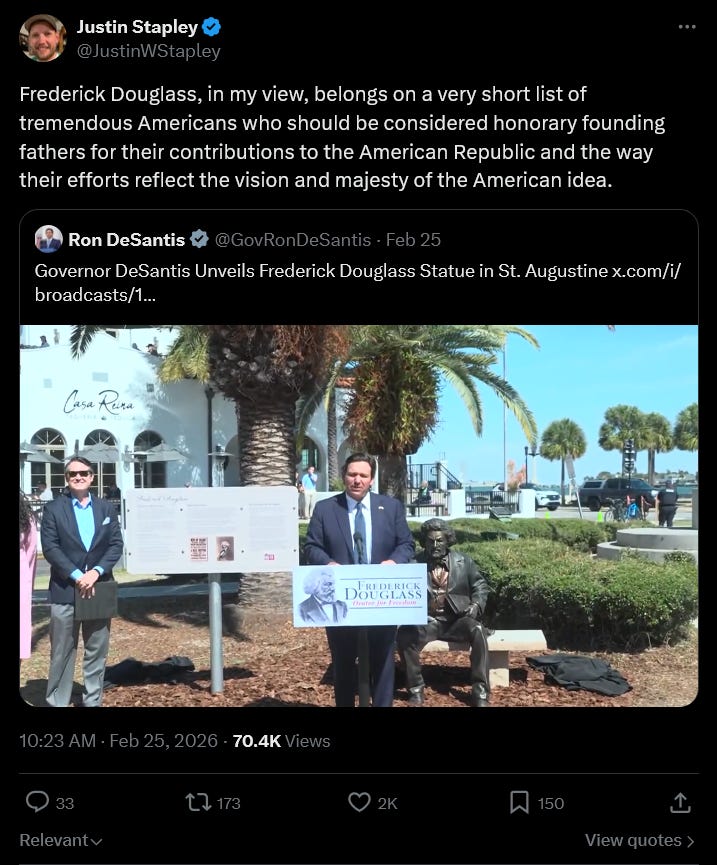
A well-deserved honor for the man who said, “Liberty is meaningless where the right to utter one’s thoughts and opinions has ceased to exist.”
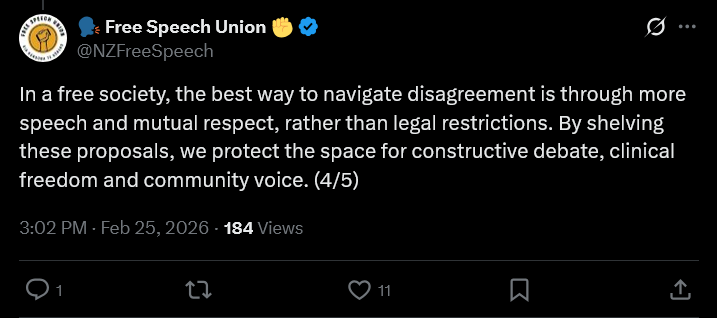
A periodic reminder that free speech and mutual respect remain our best weapons in a highly polarized public square.