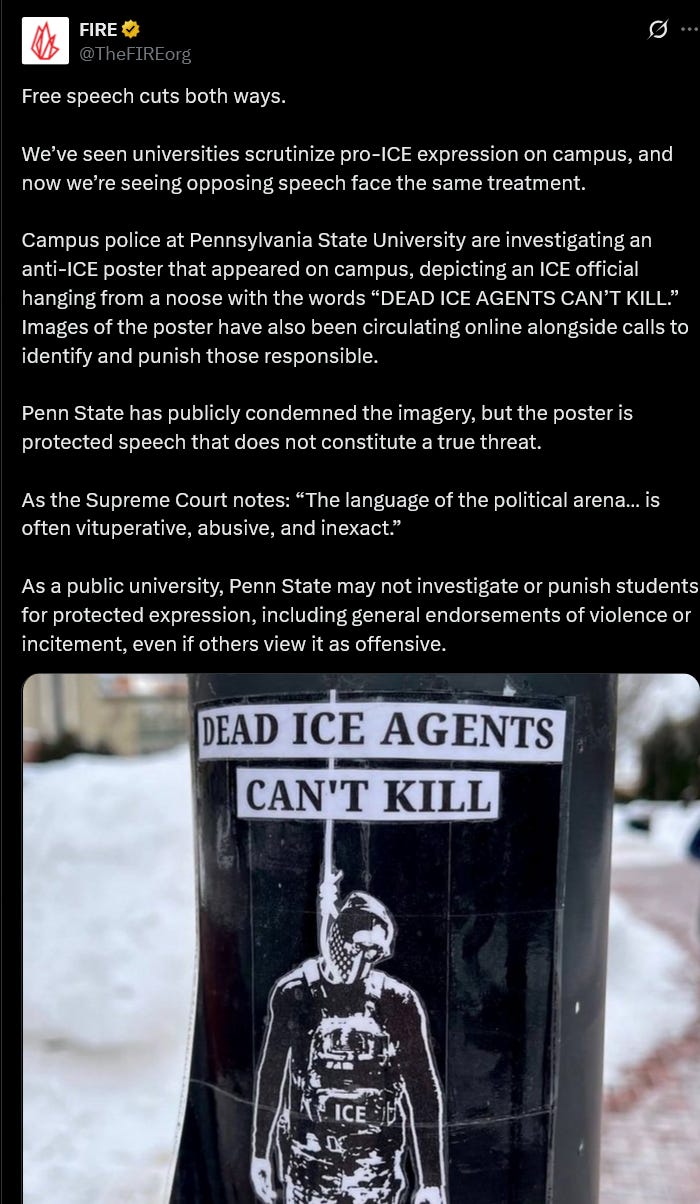
A round-up of the latest and best insight on the rise of illiberalism in the public discourse:
Jacob Sullum: Don Lemon May Be a Hack, but That Does Not Make Him a Felon
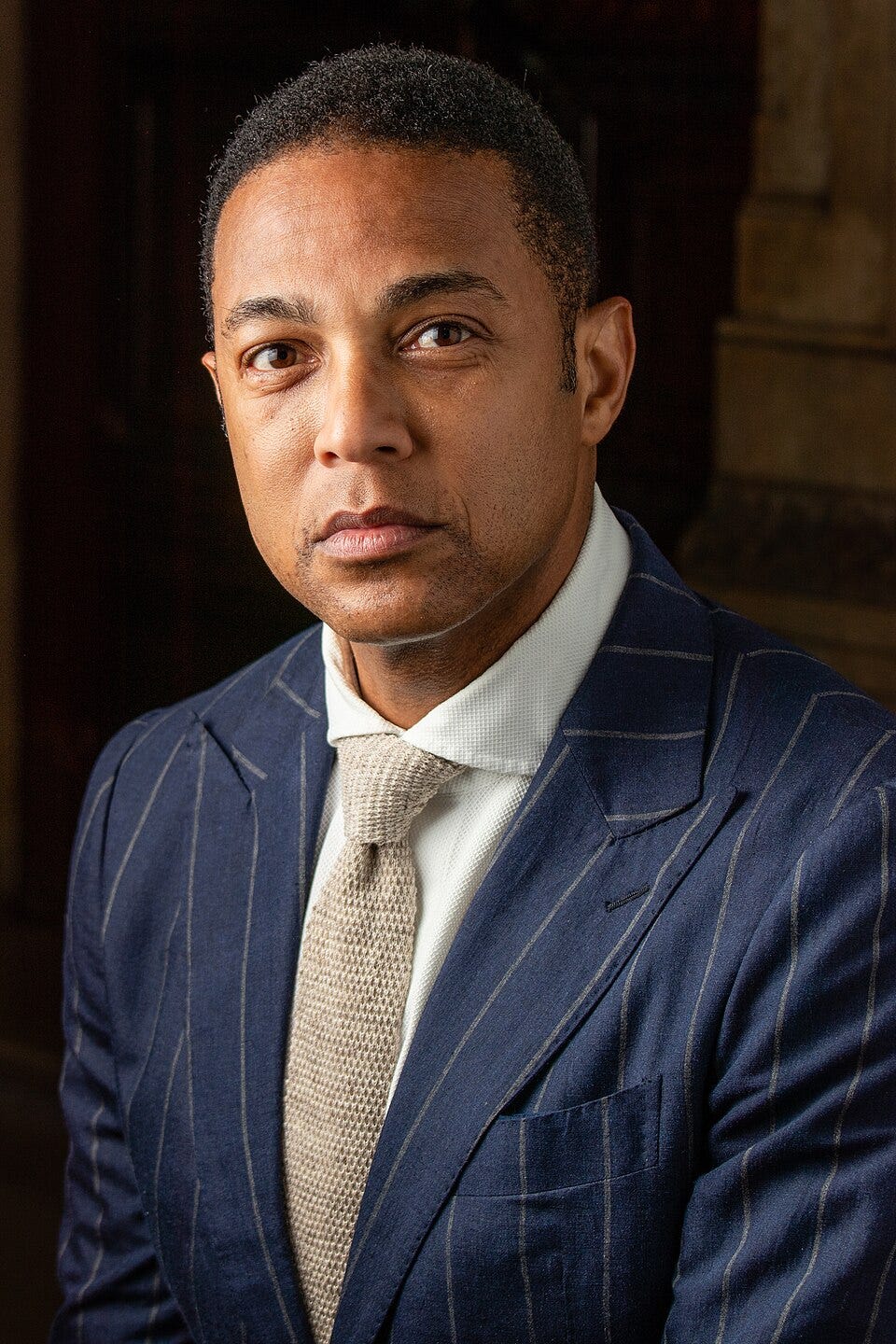
Don Lemon’s antics while covering the anti-ICE protest at a Minnesota church last month may have been in poor taste. They may even qualify as trespassing under state law. But do they constitute criminal activity under federal law? Jacob Sullum at Reason argues that they don’t:
Lemon indisputably was covering the protest for his YouTube show. The indictment against him concedes as much, repeatedly mentioning his “livestreaming” and noting his interviews with congregants and Jonathan Parnell, the pastor who was leading the service. But Lemon was unabashedly sympathetic to the protesters, their cause, and their illegal tactics. Lemon’s own footage suggests he himself may have been guilty of trespassing. The indictment’s allegations nevertheless fall short of making the case that his conduct met the elements of the two federal charges he faces.
…
The Washington Post, which reviewed video of the protest, reports that “the footage does not show [Lemon] participating in the chants that disrupted the service.” But toward the end of Lemon’s brief interview with Parnell, the pastor told him, “I have to take care of my church and my family, so I ask that you actually would also leave this building, unless you’re here to worship.” Lemon’s response was cagey. “I always worship,” he said. “I am a Christian.”
After that exchange, according to the Post, Lemon remained in the church for another seven minutes. Since Parnell’s request can plausibly be interpreted as a “demand” that Lemon “depart from the premises,” notwithstanding the “unless you are here to worship” proviso, Lemon arguably was trespassing at that point. But that apparent misdemeanor is not enough to establish that Lemon violated 18 USC 248 and 18 USC 241, the two federal statutes cited in the indictment.
Section 248, which authorizes a sentence up to a year for a first offense, applies to someone who, “by force or threat of force or by physical obstruction, intentionally injures, intimidates, or interferes with” a person exercising his religious freedom at a place of worship. “It does not appear that Don Lemon did any of those things directly,” notes First Amendment attorney Marc Randazza, although he was “part of a group that did.”
As evidence that Lemon violated Section 248, the indictment cites Lemon’s interview with Parnell, saying he and two other defendants—protester Jerome Richardson and Georgia Fort, a local reporter—”approached the pastor and largely surrounded him (to his front and both sides), stood in close proximity to the pastor in an attempt to oppress and intimidate him, and physically obstructed his freedom of movement while [Lemon] peppered him with questions to promote the operation’s message.”
If you watch the video of that encounter, you can see that Parnell voluntarily engaged with Lemon, expressing his understandable outrage at the people disrupting the service. Parnell may have been “largely surrounded” in the sense that three people were near him, but that would not have prevented him from simply walking away if that is what he wanted to do.
“The pastor seems to have voluntarily given that 49-second interview,” Randazza notes. “His participation in it ratified Lemon’s presence, whether he intended to or not.”
While the indictment asserts that Lemon was trying to “oppress and intimidate” Parnell, that intent is by no means apparent in the video. And although the indictment says Lemon “physically obstructed” Parnell, that characterization is not consistent with the statute’s definition of “physical obstruction,” which entails “rendering impassable ingress to or egress from” a “place of religious worship.”
James Samuel: UCLA museum removes hundreds of Native American artifacts, photos at tribe’s request
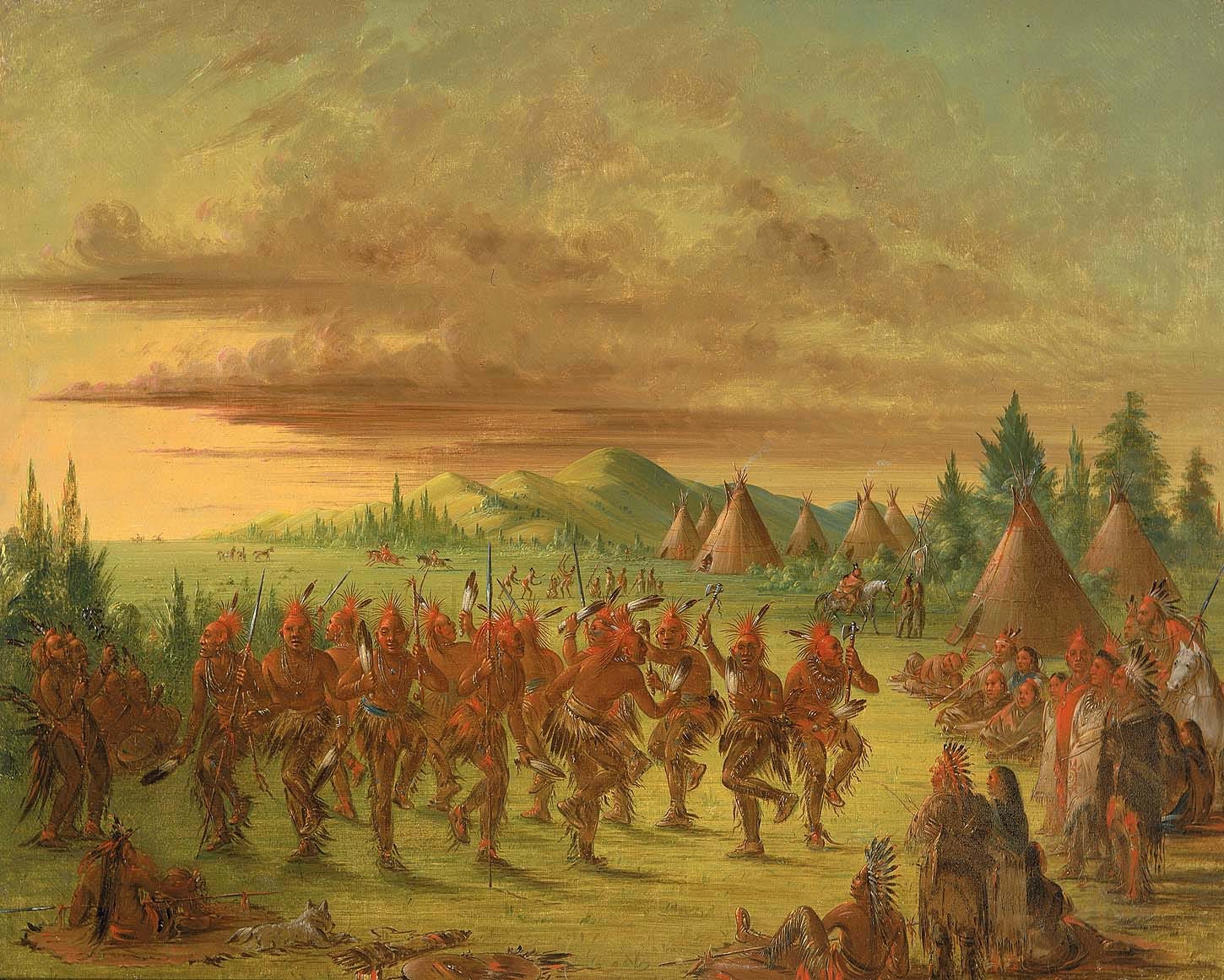
UCLA’s Fowler Museum is repatriating items with Native American cultural affiliation in accordance with the Native American Graves Protection and Repatriation Act. The 1990 law requires public institutions to return Native American human remains to their descendants. Although the act was passed with good intentions, one anthropologist fears it may lead to literal book burning. The College Fix reports:
In the case of UCLA, the Yuhaaviatam of San Manuel Nation, a Native American tribe in San Bernardino County, requested a total of “766 lots of cultural items” for repatriation from the university’s Fowler Museum, according to the notice.
The mission of the Fowler Museum is to “[explore] global arts and cultures with an emphasis on Africa, Asia, the Pacific, and the Indigenous Americas—past and present,” according to its website.
The cultural items slated for return to the tribe include “groundstone,” “ceramic sherds,” “faunal bone,” and “historic materials” such as “glass, metal, ceramics,” and “leather.”
The museum also is giving “photographic negatives of petroglyphs” in Black Canyon, San Bernardino County, to the tribe.
The notice indicated that all of the items had been “identified as culturally affiliated” with the Serrano and Taatavim peoples in consultation with the Yuhaaviatam of San Manuel Nation, and that the repatriation will occur “on or after February 6.”
A representative from the Yuhaaviatam of San Manuel Nation declined to comment when The College Fix asked over email why items such as photo negatives were requested for repatriation. The spokesperson said “it was decided not to participate in this story.”
Meanwhile, a professor emeritus of anthropology at San José State University said that the federal repatriation law “was never meant for the repatriation of data, such as photos or negatives.”
“It won’t be long until books containing images of petroglyphs are burned. To save archaeology and the knowledge of our past, NAGPRA needs to be repealed!” Professor Elizabeth Weiss posted on X in response to the UCLA notice.
Weiss told The College Fix in a recent email that the photo negatives likely will “be destroyed.”
“If the negatives, which contain images of petroglyphs from the Black Canyon site in San Bernardino County, are ‘repatriated,’ they will be destroyed — most likely burned,” she said.
Weiss posed the hypothetical question of whether tribes would continue to request repatriations for other photographs, saying, “Will the tribe next seek out copies of the 1973 book Prehistoric Rock Art of California that contains images of these petroglyphs, and destroy those too?”
“The repatriation of these negatives may seem trivial, but it opens the door to similar repatriations – and, ultimately, to book burning,” Weiss told The Fix.
Boston Globe: Trump can’t be allowed to punish campus free speech
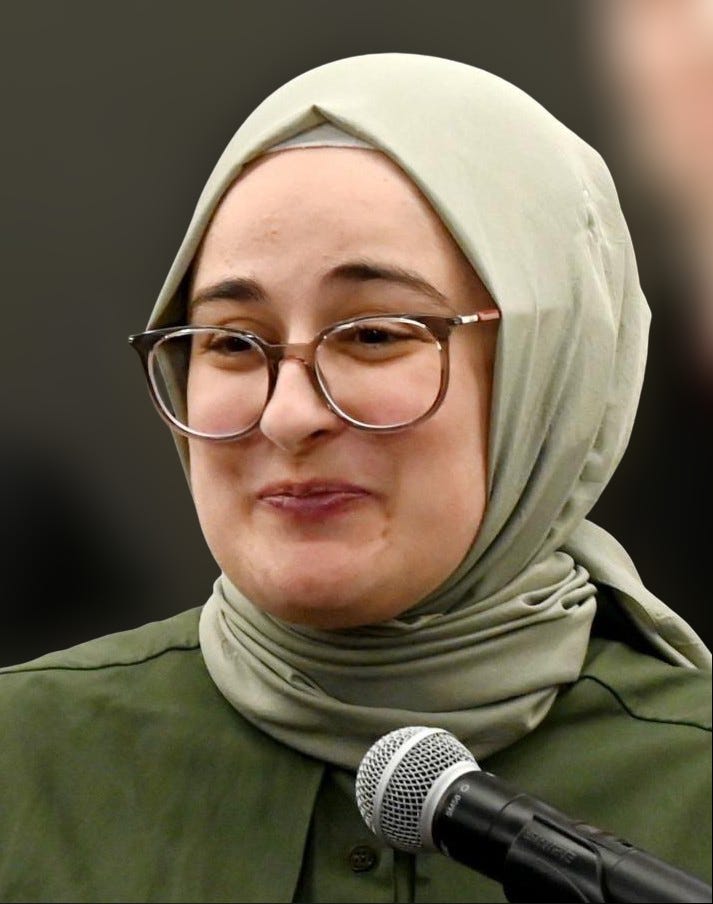
The Boston Globe editorial board revisits the case of Rümeysa Öztürk, a foreign national and Tufts University student who was arrested last March by the Department of Homeland Security. Critics allege she had expressed support for the terrorist group Hamas. The editorial board says the accusation is spurious and sets an alarming precedent for free speech on college campuses:
Tufts University PhD student Rümeysa Öztürk had her student visa revoked and was snatched off the streets of Somerville by immigration agents last March because of speech.
If there were any lingering questions about whether Öztürk committed any wrongdoing, they were put to rest by documents unsealed last week in US District Court in Boston.
Her sole offense, the documents reveal, was to commit free speech — in a country with a constitutional right to free speech enshrined in the First Amendment. It’s the latest travesty by a Trump administration that’s shown blatant disregard for the rights of Americans and non-Americans.
If, because of the experiences of Öztürk and others like her, international students fear to speak their minds and contradict the government — or simply choose not to study here at all — our campuses will be poorer for it.
As Conor Fitzpatrick, supervising senior attorney at the Foundation for Individual Rights and Expression, told the editorial board, colleges should be a marketplace of ideas. “It’s the place where not only scientific theories but social science theories and political theories get put to the test. No idea is sacred, everything is fair game for disagreement and study,” Fitzpatrick said. “Inviting someone to attend a US university on a visa but saying you’re not allowed to express these ideas or write a paper expressing this opinion, that’s not what an American education is about.”
Around X
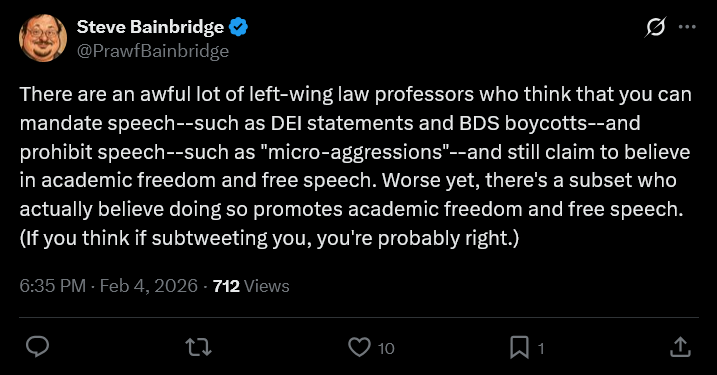
It’s nonsensical to defend academic freedom while mandating or prohibiting certain kinds of expression, argues law professor Steve Bainbridge.
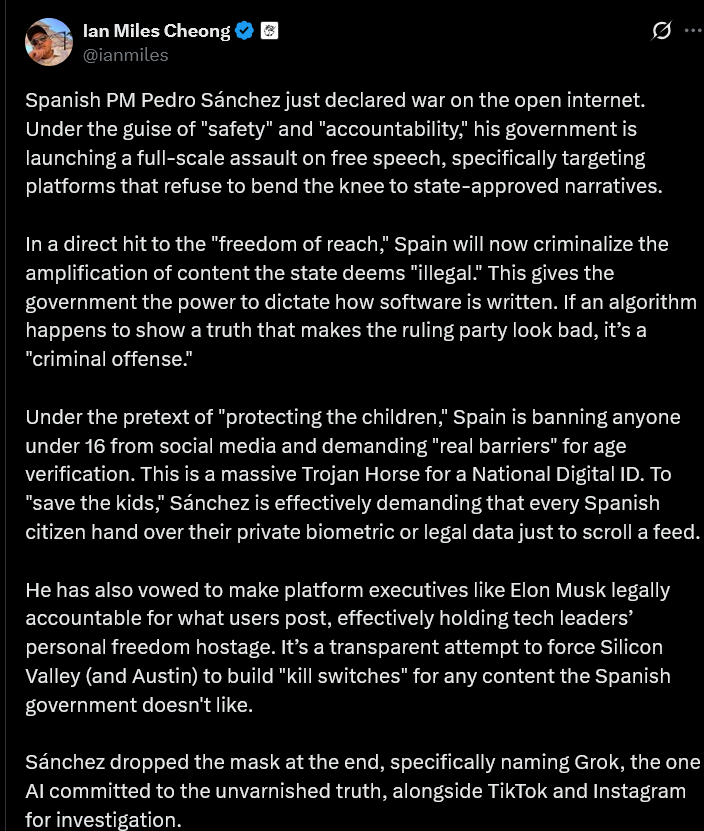
Europe continues its encroachment on digital free speech. Of course, it’s for your own good…
If we can say anything about the Foundation for Individual Rights and Expression (FIRE), we can say they are consistent defenders of free speech.