A round-up of the latest and best insight on the rise of illiberalism in the public discourse:
Chris Truax: The defamation threat to free speech won’t quit
Two weeks ago the Supreme Court declined to hear Alan Dershowitz’s $300 million defamation suit against CNN — giving Justices Clarence Thomas and Neil Gorsuch another chance to say they’d like to overturn New York Times v. Sullivan. The 1964 ruling requires public officials and figures to prove “actual malice” before winning a libel suit.
As Chris Truax lays out at The Hill, Thomas has pushed to overturn it since 2019; Gorsuch, doubtful since a 2021 dissent, joined this one. Their dissent leans, in Truax’s telling, on a founders-knew-best argument.
Truax's real target, though, is Congress: he wants lawmakers to write the actual-malice standard into federal law now:
Whipping and mutilation were widely practiced in the 18th century. Thomas Jefferson himself once drafted a bill that would have provided for “an eye for an eye” punishment when someone was seriously injured in an assault, and for castration in cases of sodomy, rape and polygamy. The bill was a serious reform and failed to pass by a single vote, because it was viewed as too lenient.
Clearly, applying historical tradition when interpreting the Constitution has to be more than a rote exercise.
So it is with the First Amendment and defamation law. Whatever threats defamation cases might have posed to the First Amendment in the 18th century, the landscape is now completely different. The Founding Fathers had no conception of the unprecedented reach and complexity of modern mass media and the internet. Things like strategic lawsuits against public participation and the prospect of billionaire presidents attempting to sue their critics into ruination and silence were utterly alien to them.
Thérèse Boudreaux: The KIDS Act is a free-speech bill wearing a child-safety costume
The Kids Internet and Digital Safety Act recently passed the House 267-117, and few in Washington want to vote against protecting kids online. That’s the problem, per Electronic Frontier Foundation (EFF) senior policy analyst Joe Mullen: the 114-page bill’s ban on content promoting “the sale or use” of alcohol, drugs, or gambling will sweep up far more than ads.
It’s also comes with new data-collection, parental-control, and AI chatbot rules its sponsor calls the strongest child-safety approach Congress has attempted:
Advocates of the 114-page legislation argue that it provides a multi-pronged approach to addressing safety concerns for children online. Rep. Brett Guthrie, R-Ky., the sponsor of the KIDS Act, called it “the strongest approach to protecting kids online that Congress has ever seen.”
But critics like Joe Mullin, a senior policy analyst at the online civil liberties advocacy group the Electronic Frontier Foundation, are concerned that the protective measures come at the expense of Americans’ rights to privacy and free expression.
While the bill package does not outright mandate that companies verify users’ ages, it creates requirements that depend upon companies knowing the age of users on their platforms. The new protective measures apply when a website or app “knows or should have known” a user is under 17 years of age, putting companies at legal risk if they do not verify all users’ ages.
“The fact that basically a website or app, no matter how big or small it is, could get in trouble if a user is a minor — and the knowledge standard is ‘knows or should have known a user’s age,’ and that’s a really low knowledge standard — that’s also going to be a problem for adults, because you’re going to have to start proving that you’re an adult,” Mullin told The Center Square.
Naman Ramachandran: Rushdie says America’s forgotten why people like him moved here
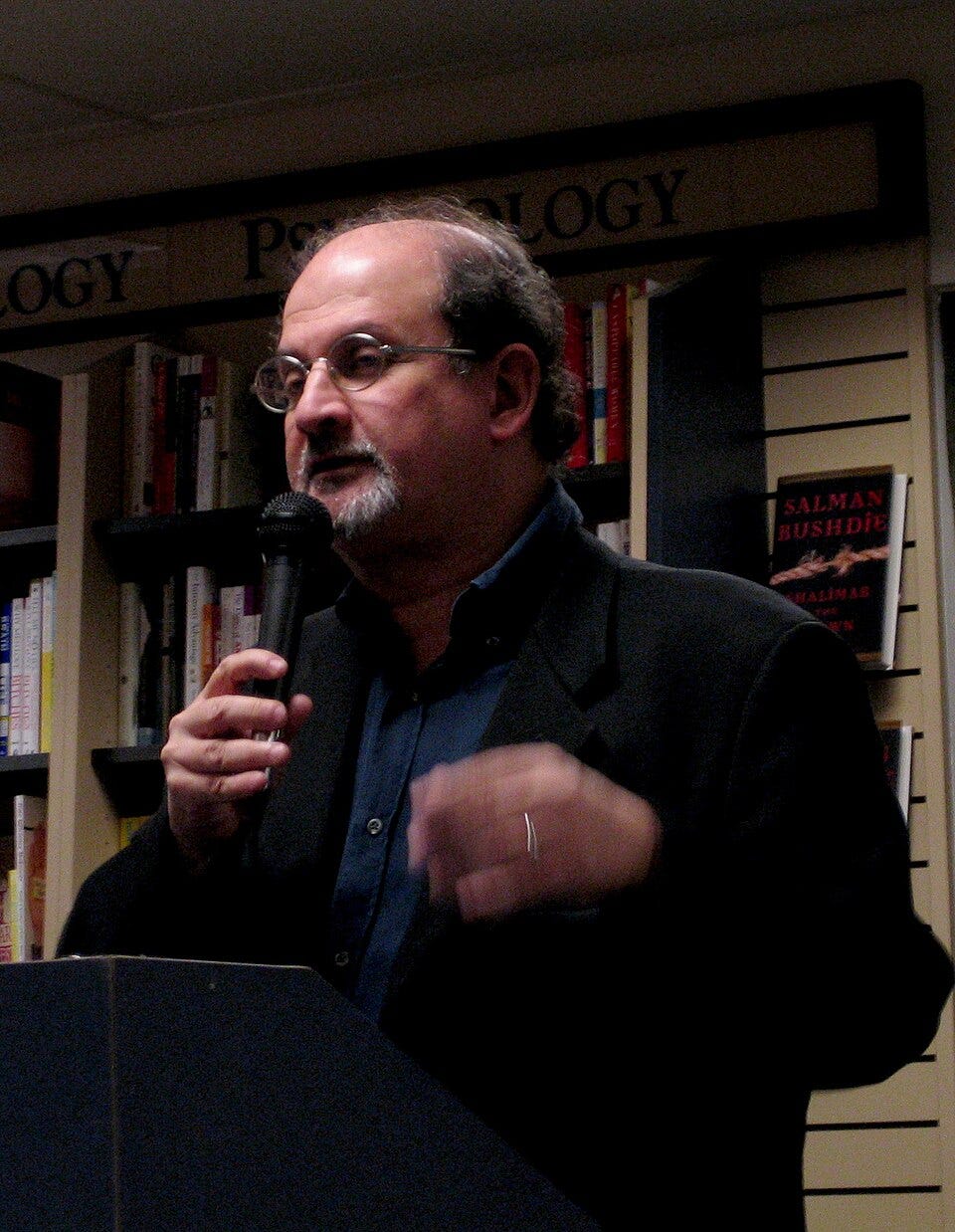
Accepting the Liberatum Cultural Honor in London this week, Salman Rushdie didn’t hold back on his adopted country, as Naman Ramachandran reports. His verdict: the current U.S. administration is undermining free expression at home even while criticizing Europe for the same. A pointed inversion of the usual script, where Washington scolds London and Brussels for their speech codes.
Rushdie’s evidence, per Ramachandran’s account: the wave of book challenges sweeping American school libraries, where one parent’s objection can get a title pulled:
Salman Rushdie warned that free expression in the U.S. is under sustained pressure from the Trump administration as he accepted the Liberatum Cultural Honor at Camden Town Hall at King’s Cross in London, the same building where he once worked on community relations before becoming one of the world’s most recognized novelists.
…
Turning to free expression more broadly, Rushdie said, “America is having a very difficult moment in this area. We have an administration, and its cohorts, who are really going after one of the most important things about America — the free speech — particularly when they come to speak in Europe, doing their best to suppress it at home.”
Rushdie pointed to book removals in American schools. “There are schools in states in America where one parent can object to a book in a school library, and the book is withdrawn,” Rushdie said. “That’s happening in the thousands of titles across America. And these are not just any old books, this is ‘Huckleberry Finn,’ this is Toni Morrison’s ‘Beloved.’”
Around X
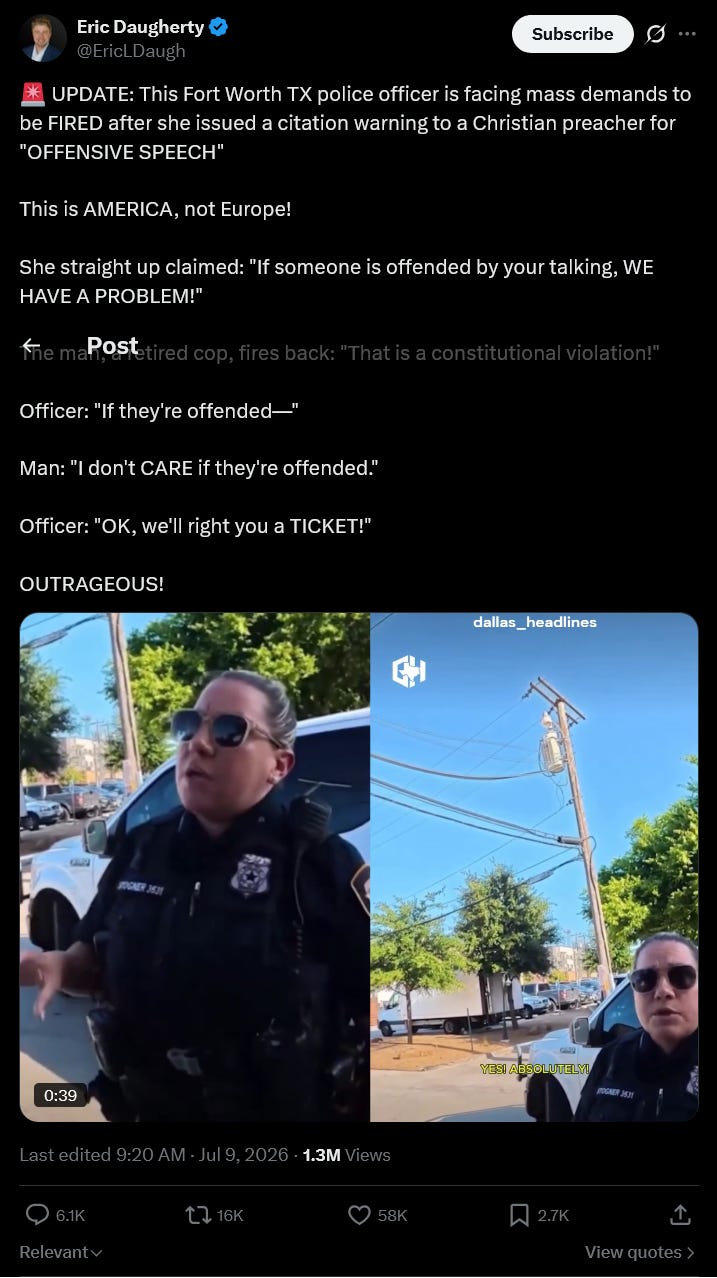
Eric Daugherty posted video of a Fort Worth police officer threatening a street preacher with a citation for “offensive speech,” telling him flatly that offending someone is a problem. The preacher, a retired cop, isn’t having it.
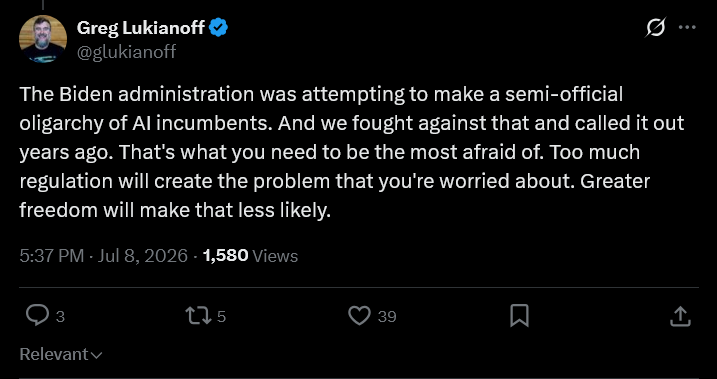
Greg Lukianoff warns his followers against empowering the government to further regulate AI, making the paradoxical libertarian argument that more rules usually mean giving Big Tech more control over your access to information.
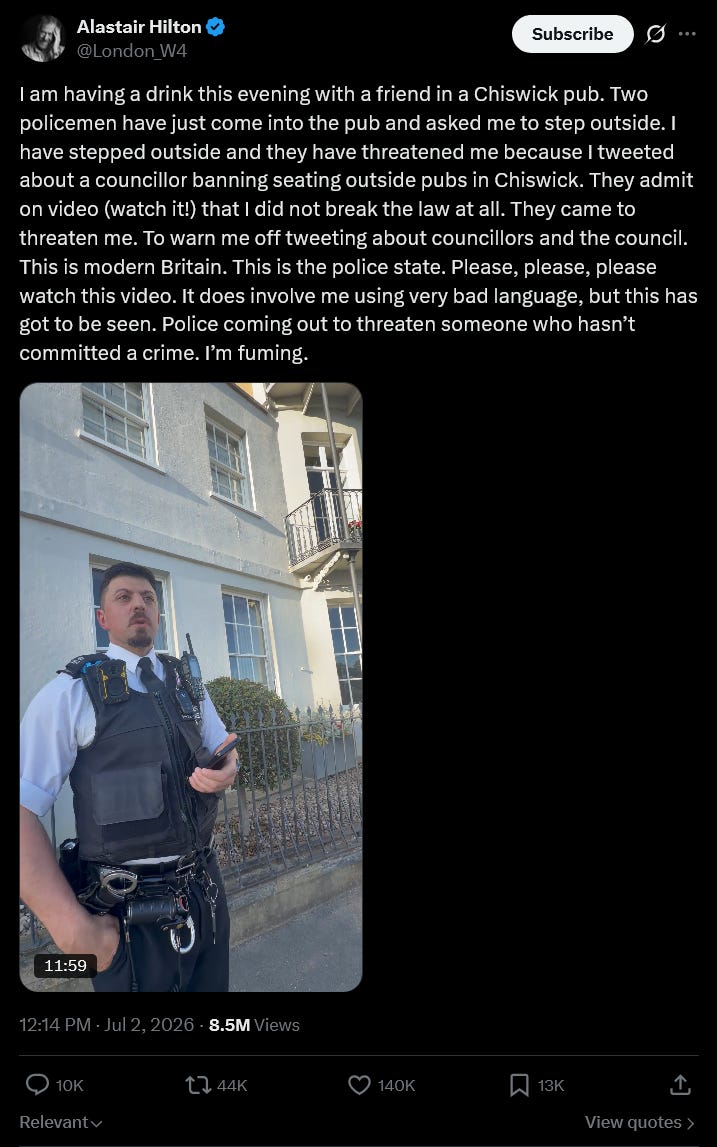
Alastair Hilton, a Chiswick resident, says two police officers pulled him out of a pub and threatened him over a tweet criticizing a local councillor’s ban on outdoor pub seating — while reportedly admitting on camera that he hadn’t broken any law.