
A round-up of the latest and best insight on the rise of illiberalism in the public discourse:
Daniel Martin: Hague: Oxford gender lectures should go ahead despite trans protests
Oxford Chancellor Lord Hague has urged the reinstatement of a gender law lecture series disrupted by trans activists, insisting academic freedom must prevail.
Dr Michael Foran cancelled the remaining talks on sex, gender identity and the law after repeated protests, but Hague courageously stressed that universities must uphold legitimate protest and the right to examine contentious ideas without intimidation. The Telegraph reports:
Lord Hague, the Chancellor of Oxford University, has said a series of lectures on gender law should be reinstated after pro-trans protests led to their cancellation.
Dr Michael Foran, an associate professor of law, said on Sunday he would not be holding his two remaining lectures because of “escalating disruptive protests”.
Activists interrupted him at two separate talks. Footage showed them standing in front of his lectern telling the audience he was a “bigot” and “transphobic”.
On Tuesday, Lord Hague, the former Tory leader, said the lectures should take place for the sake of “freedom of speech”.
“The rest of Michael Foran’s talks should go ahead,” he wrote. “Freedom of speech is a fundamental academic freedom and it must be upheld.
“Equally, legitimate and lawful protest has an important place in university life. The task is to maintain both.
“Especially at events open to the public like this, it is an important Oxford tradition that any disagreement is expressed in a civil and respectful way.”
The post of Oxford chancellor is purely ceremonial and does not confer any powers over the day-to-day running of the university.
The management of the university is in the hands of Prof Irene Tracey, the vice-chancellor.
Elizabeth Nolan Brown: Beyond Orgasm: OneTaste Case Is About Freedom of Conscience, Says European Religious Freedom Group
EU religious freedom group CAP LC is defending OneTaste founders Nicole Daedone and Rachel Cherwitz, who were convicted of conspiracy to commit forced labor in 2025. OneTaste was known for its promotion of “orgasmic meditation” and other unconventional practices, but that doesn’t make Daedone and Cherwitz criminals, the free speech NGO argues.
They slammed the prosecution for relying on anti-cult “brainwashing” narratives—warning that such a precedent could criminalize influence in any spiritual, therapeutic or lifestyle movement:
A European religious freedom group is slamming the prosecution of OneTaste founder Nicole Daedone and former executive Rachel Cherwitz. The group, CAP LC—official (French) name Coordination des Associations et des Particuliers pour la Liberté de Conscience—has United Nations consultative status, which means it’s accredited by the U.N. to submit written statements and make oral arguments before the U.N. Human Rights Council. “The issues at hand involve not only the fate of two individuals but also the limits of freedom of thought, conscience, and belief,” said CAP LC in a recent letter to the council.
Daedone and Cherwitz were convicted last year of one count of conspiracy to commit forced labor and sentenced to nine and 6.5 years in prison, respectively. They have since appealed to the U.S. Court of Appeals for the Second Circuit.
OneTaste is a wellness group best known for its promotion of orgasmic meditation (OM), a partnered clitoral stroking practice that the group advocates for both sexual and psychological health reasons. But while OM gets the most attention, it was just one part of a system of beliefs inspired by Buddhism, feminism, theosophy, and more. OneTaste leaders advocated for openness to new experiences, including sexual experiences, and consensual non-monogamy. Hardcore OM devotees sometimes lived in communal spaces and engaged in other common behaviors, like participating in daily yoga and abstaining from alcohol.
In court, prosecutors seemed intent on putting the group’s beliefs and practices on trial. They also relied on concerning theories of forced labor and of consent. Alleged victims freely admitted to consenting to various activities—from non-sexual activities and labor to participating in orgasmic meditation sessions to hookups with OneTaste investors or students—and sometimes even initiating these activities. But according to prosecutors, this consent and initiative didn’t count because OneTaste leaders were psychologically manipulative and exerted outsize influence on some participants’ lives. This was forced labor, suggested prosecutors, because Daedone and Cherwitz made them think they wanted to do things that they might not have done independently.
“The legal theory used to secure the convictions marks a major departure from established constitutional principles,” states the CAP LC letter to the U.N. Human Rights Council. “The defendants were convicted…based solely on psychological influence, without evidence of threats, violence, or physical coercion.”
Maarten Boudry: The Data a Flemish TV Network Didn’t Want You to See

Flemish public broadcaster VRT suppressed internal survey data showing dramatically higher intolerance toward women and LGBT people among respondents of foreign origin—while aggressively pushing a narrative blaming Andrew Tate for rising conservatism among young people.
At Quillette, philosopher Maarten Boudry outlines how he obtained the confidential PowerPoint, read the editorial instruction live on air and exposed how VRT lied to protect its preferred story of toxic masculinity.
Last month, I was invited onto Flemish public television to discuss a survey on rising intolerance among young people. Before going on air, I obtained an internal presentation prepared by the broadcaster’s research department. Buried in the margins was a note that was never meant for my eyes: journalists had been instructed not to report some of the most striking findings in the dataset.
Some background. The public broadcaster of Dutch-speaking Belgium—called VRT, roughly the Flemish equivalent of the BBC—periodically conducts a survey called De Foto van Vlaanderen (“The Picture of Flanders”) to take the social temperature of the region. This year’s edition produced wall-to-wall coverage across VRT’s news outlets, centred on a set of ostensibly shocking findings about kids these days: growing intolerance of LGBT people and a resurgence of conservative values. The headline figures were certainly arresting: 17 per cent of Flemish adolescents aged 12–17, and 16 per cent of those aged 18–44, agreed that there are circumstances in which a man is permitted to hit a woman. One in three young people said they would not want a transgender person in their circle of friends.
The Manosphere?
VRT’s editorial framing, echoed by a chorus of experts and commentators, was immediate and uniform. The villain was the so-called “manosphere”: young boys falling under the spell of Andrew Tate and other social-media influencers and emulating their brand of toxic masculinity and misogyny. To discuss the findings, VRT invited me onto its main current-affairs programme, De Afspraak, alongside a sexologist.
Around X
There is little we can add to this, except to nod in affirmation.
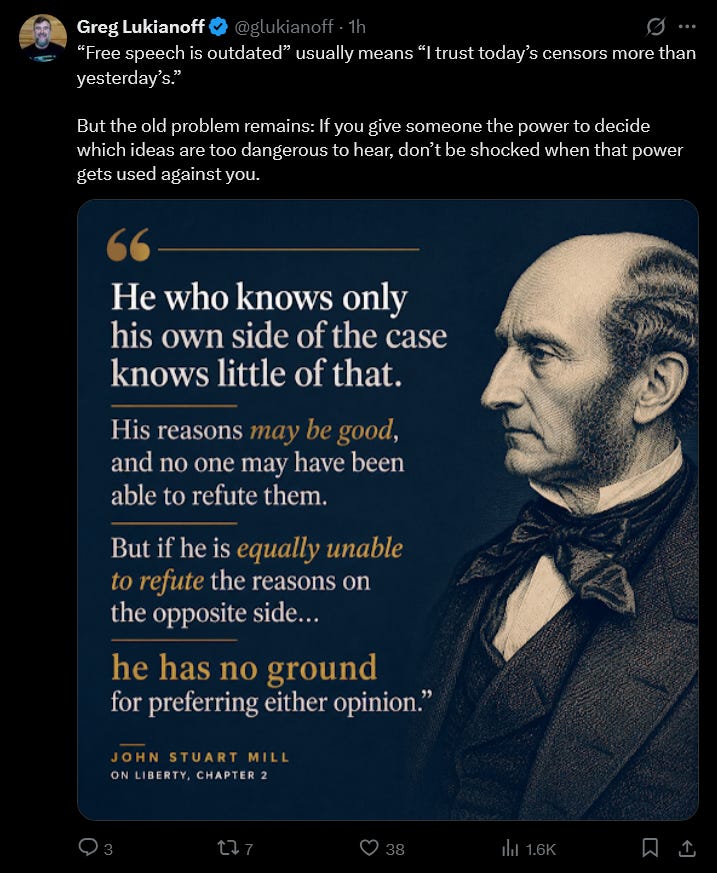
Like free speech more generally, academic freedom loses its purpose if it doesn’t protect individual expression.
We’ve been told for more than a decade that hate speech isn’t free speech. Melissa Chen wants to know why the voices behind that rhetoric are suddenly so eager to hate Elon Musk for being successful.