A round-up of the latest and best insight on the rise of illiberalism in the public discourse:
Jacob Sullum: Louisiana Cops Threatened To Arrest a Man for Handing Out Religious Leaflets. They Got Qualified Immunity.
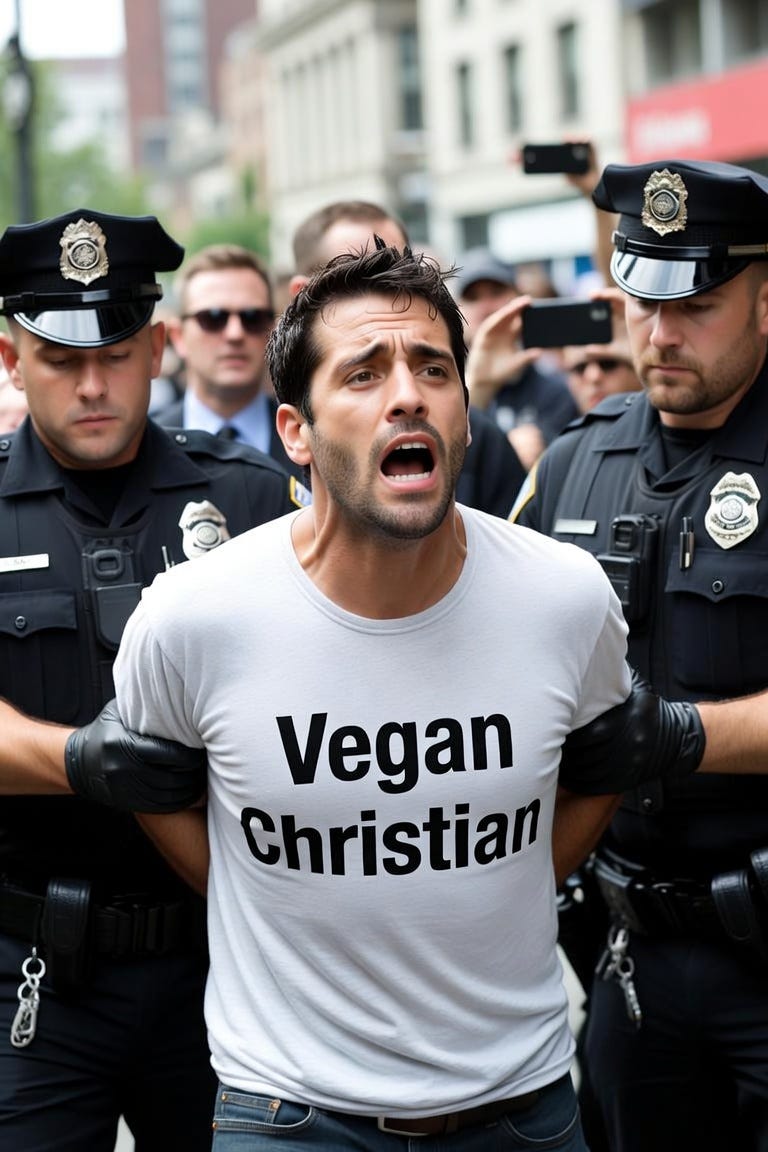
In Bossier City, Louisiana, police ordered Richard Hershey—a member of the Christian Vegetarian Association—to stop distributing religious leaflets on a public sidewalk outside a Christian rock concert and threatened him with arrest if he returned, while allowing a commercial leafleteer to continue.
The 5th Circuit granted the officers qualified immunity, blocking Hershey’s First Amendment lawsuit; he is now asking the Supreme Court to intervene, arguing that viewpoint discrimination against religious speech is an obvious constitutional violation. Reason reports:
Six years ago, Richard Hershey was distributing religious leaflets on a public sidewalk in a public park surrounding a public arena in Bossier City, Louisiana, when he was accosted by police officers who insisted that he stop. Hershey, who was promoting the views of the Christian Vegetarian Association outside a Christian rock concert at the Bossier City Arena, pointed out that he was exercising his constitutionally guaranteed freedom of speech and freedom of religion. He also noted that the officers had not interfered with another leafleteer, who was advertising a local radio station.
The cops were unmoved. If Hershey did not leave immediately, they said, he would be arrested, and he likewise would be carted off to jail if he ever dared return to the park.
It would be hard to imagine a more blatant violation of First Amendment rights. But last October, the U.S. Court of Appeals for the 5th Circuit held that Hershey could not sue the officers responsible for it because they were protected by qualified immunity, a doctrine that bars federal civil rights claims unless they allege violations of “clearly established” law. Now Hershey is asking the Supreme Court to overrule that jaw-dropping conclusion, which illustrates how broad interpretations of qualified immunity prevent victims of outrageous police misconduct from vindicating their rights.
“The right to evangelize in public, free of viewpoint-based government suppression, is as clearly established as any right in the firmament,” Hershey’s lawyers, who include former Solicitor General Paul Clement and litigators at the First Liberty Institute, note in a Supreme Court petition filed last Friday. “It is squarely protected by two separate but overlapping clauses of the First Amendment—the Free Speech and Free Exercise Clauses—and by decisions of this Court underscoring that viewpoint discrimination is verboten and that discrimination against religious speech is viewpoint discrimination (im)pure and simple. No government official should need an on-point circuit precedent to illustrate what the Constitution itself and this Court’s cases make clear beyond cavil.”
Anna Pegis: Idaho, Minnesota universities stonewall public records requests for controversial course syllabi
The University of Idaho and University of Minnesota denied requests from the American Accountability Foundation for copies of syllabi from courses flagged for promoting left-wing ideologies, claiming the documents are protected intellectual property or otherwise exempt from disclosure under state public records laws. Critics argue the universities are evading transparency and accountability for taxpayer-funded curricula that shape public higher education:
The University of Idaho and the University of Minnesota refused to provide class syllabi to a conservative research group that submitted requests under the respective states’ public records laws.
In the case of UI, the American Accountability Foundation requested syllabi for Introduction to Women’s, Gender, and Sexuality Studies and four Ecology of Health & Medicine–Foundations courses. In its demand letter to the university, AAF said the courses were “related to how the University of Idaho has changed its practices to comply with Idaho anti-DEI laws.”
The university “denied the request with respect to the syllabi on the grounds that they are ‘trade secrets’ exempt from disclosure under the Idaho Public Records Act. The university is wrong,” the demand letter to the school’s chief compliance officer states.
UI spokesperson Jodi Walker told The College Fix that the university’s “Board of Regents has outlined in policy that syllabi are intellectual property.”
“U of I policy is written to follow that state policy. Therefore, we do believe syllabi are protected under patent, trademark, copyright or other laws and are not subject to disclosure as a public record,” she said.
However, the foundation urged the school to pay closer attention to the state law’s definition of a trade secret, which requires it to derive “independent economic value” from “not being readily ascertainable by proper means” and to be protected by reasonable efforts to maintain its secrecy.
The foundation also requested syllabi copies for University of Minnesota’s courses of Human Sexuality; Justice, Law, and Medicine; Lesbian, Gay, Bisexual, and Transgender Health; and Sexual and Gender Health in Clinical Practice.
According to the foundation’s demand letter to UMN, the school refused the request “because the syllabi ‘are copyrighted and protected intellectual property.’”
However, it did offer to “‘provide [AAF] with an opportunity to inspect the data in-person.’”
The research group called this response “inadequate.”
Erin Mindoro Ezra, George P. Albutt, Robin Reikes: Free speech at work? Considerations on how employers can regulate political discourse

In the wake of Charlie Kirk’s assassination, employers who fired workers for off-duty social media posts criticizing the right-wing commentator have faced costly settlements and judgments, underscoring the risks of disciplining employees for political speech unrelated to job performance.
While private employers are not bound by the First Amendment, there are a variety of state-level restrictions they must abide by. Reuters outlines the messy details:
Following Charlie Kirk’s assassination, Americans took to their social media accounts to comment on the violence and Kirk’s legacy. This intense online debate reached the White House. Hosting Mr. Kirk’s podcast on September 15, 2025, Vice President JD Vance encouraged Americans to report people to their employers for expressing political views that differ from their own: “Call them out, and hell, call their employer.”
Many people took political revenge into their own hands, notifying private employers about their employees’ off-duty social media activities. Some employers acted upon these reports, terminating employees in response. Several months later, employers who acted on these reports are suffering financial consequences as former employees seek lucrative settlements or judgments against them.
For example, as reported in Forbes, former Ball State University administrator Suzanne Swierc recently settled for $225,000 after she was fired for her Facebook posts criticizing Kirk. Similarly, the Forbes article noted, former conservation biologist Brittney Brown secured a $485,000 settlement after being terminated for reposting a meme on Instagram criticizing Kirk’s gun violence stance. “People Punished For Criticizing Charlie Kirk After Shooting Have Won More Than $2 Million In Lawsuits.” Forbes, May 26, 2026.
These outcomes serve as a clear warning to employers about the potential consequences of disciplining employees for political conduct unrelated to their job performance.
Around X
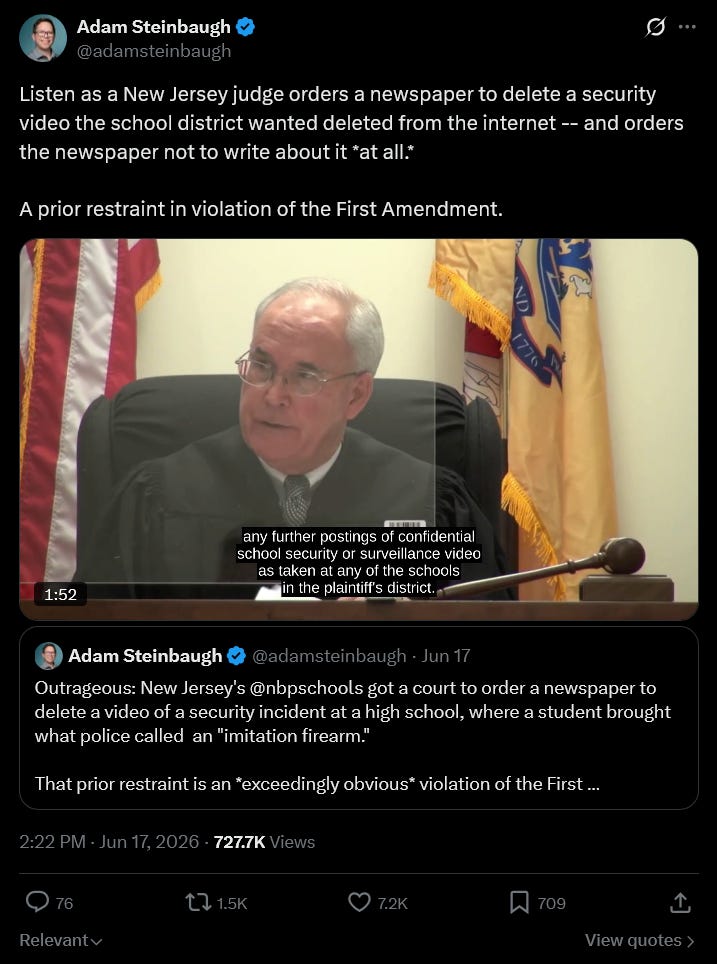
We’re horrified to see any judge issue a blatantly unconstitutional ruling like this. The good news is that close to a million people have so far heard the proceedings—and they seem equally troubled.
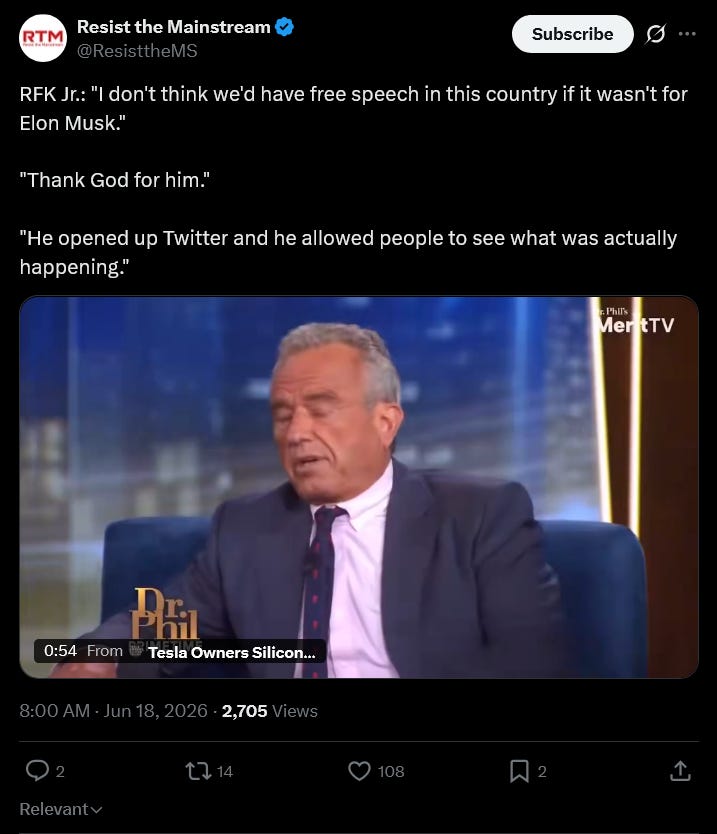
Whatever you think of Elon Musk, his efforts to safeguard free speech have been invaluable.
Historian Phil Magness is unimpressed with the critics of liberalism, who see the perceived problems with liberalism as the solutions to those same problems.