A round-up of the latest and best insight on the rise of illiberalism in the public discourse:
Richard Salsman: Animal Farm Rewritten: Hollywood Betrayed Orwell’s Anti-Communist Classic
Movie adaptations of classic books are infamous for butchering their source material. The recent retelling of George Orwell’s anti-communist novella “Animal Farm” might be the worst example of all time, however. The filmmakers quite literally inverted Orwell’s theme by making capitalism the story’s target. Richard Salsman reviews the movie for The Daily Economy:
This movie recklessly inverts Orwell’s original theme even beyond the public relations billing. Like his more famous, later work — the novel 1984 (which appeared in 1948) — Animal Farm is anti-authoritarian. It vilifies not capitalists, but communists. This movie effectively reverses Orwell’s moral framework and vilifies not communists (or even collectivists) but capitalists.
When the animals arrive on the farm, they first sense fun upon seeing signage that reads “Laughterhouse,” but they soon realize the full sign reads “Slaughterhouse.” The antagonist is not the cruel and corrupt Napoleon, but a greedy billionaire and a corporation intent on shutting down the farm. It is a clever but not-too-subtle hint — carried throughout the film — that these animals, like workers, will not merely be corralled but exploited. Filmmaker Andy Serkis appears to view this as a good and peaceful message for kids.
Not only is the original (anti-communist) theme of Animal Farm clear to anyone who bothers to read it, but Orwell himself was clearer still in his 1947 preface to the Ukrainian version, that “its various episodes are taken from the actual history of the Russian Revolution.” Orwell also knew, of course, that the 1917 revolt in Russia was not of workers against capitalists but of Bolsheviks and disgruntled (because unpaid) soldiers against the royalist-Czarist regime. Although Bolsheviks were inspired by Marxism and Marx was anti-capitalist, it didn’t follow that the Bolshevik Revolution was an overturning of capitalism. Russia in 1917 was more feudal-agrarian than it was capitalist-industrial.
Robby Soave: This Was the Moment the COVID-19 Experts Betrayed Us
We talk a lot about the need to protect all legal speech. At Reason, Robby Soave gives a shameful COVID-era example of what happens when governments favor some speech over other speech: the public’s trust in institutional authority collapses:
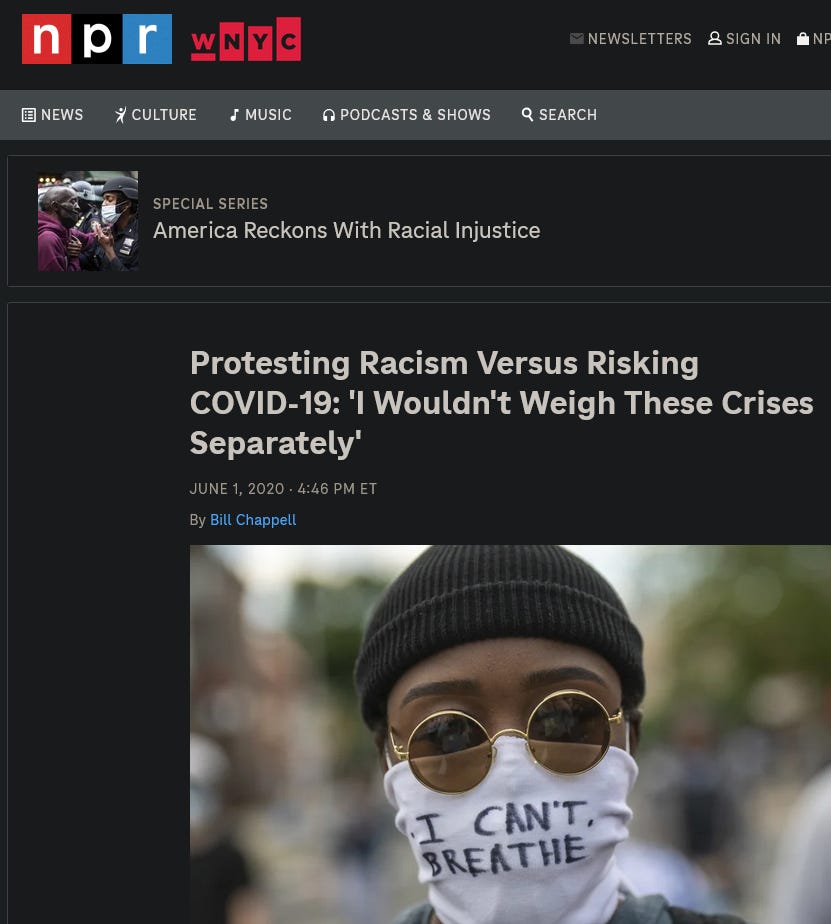
Some tweets live in infamy. Six years ago this week, NPR shared a link on X (Twitter at the time) to an article by correspondent Bill Chappell: “Protesting Racism Versus Risking COVID-19.”
This was June 2, 2020, in the grips of the pandemic. By that time, Americans had been forced to confront the reality that “two weeks to slow the spread” was a lie. The two weeks had come and gone at the end of March, yet government health advisors had continued to pressure authorities at the federal, state, and local levels to maintain lockdowns, mask mandates, and prohibitions on social gatherings.
These policies were initially sold to the public as temporary measures that were necessary to give hospitals time to receive an influx of COVID-19 patients. By the start of the summer, it had become clear that public health experts would continue to insist on heavy-handed mitigation measures until either case counts crashed on their own or a vaccine became widely available. This meant that in Democratic-controlled municipalities, where it was fashionable to “trust the science,” relevant policymakers would keep lockdowns in place, require masks in all public spaces, and discourage large gatherings—even outdoors.
Washington, D.C., was once such location. The streets were generally empty. When people did venture outdoors, they were expected to wear masks, even when walking by themselves or engaging in vigorous exercise.
But then something happened: a black man, George Floyd, died while in police custody after an officer, Derek Chauvin, kneeled on his back for nine minutes. Chauvin would eventually be convicted of second-degree murder. Video footage of Floyd’s death caused a massive public outrage and generated protests against racism and police violence across the country.
One might have expected public health experts to express sympathy with the cause but maintain their ironclad support for mitigation measures. After all, they had had no problem recommending that government officials close down schools, churches, and funeral homes, all of which serve vital social functions. They did not.
Maria Tardiff: Conservative scholars debunk claim Declaration of Independence was document of revolt
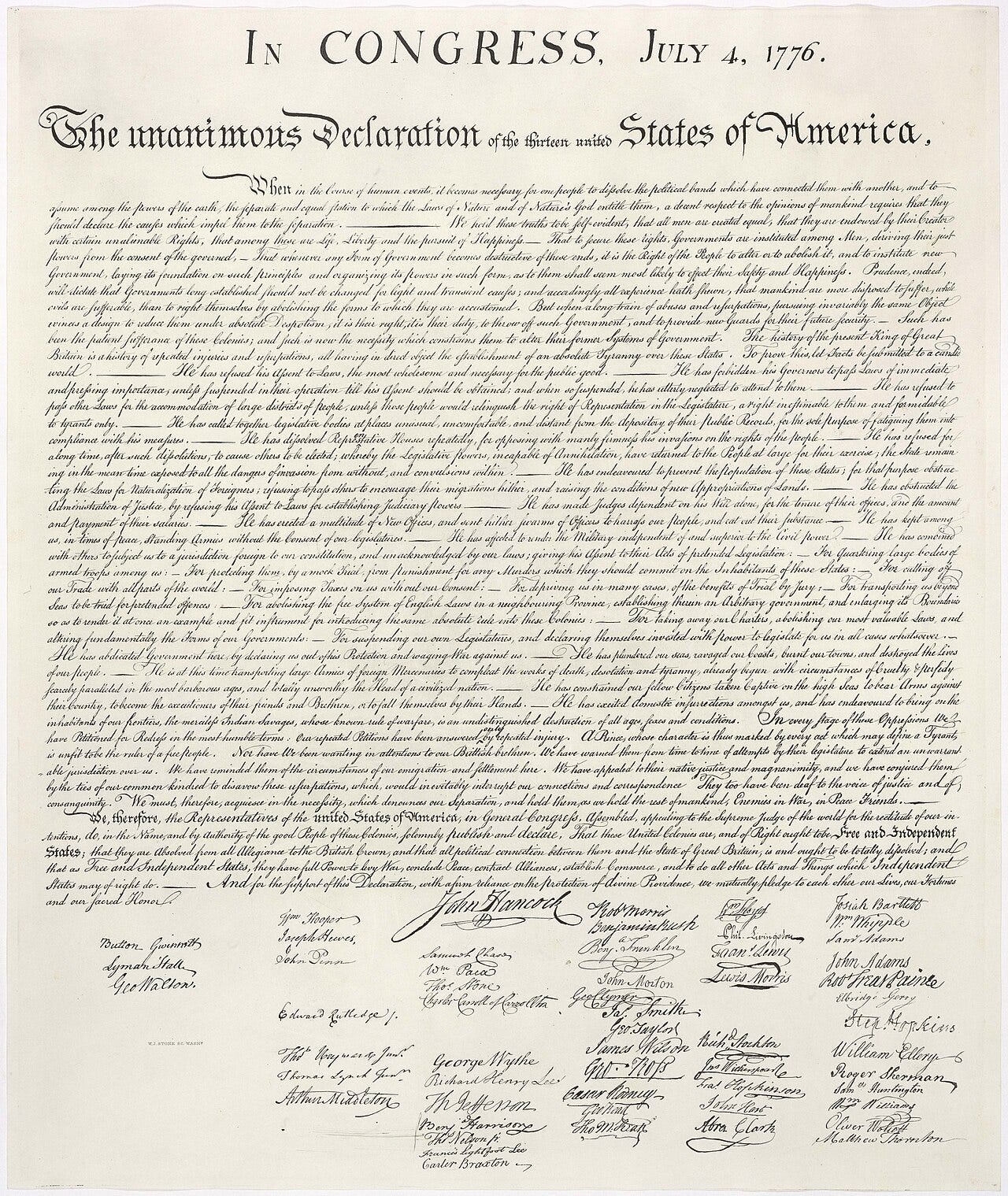
At The College Fix, Maria Tardiff challenges an all-too-common myth about America’s founding. Our declaration of independence from Great Britain was not about justifying revolution, but preserving liberty:
While most Americans grew up hearing that the Declaration of Independence was a revolutionary document giving Americans “the right to blow things up,” a group of conservative scholars recently argued the Founding Fathers penned a thoughtful foundational statement that served as a rational basis for the emerging country.
The declaration is “the most monumental statement of human liberty written in the English language,” said Matthew Spalding, a constitutional government professor at Hillsdale College and one of three panelists who spoke at a recent event dissecting the document.
Hosted by the center-right National Association of Scholars, the mid-May webinar was one in the group’s new series “1776 in Mind” commemorating America’s 250th anniversary.
Spalding, who oversees the Kirby Center for Constitutional Studies and Citizenship at Hillsdale’s Washington, D.C. campus, emphasized the document has a “narrative of its own, so that the declaration would tell its own story,” and does not need to be read through the biased lenses of interpreters.
Spalding said the text reveals that the founders were not just frustrated revolutionaries but well versed in British history and government, citing the influences of classical politics and Christianity on the declaration.
Spalding pointed to phrases like “prudence will dictate” in the declaration that sound more rational than revolutionary, and added what the founders argue for is “not an abstract, revolutionary right, à la the French revolution,” but rather “what makes America revolutionary is a change in ideas, but it’s not actually a revolution, rather a founding.”
Around X
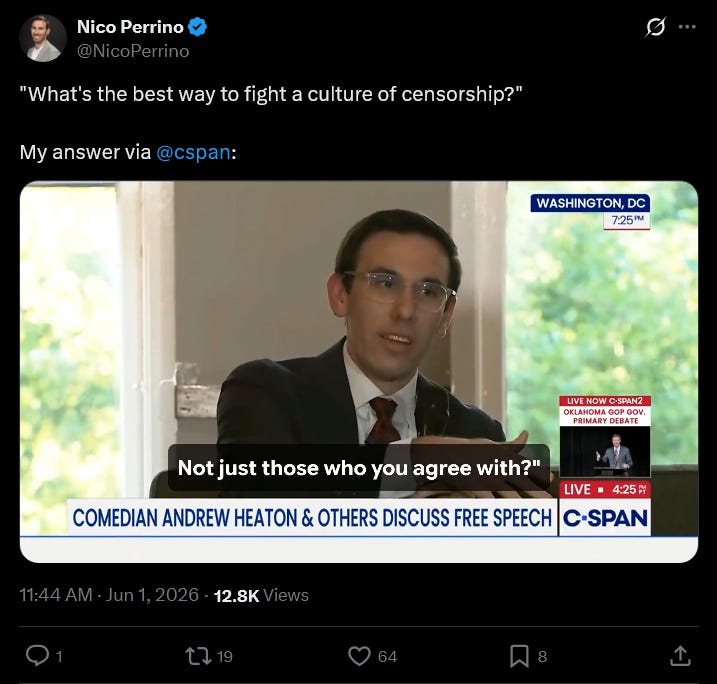
How do we defeat censorship culture? Nico Perrino says the answer hasn’t changed: defend speech you disagree with.
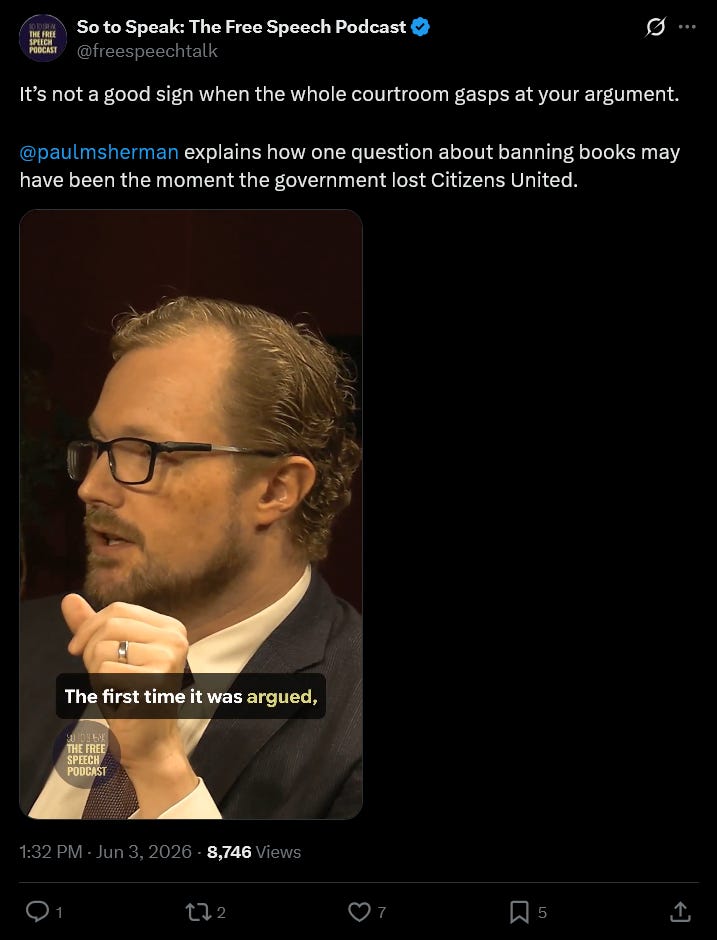
Legal scholar Paul Sherman explains how the federal government lost its bid to further regulate campaign speech in Citizens United v. FEC: by trying to reserve the right to ban books.
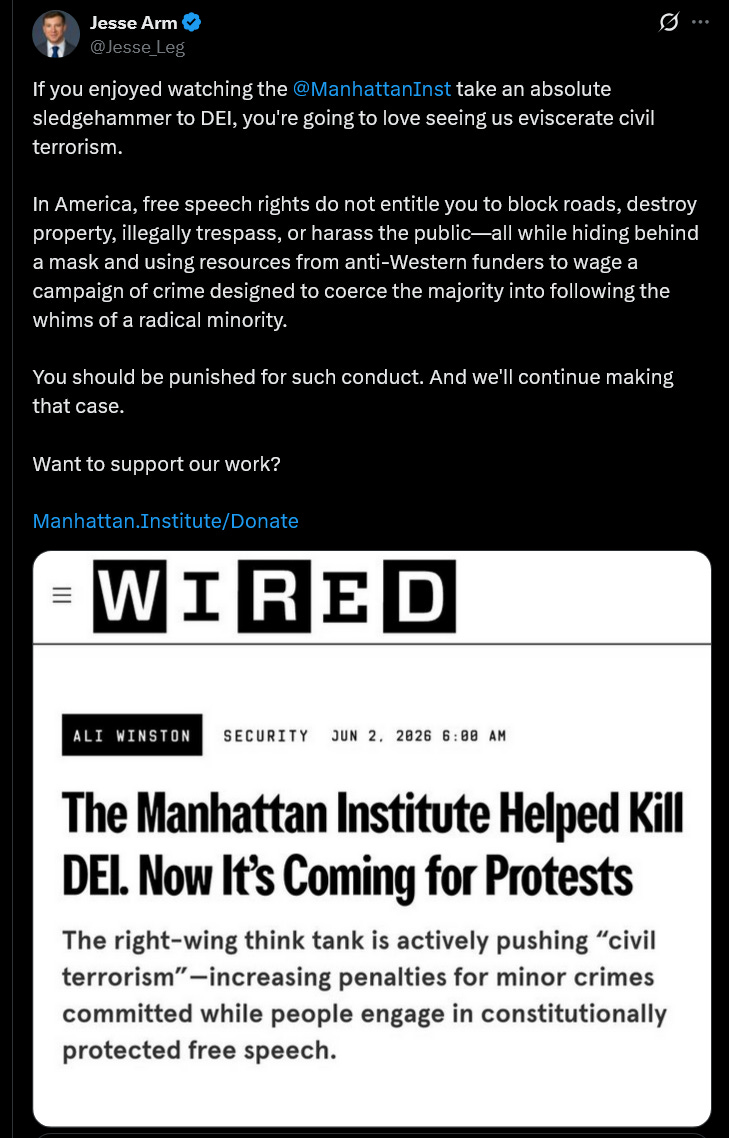
The Manhattan Institute (MI) has challenged recent media coverage of its opposition to political violence. WIRED framed the effort as a threat to protesting more generally; MI’s Jesse Leg wasn’t having it. Destroying property is not protected speech, he insisted.