A round-up of the latest and best insight on the rise of illiberalism in the public discourse:
Simon Olech: Bangor U. debate society refuses to debate conservative Reform UK, prompting backlash

UK-based Bangor University’s debating society refused to allow two conservative speakers to host a Q&A, claiming the event would constitute hate speech. The controversy has sparked calls for the school’s public funding to be eliminated. The College Fix reports:
The Debating and Political Society at Bangor University, located in Wales, recently refused to allow two prominent right-wing speakers from conducting a live Q&A session with students, stating to do so would allow “hate” on campus.
Reform UK, a successor of the Brexit party, touts immigration controls, tax cuts, and deregulation.
The proposed event included a Q&A session from Sarah Pochin, a Reform UK member of Parliament, as well as Jack Anderton, a political campaigner focused on issues including housing and immigration, as part of Anderton’s A New Dawn Tour.
However, the Bangor Debating and Political Society refused their request in mid-February.
“Bangor receives £30 million in state funding a year, much of which comes from Reform-voting taxpayers,” Zia Yusuf, the party’s home affairs spokesman, posted on X. “I am sure they won’t mind losing every penny of that state funding under a Reform government.”
Richard Tice, deputy leader of Reform UK, posted on X: “Simple. In line with our values, if Bangor Uni does not believe in free speech, then British taxpayers should not have to fund them. Perhaps remove all government funding and no student loans for Bangor students.”
Anderton issued a response alongside MP Pochin on X, describing the irony of a debating society that refuses to debate, adding “free speech is under attack” and calling out the universities that “are really not doing their duty in protecting free speech for students and the wider public.”
Andrew Gilligan: This ‘anti-Muslim hostility’ definition is truly sinister
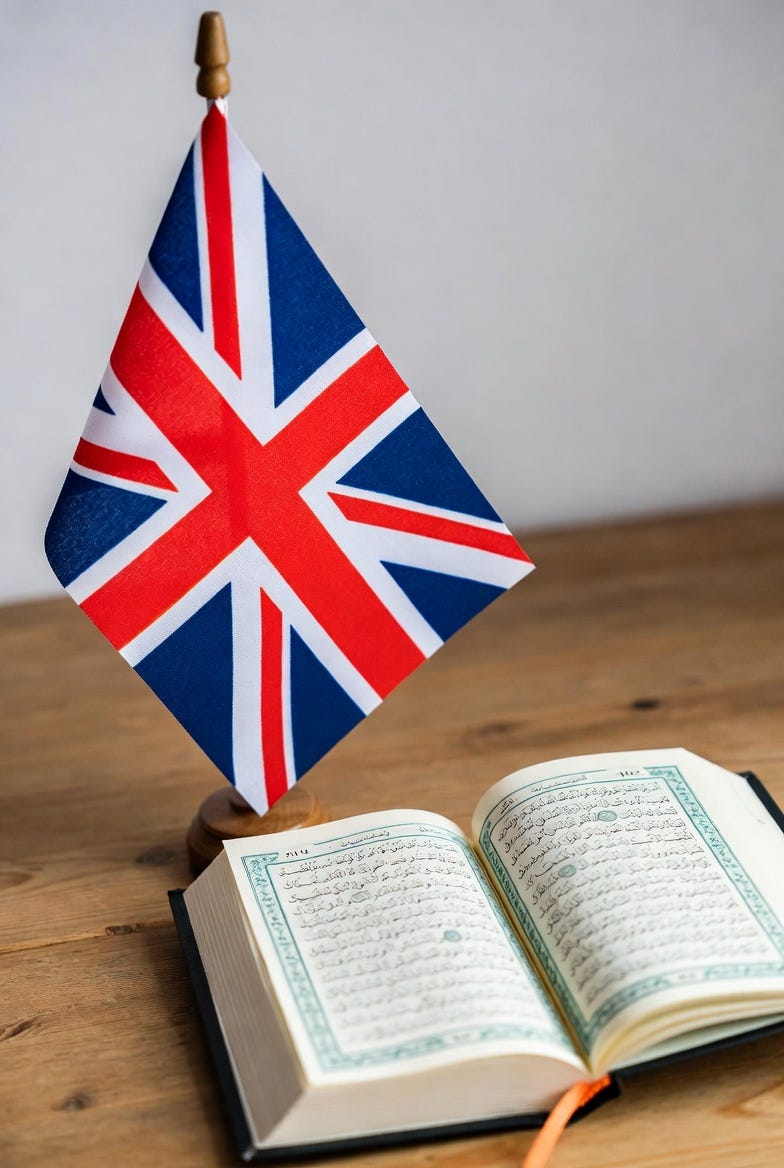
It’s already illegal in the UK to discriminate against individuals based on their religious beliefs. As a result, Andrew Gilligan at The Spectator wants to know why Britain needs a law that carves out special protections for Muslims. Not only will the proposal strengthen divisive extremists on all sides, Gilligan argues, it will give the government another excuse to justify its already bulging restrictions on speech:
The government’s new official definition of ‘anti-Muslim hostility’ is 144 words long. But in a sign that even ministers now realize what a mess they have made, it is followed by a further tortuously pleading 1,400 words which ‘must be read together’ with it.
You will be relieved to hear, according to this ‘accompanying text,’ that the definition is no threat at all to ‘the fundamental right of every person in the UK to exercise freedom of speech,’ or to ‘academic and political discussion,’ or to ‘criticisms of religion or belief,’ or to ‘debates in the public interest.’
To which I reply: qui s’excuse, s’accuse (he who excuses himself, accuses himself). If this were not a threat to free speech, the government would not need to say so. And to which I also reply: for the state to publish a list of examples of permitted speech sets a deeply sinister precedent, and on subjects far wider than Muslims.
…
Yet here is an obvious and open act of two-tier policy. Hatred and discrimination against Muslims are emphatically wrong – but are already illegal. The only purpose of an additional definition must be to create special protections for one faith which do not apply to those of other faiths or none.
Institute for Free Speech: Broad Coalition of Free Speech Organizations and Scholars Urges Supreme Court to Hear Case of Professor Silenced by University’s Threats
An all-star lineup of free-speech advocates is urging the Supreme Court to hear the case of Richard Lowery, a University of Texas (UT) professor who was threatened with punishment for criticizing UT’s DEI policies. The Fifth Circuit Court of Appeals dismissed Lowery’s suit because the school didn’t act on its threats.
The coalition of free speech groups says that’s precisely why the Court must settle the matter: the Fifth Circuit ruling “provides a roadmap for would-be censors to silence public employees without legal consequence”:
A compelling and ideologically diverse coalition of free speech organizations and First Amendment scholars have filed amicus (friend of the court) briefs urging the Supreme Court to hear the Institute for Free Speech case Lowery v. Mills, which challenges a ruling that leaves public employees without legal recourse when government employers silence them through threats rather than formal discipline.
The Alliance Defending Freedom, Institute for Justice, Manhattan Institute, Protect the First Foundation, Cato Institute, Foundation for Individual Rights and Expression, National Coalition Against Censorship, and a group of more than two dozen leading First Amendment scholars all filed or joined briefs in support of granting the Institute’s petition for the Court to take the case.
The case involves University of Texas (UT) Professor Richard Lowery, who was pressured by university officials to stop publicly criticizing UT’s administration, DEI programs, and funding decisions—or face reduced pay, loss of a lucrative research post, and other consequences. Rather than risk those outcomes, Professor Lowery self-censored. Both the trial court and the U.S. Court of Appeals for the Fifth Circuit acknowledged that UT’s threats would deter “a person of ordinary firmness” from speaking, yet dismissed his First Amendment claim because the university never carried out its threats.
That ruling leaves the Fifth Circuit, which covers Texas, Mississippi, and Louisiana, at odds with ten other federal appeals courts. While the overwhelming majority of courts ask whether an employer’s conduct would deter a reasonable employee from speaking on matters of public concern, the Fifth Circuit, along with the Southeast’s Eleventh Circuit, require a completed adverse action—a firing, demotion, or formal reprimand—before an employee can sue. These outlier decisions mean that nearly 80 million people—about 23% of the U.S. population—live in states where public employees currently lack meaningful First Amendment protection against employer threats.
The new filings make clear that this gap in constitutional protection deeply troubles advocates across the ideological spectrum.
Around X
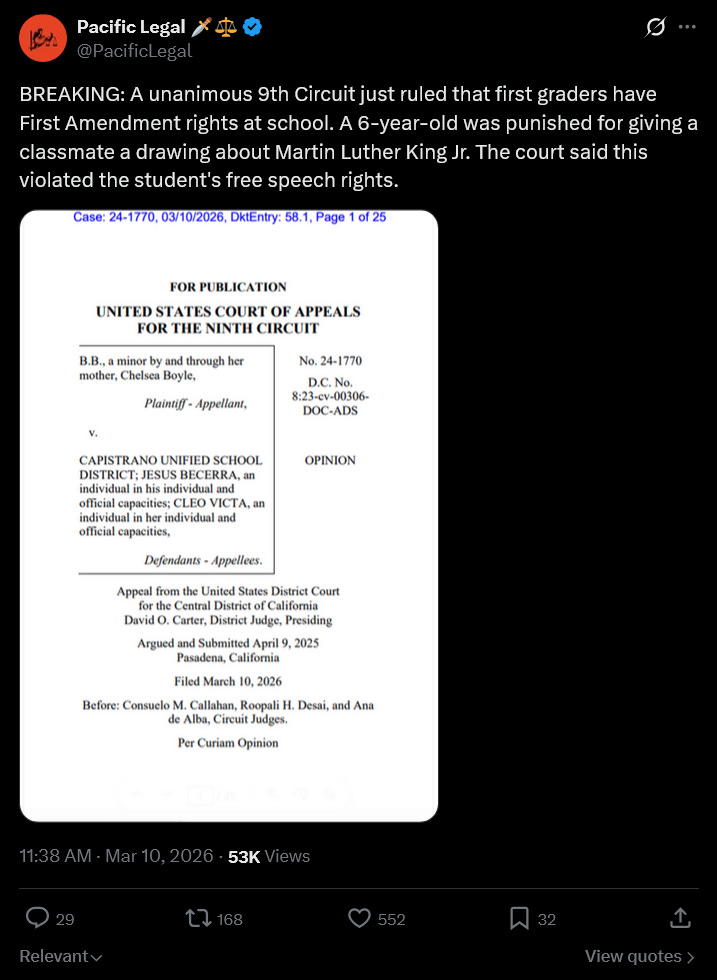
Good news out of the 9th Circuit this week: children do indeed have First Amendment rights; their youth is no excuse to silence their speech.
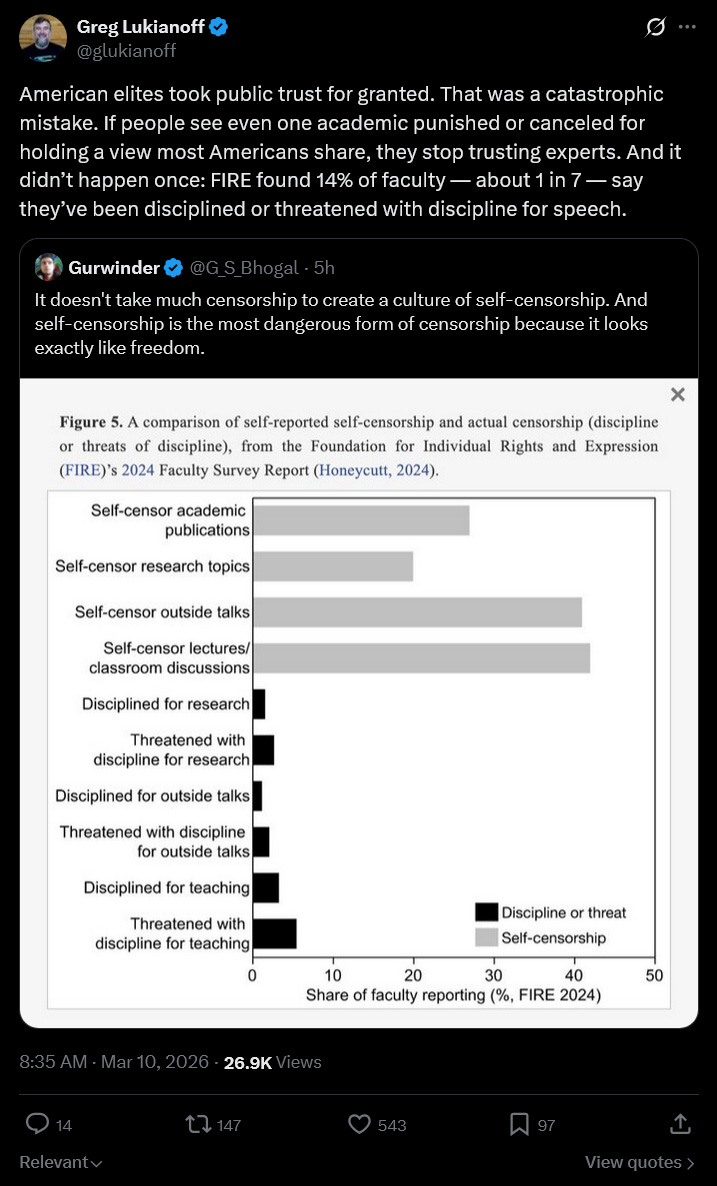
A lesson America’s intellectuals have learned the hard way in recent years: Censorship destroys the public’s trust in experts.
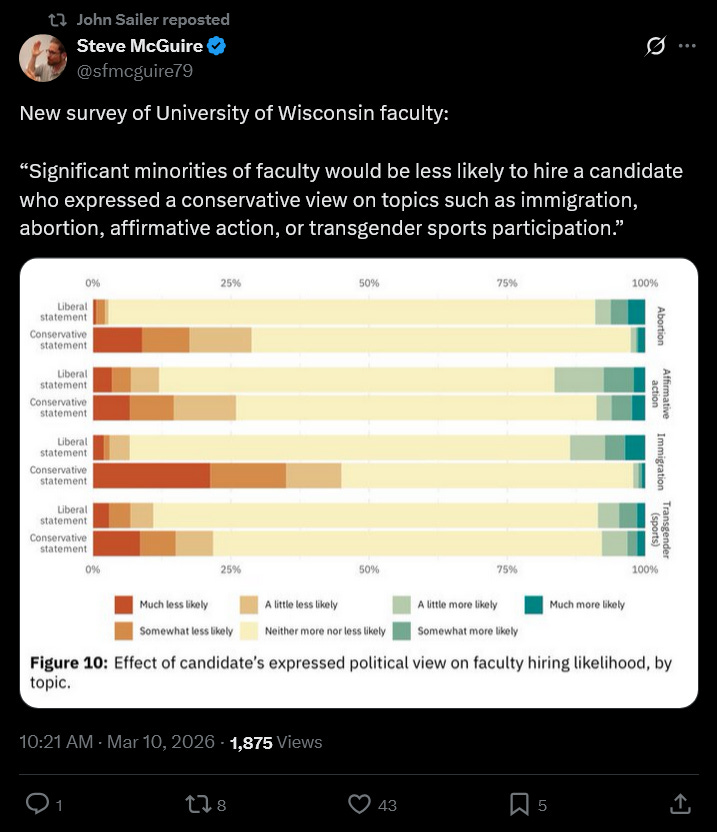
Steve McGuire highlights a concerning poll from the University of Wisconsin. If the results are any indication, dissent from the political orthodoxy on campus is still discouraged.