A round-up of the latest and best insight on the rise of illiberalism in the public discourse:
Bradley Smith, Brett Nolan: The Supreme Court Protected Donor Privacy. The IRS Didn’t Get the Memo.
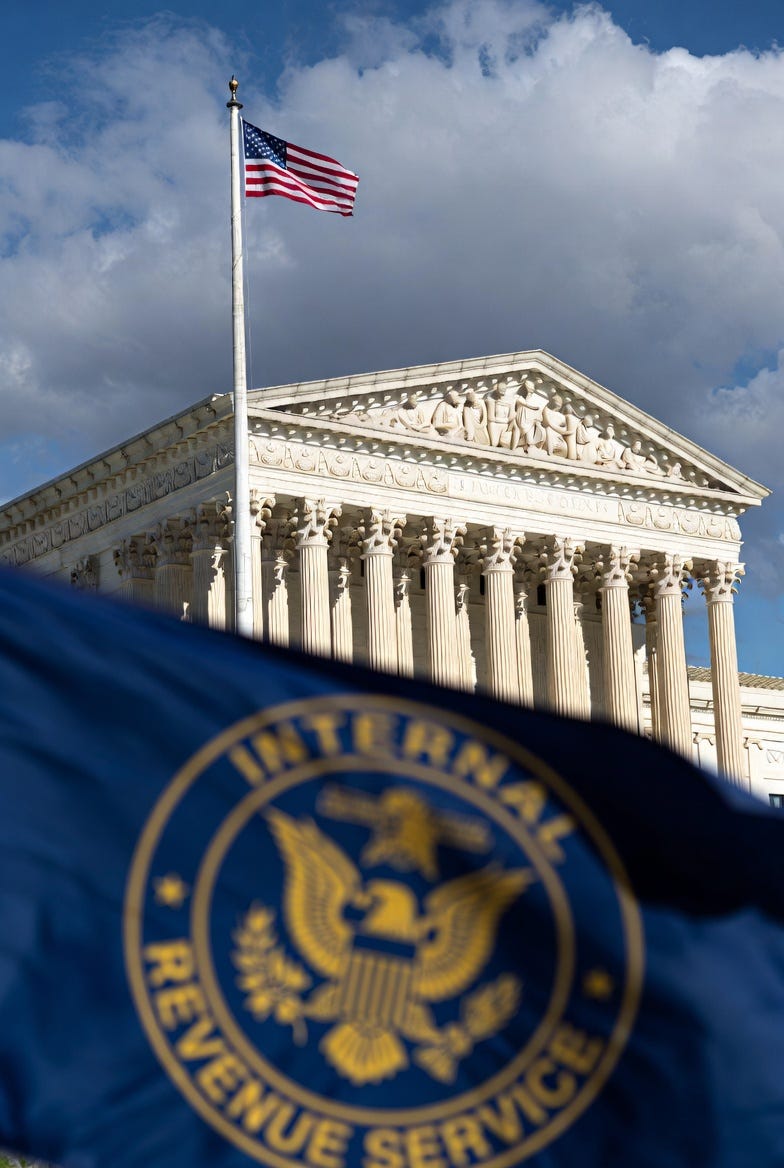
An ongoing legal battle has pit the US Supreme Court against the IRS on donor privacy. The Court recently ruled that the Constitution strongly protects donor information from prying bureaucratic eyes. Problem solved, right? Not exactly. In a separate case, the IRS is effectively trying to undo the decision. Reason reports on the potentially serious free speech implications:
The Supreme Court issued a resounding victory for donor privacy and free speech last month in First Choice Women’s Resource Centers v. Davenport, but it is cold comfort to the hundreds of thousands of nonprofit organizations around the country that must continue handing over similar information to the IRS every year.
First Choice reaffirmed that the First Amendment strongly protects the privacy of nonprofit supporters. The case arose after New Jersey’s attorney general issued a sweeping subpoena to First Choice, a Christian, pro-life medical nonprofit serving pregnant women, new mothers, and fathers.
The subpoena demanded the names and addresses of nearly all of First Choice’s donors. The Supreme Court unanimously held that such demands inflict real and immediate harm because they deter people from associating with disfavored groups—even if the government promises to keep the information confidential.
…
But it’s a much different story for the federal government in Buckeye Institute v. Internal Revenue Service, a case that our organization, the Institute for Free Speech, is litigating in the U.S. Court of Appeals for the 6th Circuit.
In Buckeye, the IRS is defending a broad disclosure regime that requires hundreds of thousands of nonprofits to disclose donor information to the federal government every year. Five years ago, in Americans for Prosperity Foundation v. Bonta, the Supreme Court held that disclosing this information—which appears on a tax form called a Schedule B—creates a “real and pervasive” chilling effect on the First Amendment. But the IRS claims that because donors to Buckeye can receive a tax deduction for their charitable contribution, Bonta doesn’t apply.
On the same day the Supreme Court announced its decision in First Choice, the IRS was in the 6th Circuit arguing that courts should not second guess the government’s claimed need to stockpile a treasure trove of sensitive donor data.
The central question in Buckeye is what standard courts must apply to evaluate the law. The Supreme Court’s decision in First Choice reaffirmed that “any demand” for donor information requires the government to satisfy “exacting scrutiny.” That means the government cannot compel organizations to reveal their donors without first proving that collecting this information is necessary to further an important government interest.
ACLU: Recording Law Enforcement is a First Amendment Right
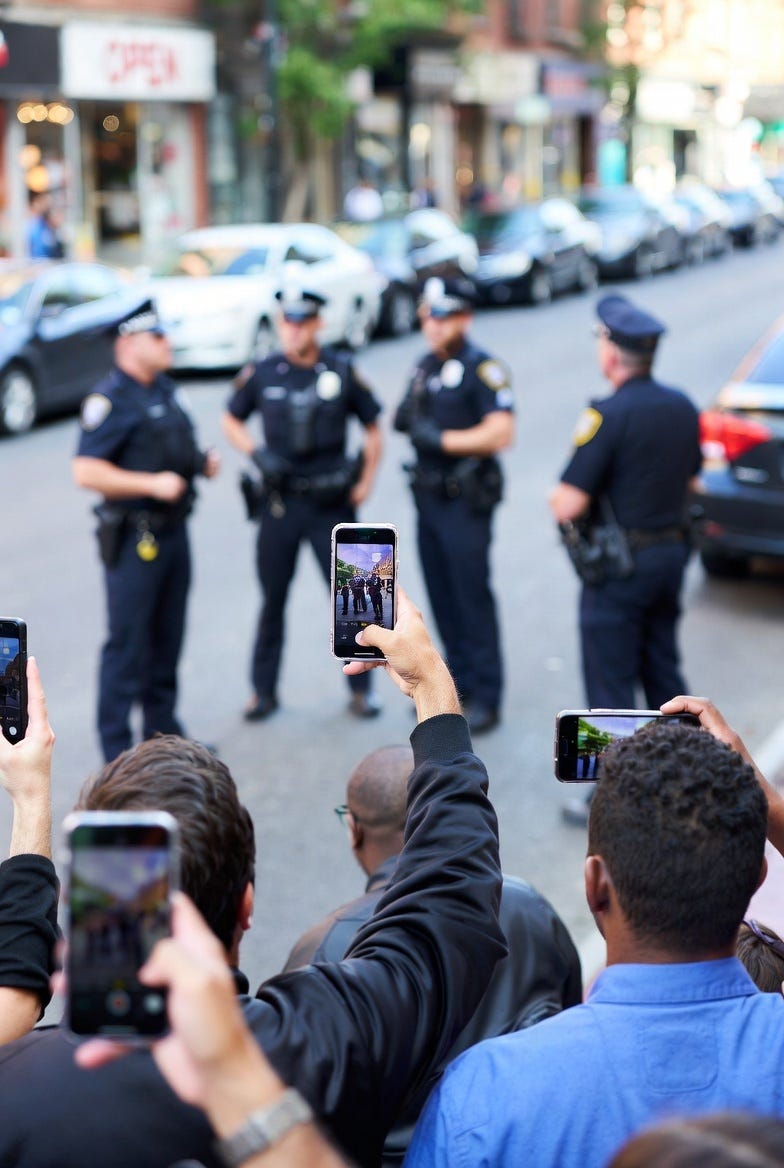
Never forget: the First Amendment protects your right to record law enforcement. The ACLU outlines the relevant legal precedent, explaining why they continue to defend Americans who have been harassed and even arrested for filming the police:
The courts have repeatedly recognized that the First Amendment encompasses the right to record law enforcement when officers are performing official actions in public. This right is protected as part of the gathering and dissemination of information about government officials, and as a medium of expression in and of itself. The right to record gives civilians the ability to hold law enforcement and other government officials accountable for their actions so their communities are informed and protected.
Every circuit court to consider the issue has held that the First Amendment protects the right to record law enforcement activity in public and people’s exercise of that right has proven critical to democratic accountability time and time again. From the footage of law enforcement brutalizing Rodney King in 1991 to that of the murder of George Floyd in 2020, recordings of officers in public document abuses and spark political discussion and advocacy.
Since the Supreme Court’s 1952 decision in Joseph Burstyn, Inc. v. Wilson, video has been understood as being protected by the First Amendment. In that case, the Supreme Court recognized that the First Amendment guarantees protection to films, videos, and movies because “it cannot be doubted that motion pictures are a significant medium for the communication of ideas,” and that they “may affect public attitudes and behaviors in a variety of ways, ranging from direct espousal of a political or social doctrine to the subtle shaping of thought which characterizes all artistic expression.”
Several later cases applied this reasoning to hold that the First Amendment also protects the process of creating video, including recording. In Animal Legal Defense Fund v. Wasden (2018), for example, the Ninth Circuit explained that the process of creating a video, much like writing a book, cannot be disentangled from the end result, and is therefore protected by the First Amendment. Otherwise, the government could effectively silence expression by stopping someone in the midst of recording (or writing, or painting).
Institute for Free Speech: Nashua’s Flag Censorship Ends with Federal Court Judgment
Nashua, New Hampshire, maintains a “Citizen Flag Pole,” on which residents can fly flags they deem important. But the city was getting choosy about the flags it allowed to be displayed. The Institute for Free Speech (IFS) got wind of this censorious policy and sued the city in federal court. Today they announced their victory in the case:
A federal district court in New Hampshire has entered a judgment against the City of Nashua in Scaer, et al. v. City of Nashua, a First Amendment case challenging the city’s viewpoint-based censorship of citizen flag requests.
The judgment, accepted by Institute for Free Speech clients Bethany and Stephen Scaer and entered by the court, orders Nashua to permanently maintain a policy closing the City Hall flagpoles to private expression and prohibits the city from resuming the discriminatory practices at the heart of the lawsuit.
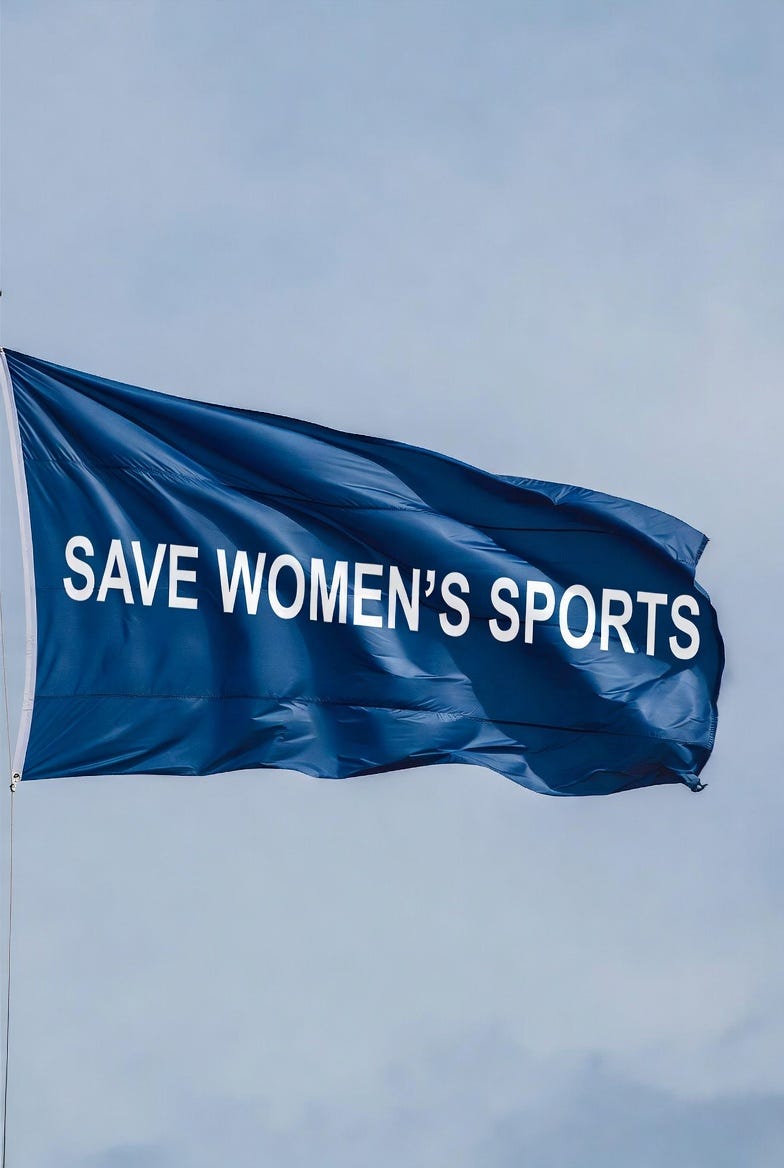
The case stemmed from Nashua’s repeated denials of the Scaers’ requests to fly flags on the city’s so-called “Citizen Flag Pole,” offering no substantive justification beyond concluding that the Scaers’ flags were “not in harmony” with the city’s message. In one instance, Nashua initially approved Bethany Scaer’s “Save Women’s Sports” flag, but the city then revoked that approval just one day later after receiving complaints.
In December 2025, the U.S. Court of Appeals for the First Circuit unanimously reversed a lower court ruling, holding that Nashua had violated the First Amendment by engaging in viewpoint discrimination and rejecting the city’s attempt to characterize its censorship as “government speech.”
Around X
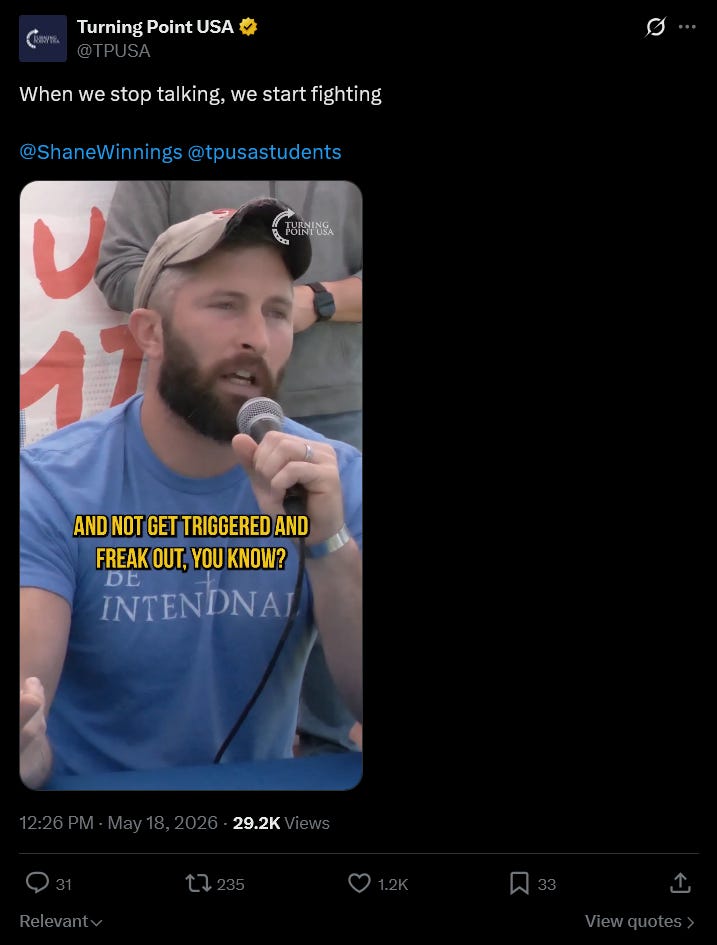
“When we stop talking is when we start fighting.” Wise words from the late Charlie Kirk.
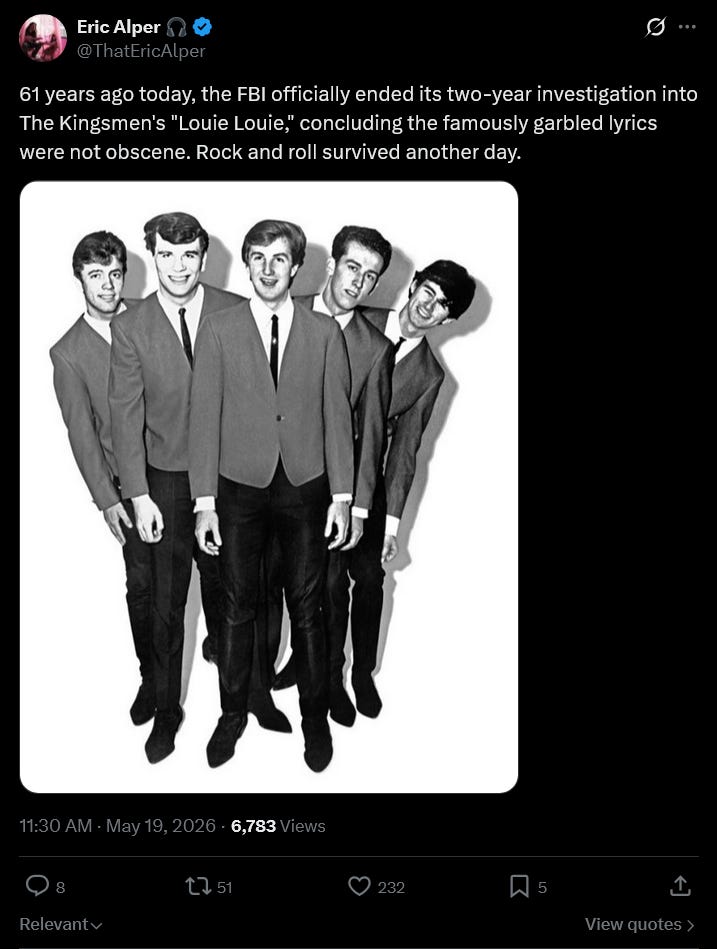
Thanks goodness the FBI protected us from the baleful influence of…Louie Louie.
Over a month in jail—for an “offensive” Facebook post. The Foundation for Individual Rights and Expression (FIRE) was having none of that.