A round-up of the latest and best insight on the rise of illiberalism in the public discourse:
Sarah McLaughlin: UK police arrest hundreds more peaceful protesters under anti-terror law
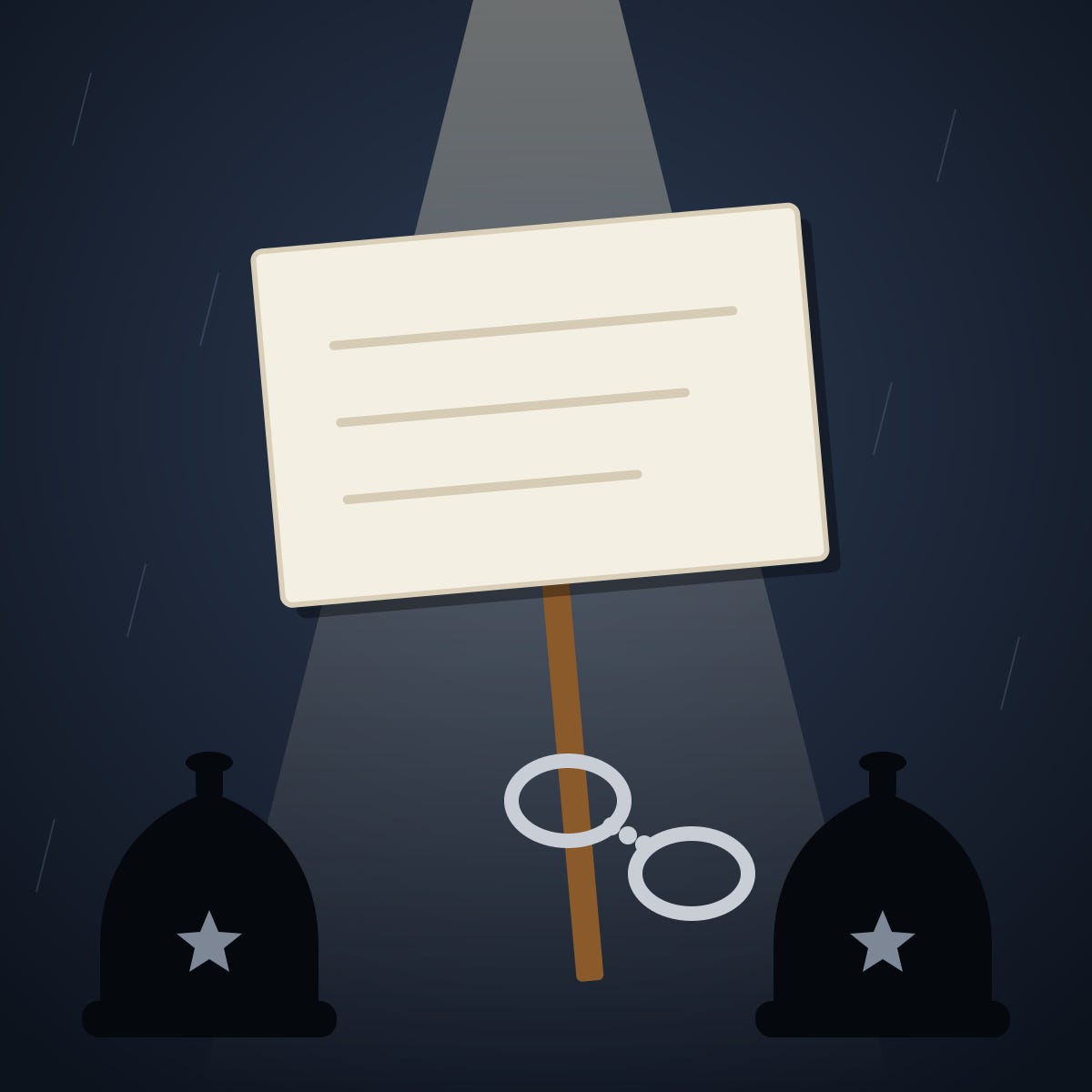
On Halloween, London police arrested 325 people for standing outside the U.S. embassy holding signs that read “I oppose genocide, I support Palestine Action.” Days later, more than two dozen others were arrested outside the UK Supreme Court as the banned group’s legal challenge got underway.
At FIRE’s Free Speech Dispatch, Sarah McLaughlin notes that amid Britain’s better-known speech scandals—police at the door over jokes, talk of passport checks to post online—this one has been quietly ballooning for more than a year:
Few international free speech stories have received as much attention in recent months as the United Kingdom’s descent into a censorial spiral, as I’ve regularly covered here at the Free Speech Dispatch. Police show up at the doors of social media users — even teens — to question them over jokes, pseudo-blasphemy arrests are on the table, and officials are now warning that the under-16 social media ban may require adults to show their passports to post. And that won’t even be the end of the growing battle against online “harm.”
But amidst these other censorship battles, another one with high stakes has been brewing for years: Thousands of Britons are facing terror charges for nothing more than holding signs.
UK’s censorship of Palestine Action keeps ballooning
Sixteen months ago, the UK banned activist group Palestine Action, some members of which have been convicted of criminal conduct including vandalism of military planes and assault of a police officer during a break-in at an Israeli defense firm. (Vandalism and assault are, of course, not protected expression.) The group is currently challenging its proscription at the UK’s Supreme Court, and the court’s ruling could leave a substantial imprint on free expression in the UK.
Hugo Timms: Michel Houellebecq must not be silenced
On Tuesday, a Paris court formally charged infamous novelist Michel Houellebecq over a 2022 interview with philosopher Michel Onfray in which he made sweeping, inflammatory remarks about Muslims in France. The head of Paris’s Grand Mosque filed the first complaint but dropped it after speaking with Houellebecq.
Two other groups, an anti-racism organization and the Union of French Mosques, stayed on as plaintiffs. At spiked, Hugo Timms argues the case says more about France than about its most provocative author:
Having written about Islam and mass immigration for three decades, Houellebecq is a well-known critic of both. The experience of France – and indeed his own – in recent years hasn’t led to any softening of his views. Speaking to the philosopher Michel Onfray, in a conversation later published in Front Populaire in 2022, Houellebecq predicted ‘shootings in mosques, in cafés frequented by Muslims, in short, Bataclans in reverse’, when parts of France ‘come under Islamist control’. He said that French people don’t want Muslims to assimilate so much as to ‘stop stealing’ and ‘[stop] assaulting’ people. Another ‘good solution’, he said, was for Muslims to leave France.
...
Once upon a time, expressing strong opinions was simply what writers did. Even if Michel Houellebecq is acquitted, champions of free speech will have little to celebrate. A society whose most celebrated writer is constantly defending himself from Islamic grievances – whether by lawyers or armed police – has already lost a crucial battle.
J.D. Tuccille: Documents Reveal the Postal Service’s Broad Surveillance of Political Activists
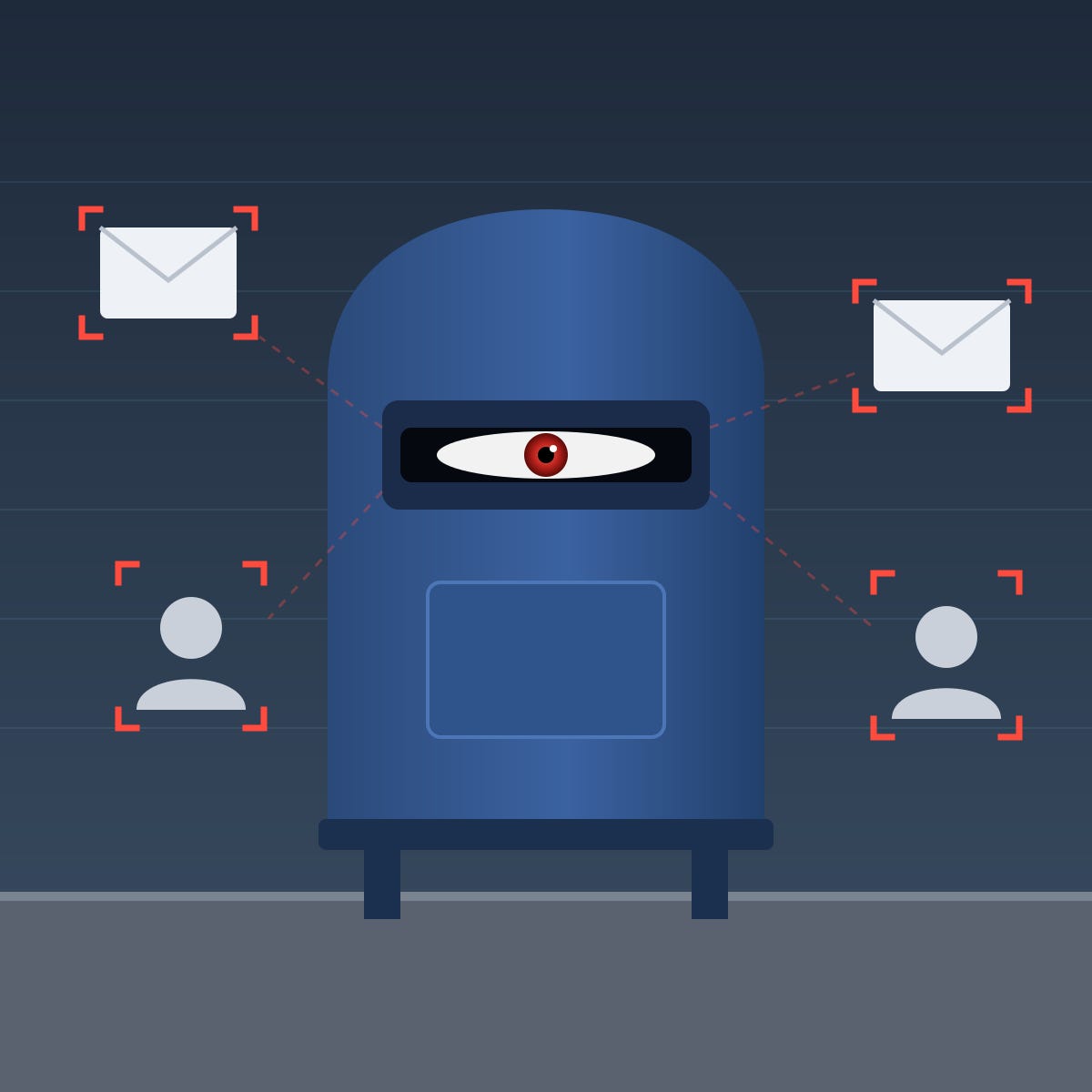
What does the U.S. Postal Service have to do with your protest plans? More than you’d think. Records pried loose this month by an Electronic Frontier Foundation lawsuit show the Postal Inspection Service’s Internet Covert Operations Program, originally pitched as a tool against drugs in the mail, spent 2020 and 2021 monitoring and circulating information about planned demonstrations. At Reason, J.D. Tuccille asks the obvious question:
Is it entirely necessary for every federal agency to … reimagine itself as Big Brother? OK, silly question. Of course, it’s not necessary for the Post Office—that’s the agency under scrutiny this time—to engage in mass surveillance. It just seems to be an activity in which all government bureaucracies inevitably engage. That’s the most logical explanation for why the U.S. Postal Service decided that it should monitor the internet for information about political demonstrations.
“The law enforcement arm of the U.S. Postal Service has been quietly running a program that tracks and collects Americans’ social media posts, including those about planned protests,” Jana Winter first reported in 2021 for Yahoo! News.
“Analysts with the United States Postal Inspection Service (USPIS) Internet Covert Operations Program (iCOP) monitored significant activity regarding planned protests occurring internationally and domestically on March 20, 2021,” according to a March 2021 bulletin from the iCOP that was included in the article. “Locations and times have been identified for these protests, which are being distributed online across multiple social media platforms, to include right-wing leaning Parler and Telegram accounts.”
Around X
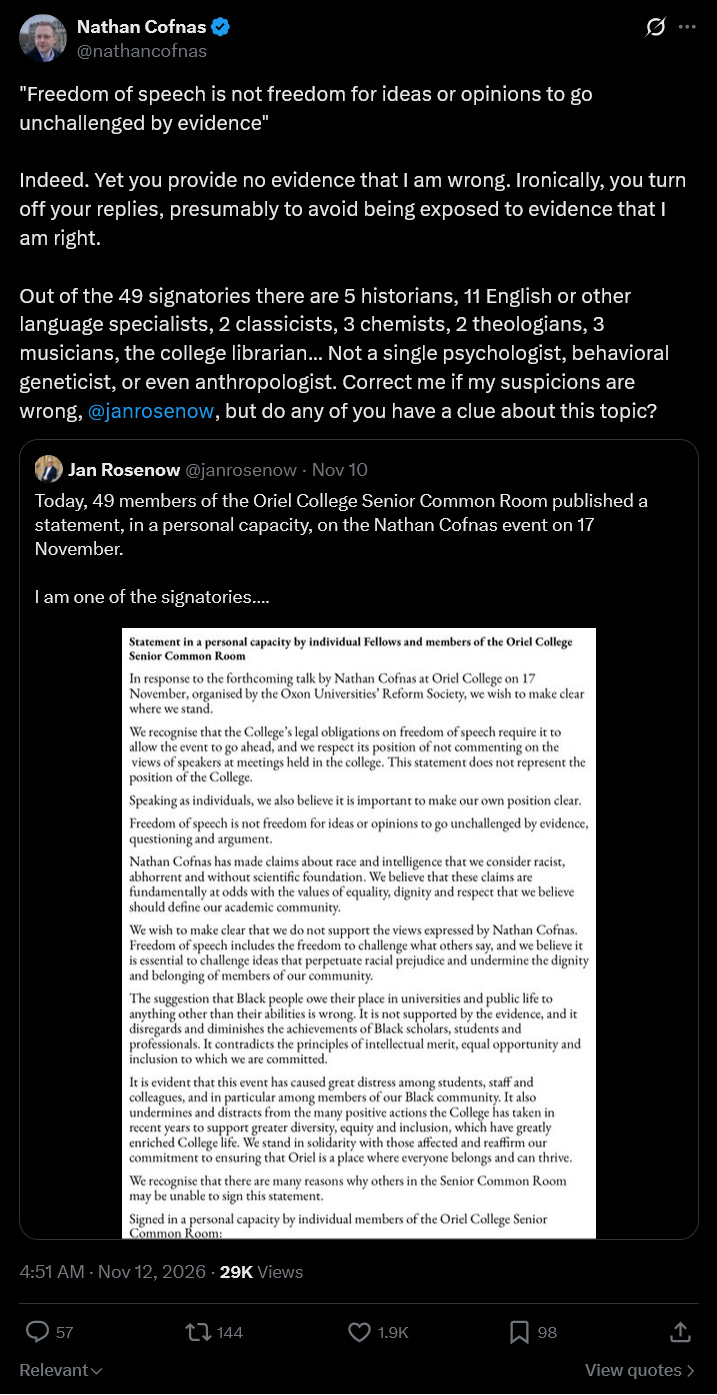
Philosopher Nathan Cofnas is due to speak at Oxford’s Oriel College on November 17, invited by a student Reform society. Forty-nine members of the college’s Senior Common Room have signed a statement calling his claims about race and intelligence racist and without scientific foundation—while acknowledging the college is legally obliged to let the talk go ahead.
Cofnas fired back, noting that the signatory who shared it online had switched off replies.
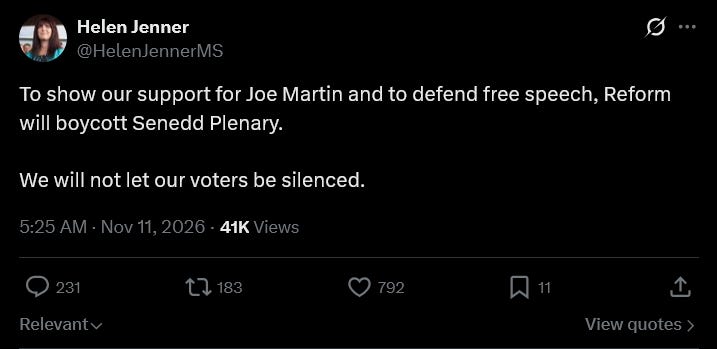
In Wales, the Senedd's presiding officer has barred Reform member Joe Martin from being called to speak until he apologizes for asking the Welsh government for a statement on what he called the "demographic replacement of white British people."
Reform Wales leader Helen Jenner responded by announcing a party boycott of plenary sessions. You can find Martin's framing ugly and still wonder what a parliament is for if an elected member can be silenced over the content of a question.
Finally, James Melville is fuming over a Telegraph report that HMRC, Britain's tax authority, may soon be able to demand taxpayers' AI chatbot conversations under pending legislation that broadens the digital records it can request. After this week's Postal Service story, forgive us for not taking "we only look when we need to" on faith.