A round-up of the latest and best insight on the rise of illiberalism in the public discourse:
Meghan Cox Gurdon: The West Leaves Free Speech Behind
When Ayatollah Khomeini called for Salman Rushdie’s death in 1989, the Western literary world closed ranks around him. This month, after a complaint from the Union of Mosques of France, a judge in Nanterre placed Michel Houellebecq — author of Submission — under formal investigation for complicity in incitement to discrimination, hatred or violence, over remarks about Muslims he made in a 2022 magazine interview.
At WSJ Opinion, Meghan Cox Gurdon argues the contrast between the two cases says everything about how far the West has drifted:
Back in the day, it took an Ayatollah to indict a writer for offending Islam. And when it happened, the literary world recoiled in horror. Now it only takes a Western European government. And this time around, the literary world gives a polite cough and turns its gaze elsewhere.
Quel changement.
Following a complaint lodged by the Union of Mosques of France, a judge in Nanterre put the novelist Michel Houellebecq under investigation for “complicity in incitement to discrimination, hatred or violence” for having made sharp remarks about Muslims four years ago. Mr. Houellebecq, probably France’s greatest living writer, is best known outside the country for his 2015 novel “Submission,” a grim satire that imagines French society surrendering to Islamist rule. In any case, it used to be axiomatic in the West that a writer ought to be free to express his thoughts, even disagreeable ones. Not so today.
The degree of change shows itself in what now probably will feel to some readers as ancient history. It was 1988, another world. Ronald Reagan was president of the U.S. Ruhollah Khomeini, the tyrant of Iran, had been in power a little less than a decade. There had yet been no 9/11, no Gulf Wars, no Oct. 7, no looting of Dior or burning of Limoges City Hall.
Beth A. Williams: 4 essential lessons we learned from the government’s dangerous war on ‘disinformation’
In 2021, the Biden White House declared that a disinformation crisis on social media was feeding polarization that could spill into domestic terrorism. Officials then leaned on platforms to label, bury and delete posts.
Now the Privacy and Civil Liberties Oversight Board, the watchdog created after 9/11 to keep counterterrorism from trampling civil liberties, has released a staff report on that campaign after a four-year investigation.
Writing at Fox News, PCLOB member Beth Williams lays out the bottom line: the government never provided the board any evidence that disinformation actually fueled domestic terrorism. Her conclusion is as plain as it gets:
The government should not be in the business of policing Americans’ speech. The social media engagement practices that were utilized first to counter disinformation from malign foreign actors were, unfortunately, easily translated to countering domestic terrorism. The risk that the need to fight terrorism would be used to justify curtailing civil liberties is well recognized. Indeed, it is the reason that the 9/11 Commission recommended the creation of PCLOB.
And it is why the commission recommended that “[t]he burden of proof for retaining a particular governmental power should be on the executive, to explain [both] that the power actually materially enhances security and that there is adequate supervision of the executive’s use of the powers to ensure protection of civil liberties … If the power is granted, there must be adequate guidelines and oversight to properly confine its use.”
Greg Piper: Free speech groups gang up on deep-blue states to block AI censorship, government mouthpiece laws
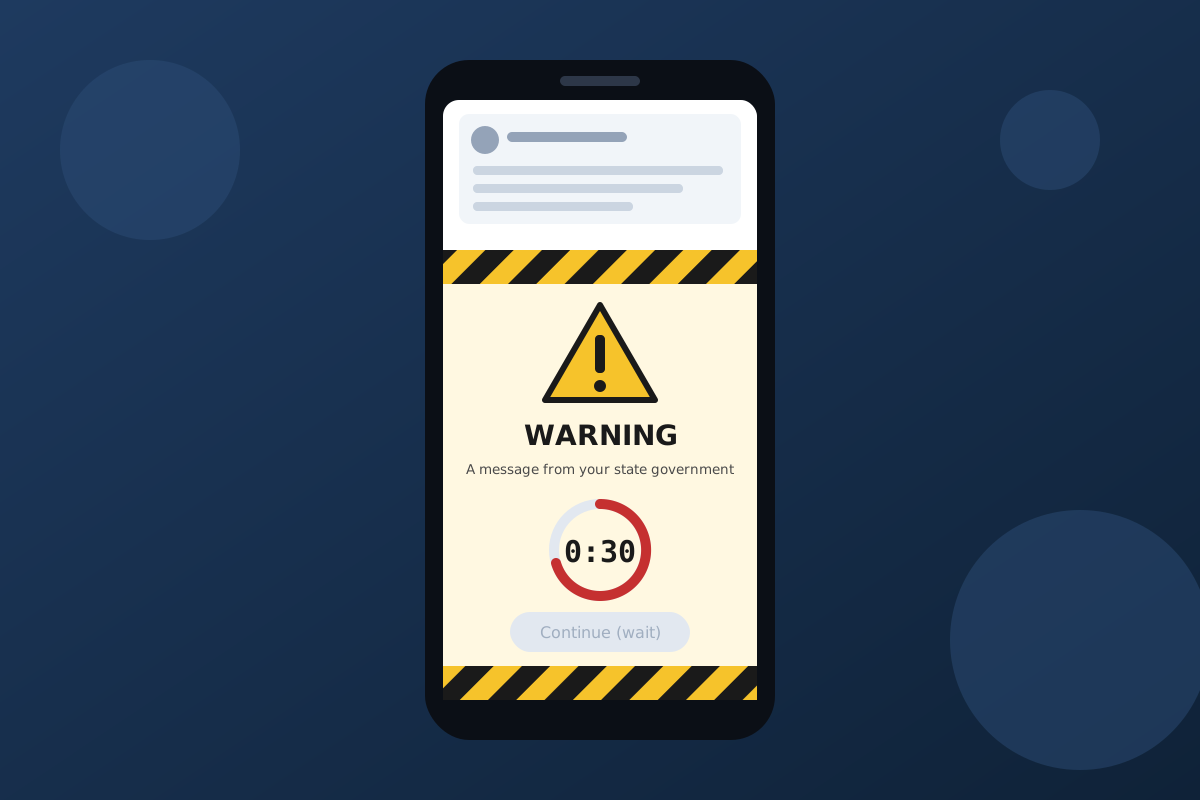
Plenty of victorious Democrats campaigned on tougher regulation of social media and AI in this month’s midterms. At Just the News, Greg Piper reports that the courts may have other ideas. Tech trade group NetChoice, whose members include Meta and X, has sued New York over a new law that would force recurring tobacco-style warnings onto so-called addictive feeds.
The warning would consist of a quarter of the screen for 10 seconds at first, escalating to three-quarters of the screen for 30 seconds after three hours of use, then every hour after that, for any user the platform hasn’t reasonably determined is over 17. A federal judge already blocked a similar Colorado law earlier this month. As NetChoice put it after that ruling:
“Public health” can be used to justify all kinds of overreach. Everything about New York’s law targets the content of speech, from its application to services that are primarily “socially interactive” and provide “user-generated content” as opposed to those that publicize only their own editorial content, the suit says. That means the government’s policy must be the least restrictive to accomplish its objective.
Even under the lower judicial standard of “intermediate scrutiny,” the law cannot survive because it doesn’t “directly and materially advanc[e] the asserted governmental interest” and is “more extensive than necessary to serve the interests that support it,” NetChoice said.
Around X
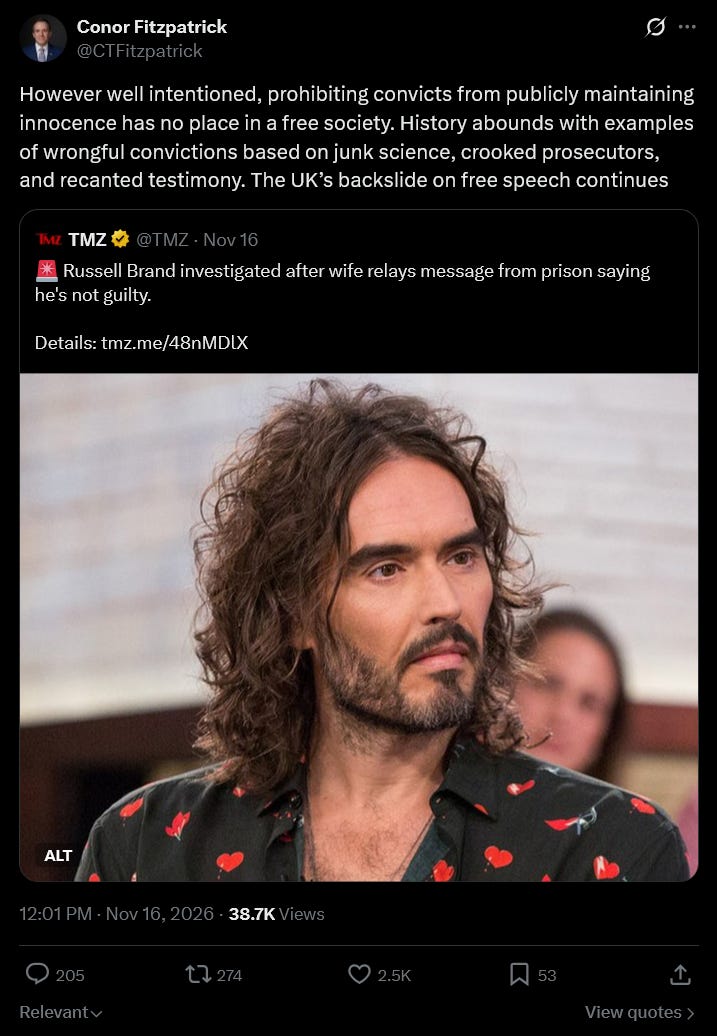
In Britain, Russell Brand, convicted of rape and sexual assault earlier this month and sentenced to ten and a half years, had his wife read a message on YouTube in which he maintained his innocence. The Prime Minister’s spokesperson called it appalling.
FIRE attorney Conor Fitzpatrick’s pushed back, arguing that banning convicts from publicly protesting their innocence “has no place in a free society.”
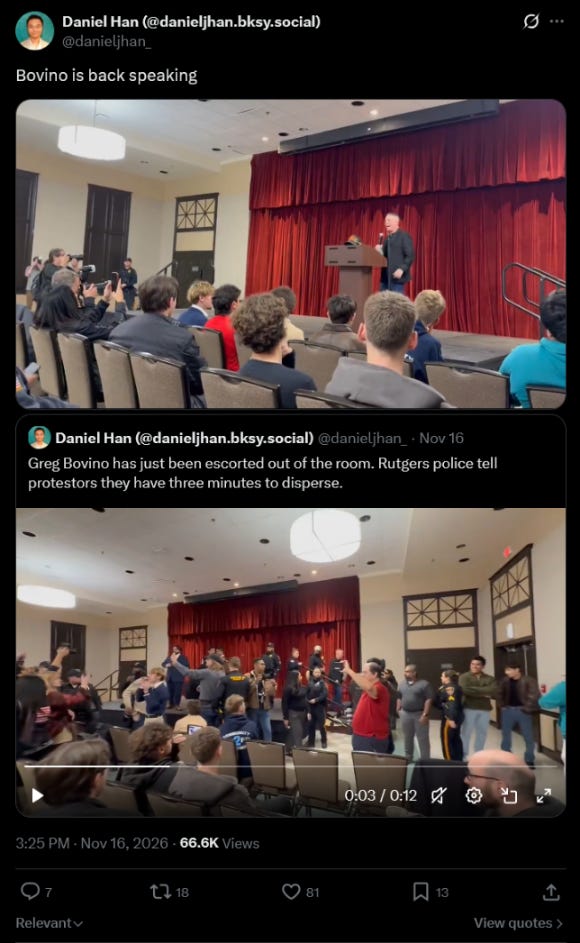
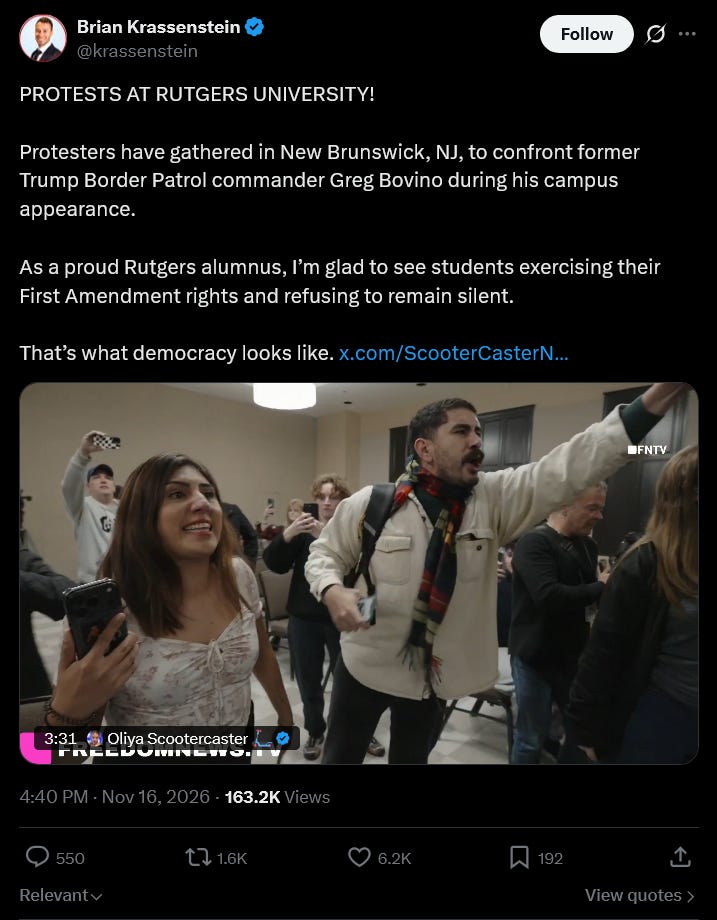
Back home, protesters disrupted a Rutgers Republicans event featuring former Border Patrol commander Gregory Bovino just minutes into his remarks on Monday night. Rutgers alum Brian Krassenstein cheered the protesters for exercising their First Amendment rights. Connor Murnane called that half right: protesting a speaker is protected; shouting him off the stage is a heckler's veto.
The happy ending, via Politico's Daniel Han: after police gave the disruptors a few minutes to disperse, Bovino was back at the mic. Not bad for a school FIRE ranks 257th out of 261 on campus free speech.