A round-up of the latest and best insight on the rise of illiberalism in the public discourse:
Jack Verrill: Russia Wants To Censor Americans. Why Are U.S. Tech Companies Helping?

When Russia designated the New York–based Human Rights Foundation “undesirable” earlier this year, a takedown demand was bound to follow. What HRF didn’t expect was the messenger. In September, the order to block Russians from its Tyranny Tracker arrived from WP Engine, a web host headquartered in Austin, Texas, which was passing along a demand from Roskomnadzor, the Kremlin’s censorship agency.
At Reason, Jack Verrill makes the case for the GRANITE Act, a bill from Rep. Michael Rulli (R–Ohio) now sitting in the House Judiciary Committee. It would put in statute that U.S. courts won’t enforce foreign censorship orders, and let Americans ask a U.S. judge to declare a particular order unenforceable:
“What troubled us was that an American company passed that demand on to us nonchalantly as if it created a legal obligation,” says Javier El-Hage, chief legal and policy officer at HRF. The Kremlin’s censorship agency, Roskomnadzor, contacted WP Engine with a demand to block Tyranny Tracker from Russia. WP Engine complied, telling the HRF that if it did not geo-block Tyranny Tracker, the web hosting company would “geo-block the site on [the HRF’s] behalf.” An American company censoring an American nonprofit at the behest of a foreign government—dutifully passing the order along as if it were an overdue library book notice.
The Guaranteeing Rights Against Novel International Tyranny and Extortion (GRANITE) Act aims to stop this. Introduced in the House by Rep. Michael Rulli (R–Ohio) in August and currently sitting in the Judiciary Committee, the bill would confirm in statute that U.S. courts will not enforce foreign censorship orders, and would allow individuals to sue foreign censors for attempting to restrict the protected speech of American citizens. The former is the shield; the latter is the sword.
Anne Struffmann: The West’s Free Speech Consensus Is Fracturing
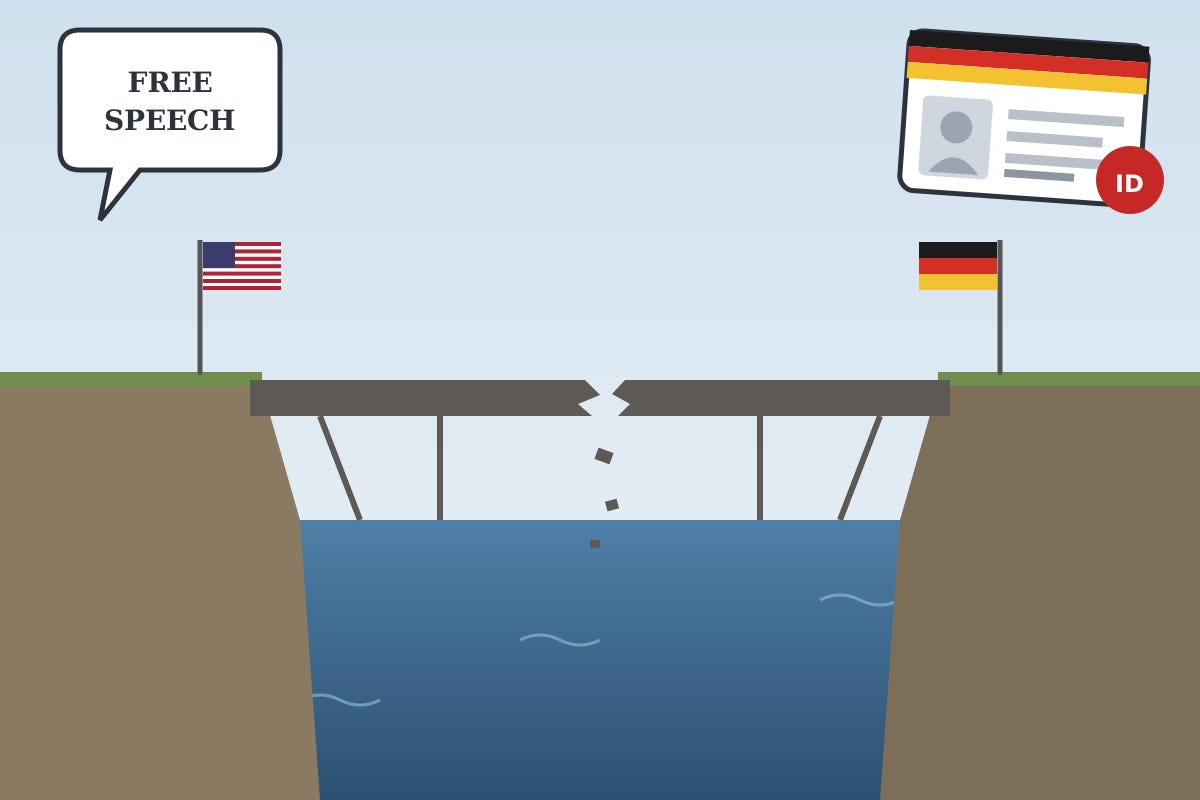
Asked recently by a young German researcher what a pending digital ID law would mean for whistleblowers and investigative journalists, German Chancellor Friedrich Merz insisted the debate had nothing to do with free speech, describing the concept as a libertarian American export.
At The Daily Economy, Anne Struffmann takes the chancellor to school on his own country’s history. Free expression didn’t arrive at Ellis Island, she argues, it runs through Kant’s 1784 essay on Enlightenment, the Frankfurt National Assembly of 1848, and Article 5 of Germany’s Basic Law, which expressly rules out censorship:
Understandably, the Chancellor’s rejection of free speech incited a wave of backlash both domestically and abroad. Placing it on the other side of the Atlantic not only pushes the already-tense partners further apart, but suggests a historically revisionist idea that free speech is somehow alien to Germany.
Certainly, the First Amendment creates strong protections around speech. But the intellectual origins of free expression do not begin at Ellis Island.
In Königsberg in 1784, Immanuel Kant wrote Was ist Aufklärung? — What Is Enlightenment? His answer to intellectual dependence was not government supervision of permissible thought but individual reason. “The public use of one’s reason must always be free,” Kant wrote.
The same tradition surfaced politically during the revolutions of 1848. The Frankfurt National Assembly placed freedom of expression and press among the German people’s political liberties. Germany’s subsequent history included two dictatorships that systematically suppressed dissent: Hitler’s Germany followed by the communist regime in East Germany. But the lesson Germany ultimately drew from these periods was not that speech should be limited.
John Coleman: California’s new chatbot law has a free speech problem

Fifteen years after the Supreme Court struck down California’s ban on selling violent video games to minors, Sacramento is back with a new interactive medium to child-proof. “Adam’s Law” (SB 1119), whose main requirements take effect July 1, 2027, restricts what “companion chatbots” can say to users suspected of being minors.
Beyond requiring operators to take reasonable steps to keep bots from encouraging suicide or drug use, it forbids them from claiming a special or unique understanding of the minor and from praise or flattery the law deems excessive for the context. FIRE’s John Coleman asks the obvious questions:
But what counts as excessive praise? How much understanding is special or unique? Toymakers can be held responsible for choking hazards or defective parts. But there’s a clear difference between regulating physical hazards and suppressing speech.
The problem isn’t lawmakers trying to keep children safe. The bill requires developers to try to determine what speech crosses these vague lines and take measures to suppress speech otherwise fully protected by the First Amendment. Apply the same standards to books, film, or ordinary conversation, and the government interference with free speech becomes obvious. SB 1119 is no different: it’s a clear example of government policing expression.
Around X
X told the Delhi High Court that an impostor using the Delhi Police’s name tried to get it to remove the accounts of two Indian digital-rights groups, the Internet Freedom Foundation and SFLC.in, over claims they had defamed the Hindu nationalist RSS. The fake orders came in through X’s online reporting form, per Reuters.

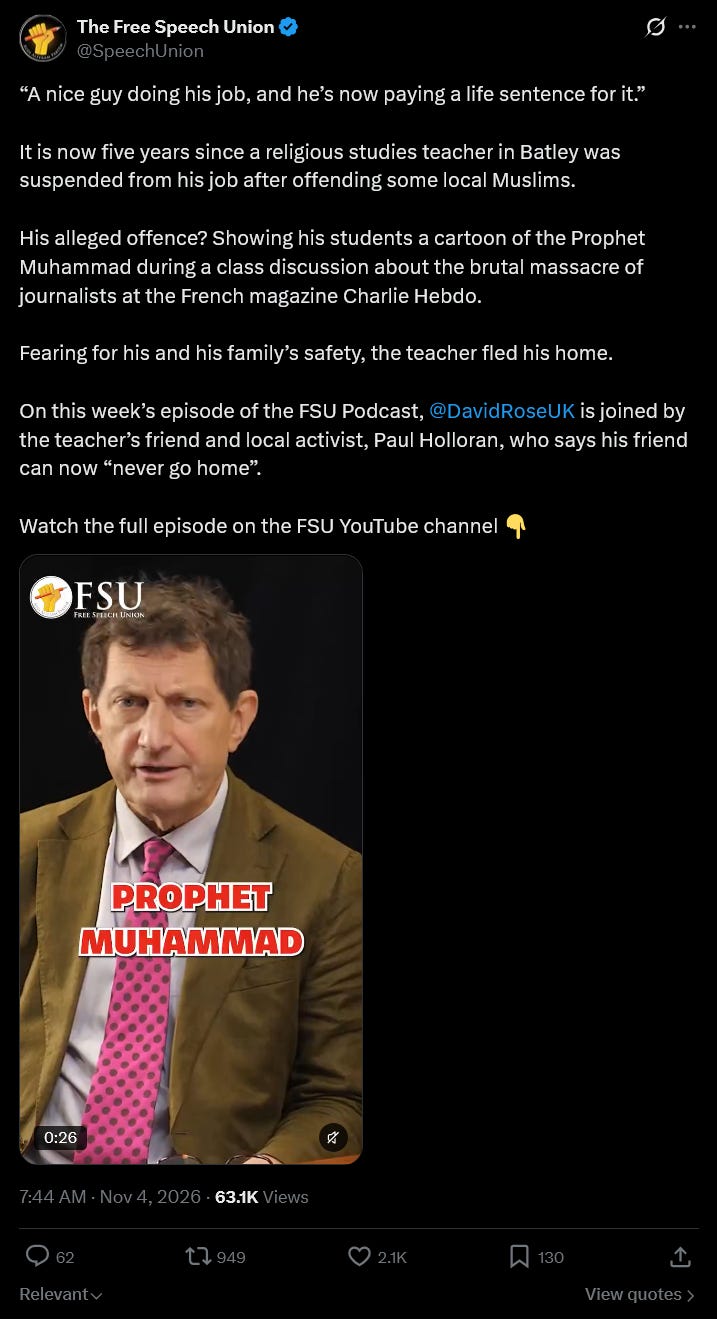
Five years on, a UK school teacher suspended for showing his religious studies class a cartoon of the Prophet Muhammad is still paying for it. The Free Speech Union shares a clip from its podcast that describe a man who was just doing his job: he's "now paying a life sentence for it."
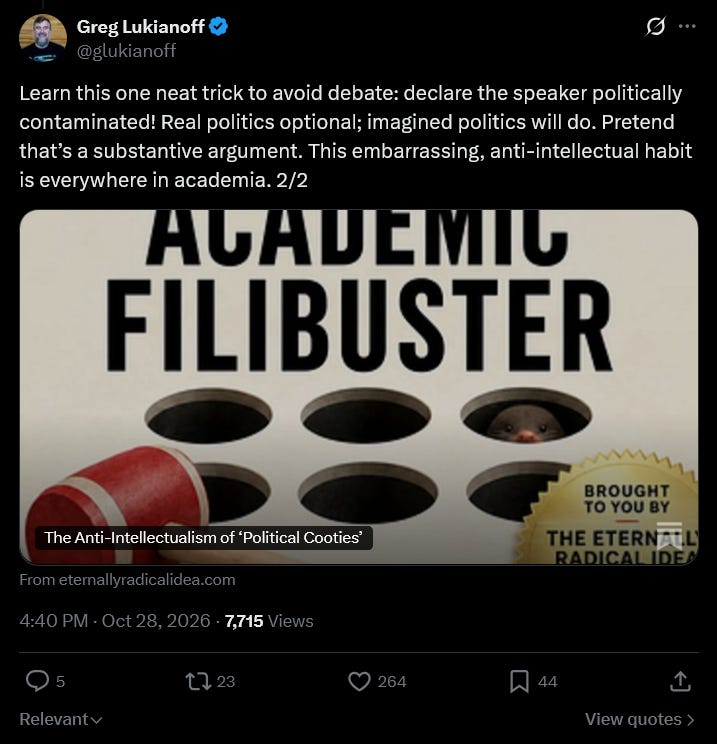
Finally, FIRE CEO Greg Lukianoff names a habit he calls "Political Cooties": dodging debate by declaring the speaker politically contaminated, with imagined politics doing the job just as well as real ones. He calls it anti-intellectual and everywhere in academia.