
A round-up of the latest and best insight on the rise of illiberalism in the public discourse:
Zach Greenberg: Pepperdine banned a professor who taught about a black Jesus
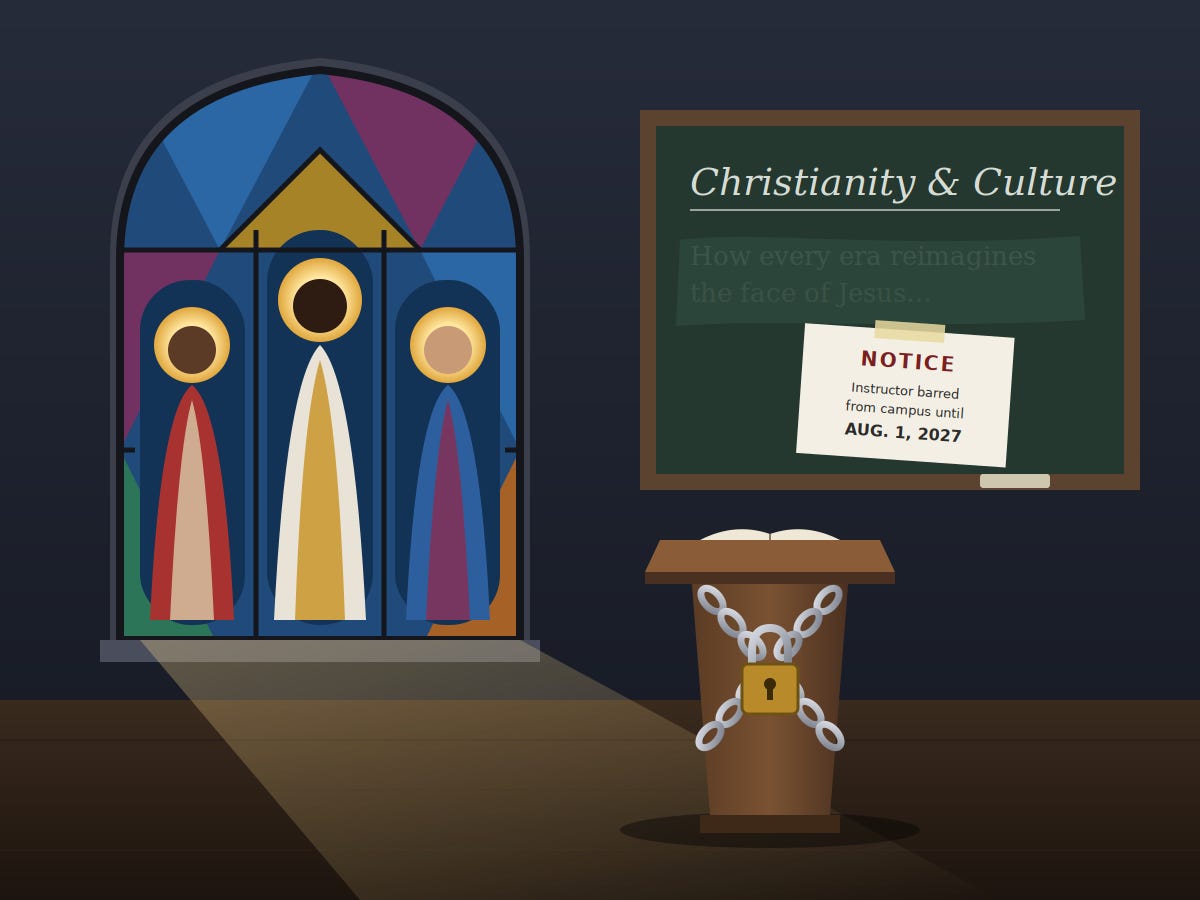
Christina Littlefield has taught at Pepperdine for 14 years and holds a Cambridge Ph.D. in divinity. She won’t be teaching this fall. At FIRE, Zach Greenberg reports that the private Christian university has put her on paid leave through August 2027 and barred her from campus, citing unprofessional speech and classroom conduct that left students uncomfortable.
Her offenses, per the disciplinary notice: assigning a chapter of American Jesus, a book surveying how Americans have reimagined Jesus over the centuries (including as a black messiah), which drew a 2024 parent complaint; and likening colleagues who supported censoring a campus art exhibition to fascist censors:
Pepperdine is a private Christian university, so the First Amendment does not require it to provide faculty the same speech protections they would receive from a public university. But the school has voluntarily made certain promises to its faculty.
Its Statement of Academic Freedom declares that “free inquiry and the pursuit of truth are indispensable conditions for the attainment of the goals of any university.” It promises professors “freedom of discussion in the classroom” and says faculty have a “basic duty to encourage freedom of inquiry in peers and in students.”
It properly recognizes faculty’s “freedom in teaching … must not be interpreted to discourage what is ‘controversial,’” adding that “Controversy is at the heart of the free academic inquiry, which this statement is designed to foster.”
Any professor teaching at Pepperdine would rightly believe the university has their back when it comes to complaints about subjectively “offensive” lecture content. They would reasonably feel safe to teach even provocative material to students, to challenge their assumptions and expand their worldviews.
Yet Pepperdine suspended Littlefield for more than a year for teaching about how other scholars discuss a black Jesus in her “Christianity and Culture” class, merely because that “made students feel uncomfortable.”
C.J. Ciaramella: Miami Beach Can’t Dodge First Amendment Lawsuit After Police Questioned Woman Over Anti-Israel Facebook Post

In January, two Miami Beach police detectives knocked on Raquel Pacheco’s door to ask about a Facebook comment she’d left under a post by Mayor Steven Meiner, one claiming the mayor consistently calls for the death of all Palestinians. The officers warned that the comment could provoke someone into acting on it. Pacheco filmed the whole thing.
At Reason, C.J. Ciaramella reports that Chief U.S. District Judge Cecilia Altonaga allowed parts of Pacheco’s First Amendment lawsuit to proceed, ruling that she had adequately alleged that her criticism of Israel motivated the mayor to send police to her home, and that the city had adopted a viewpoint-discriminatory policy against pro-Palestinian expression. The judge tossed several of her other claims:
“This is freedom of speech. This is America, right? I’m a veteran,” Pacheco told the officers.
“And I agree with you 100 percent,” one officer responded. “We’re just trying to see if it’s you, because if we’re not talking to the right person, we want to go see who the right person is.”
“We’re just trying to prevent someone else from getting agitated or agreeing with the statement,” one of the detectives told Pacheco. “We’re not saying it’s true or not.”
Pacheco refused to further answer the detectives’ questions.
After Pacheco’s video of the encounter went viral, Jones, the Miami Beach police chief, released a statement defending his decision to send the officers to her home, saying that “given the real, ongoing national and international concerns surrounding antisemitic attacks and recent rhetoric that has led to violence against political figures,” he had “serious concerns that her remarks could trigger physical action by others.”
However, there is a high First Amendment bar to clear to meet the legal standard for incitement. Under the test that the Supreme Court established in the landmark First Amendment case Brandenburg v. Ohio, the government must prove that the rhetoric incited violence or threats of violence and that the incitement was imminent, likely, and intentional.
Hugo Timms: Green ‘nutters’ and ‘lunatics’ want to ban the word ‘mother’

Ahead of this Saturday’s conference in Brighton, the Green Party of England and Wales has issued an inclusive-terminology guide for attendees. At spiked, Hugo Timms runs through the list: parents and carers in place of mothers and fathers; no gendered job titles like policeman or chairman; farewell to elderly, able-bodied, youngster, and homosexual; Even nutter and lunatic are out, on the grounds that they stigmatize mental illness:
This ‘inclusive’ guidance is, in reality, a list of banned words and phrases.
Around X
Speaking of Britain: John Cleese has been named in a referral to Prevent, the UK government’s counter-extremism program, over a series of posts about Islam. The referral was first reported by the British Muslim outlet 5Pillars, which has been sharply critical of Cleese. Cleese’s response:


Meanwhile, Sens. Adam Schiff and Alex Padilla have written to more than half a dozen tech executives demanding written answers, by October 15, on how their platforms will combat election misinformation and disinformation ahead of the midterms. When two senators send questions with a deadline attached, platforms tend to hear something other than a question.


Finally, Defense Secretary Pete Hegseth used his State of the Force address on Wednesday to declare that the American press makes Iranian state media look reasonable, per video posted by Aaron Rupar.
For the record, Iran’s regime just opened a criminal probe into a theater company because an actress rested her head on her co-star’s chest onstage. American reporters can say what they like about Hegseth. That’s rather the point.