A round-up of the latest and best insight on the rise of illiberalism in the public discourse:
Jack Nicastro: Why Insulting Brigitte Macron Online Can Mean Prison Time in France

Americans are (mostly) free to mock our elected leaders as we please. Things are rather different in France, where insulting the first lady could actually land you in jail. Jack Nicastro reports for Reason:
In the United States, poking fun at politicians online is a birthright. In France, it could land you in jail.On Monday, a French court found 10 people guilty of cyberbullying France’s first lady, Brigitte Macron. The defendants’ “crime” was falsely claiming on X that the first lady was born male and characterizing her relationship with French President Emmanuel Macron as pedophilic. (The French president met his wife when he was about 16 years old and she was a 39-year-old drama teacher at his high school.)
Defendants denied the charges against them by “saying their posts were either meant in jest or constituted legitimate debate,” reports The New York Times. Unfortunately for them, this argument rang hollow for the court, which handed out a variety of punishments. These included compulsory cyberbullying awareness training, eight suspended prison sentences, one six-month sentence to be served from home, and a six-month social media ban for five of the defendants. The defendants were also fined 600 euros (roughly $700) each and were ordered “to contribute to a total of 10,000 euros—about $12,000—in compensation” to the first lady, reports the Times.
While the thought of someone facing fines and jail time for a social media post may seem strange to Americans (although it does sometimes happen), French constitutional law is much more permissive of speech restrictions than its American counterpart.
The French Constitution holds that “any citizen may therefore speak, write and publish freely.” However, unlike the First Amendment to the U.S. Constitution, it immediately caveats this right by excluding “what is tantamount to the abuse of this liberty in the cases determined by Law.”
This carveout has allowed the French government to outlaw speech acts like bullying, which it defines as “the act of bullying a person through repeated comments or behavior whose purpose or effect is to degrade their quality of life, leading to an alteration in their physical or mental well-being.” Cyberbullying is defined as bullying through an electronic medium. Both are punishable by up to two years’ imprisonment and a fine of 30,000 euros (nearly $35,000).
Hugo C. Chiasson, Elise A. Spenner: Garber Faults Faculty Activism for Chilling Campus Debate and Free Speech
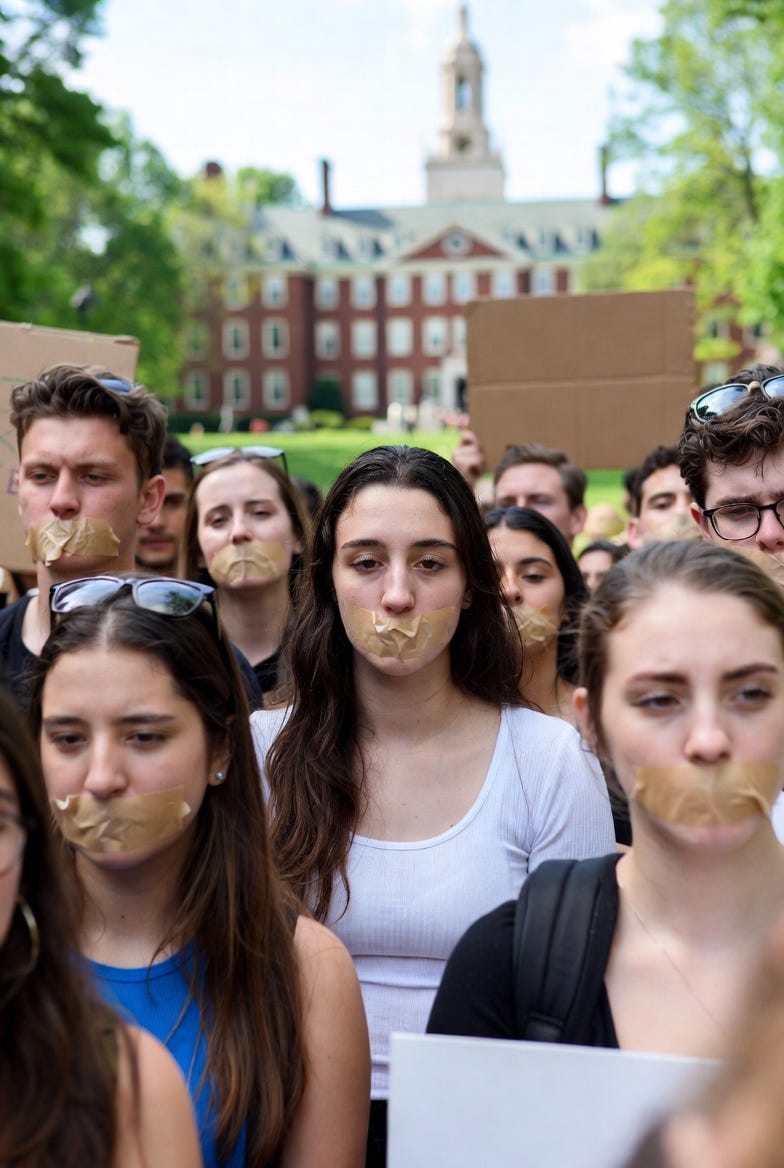
The first step is admitting you have a problem, and at least one college administrator—Harvard President Alan Garber—has acknowledged his school’s efforts to chill student speech. Even better, he’s taking steps to make things right:
Harvard President Alan M. Garber ’76 said the University “went wrong” by allowing professors to inject their personal views into the classroom, arguing that faculty activism had chilled free speech and debate on campus.
In rare and unusually candid remarks on a podcast released on Tuesday, Garber appeared to tie many of higher education’s oft-cited ills — namely, a dearth of tolerance and free debate — to a culture that permits, and at times encourages, professors to foreground their identity and perspectives in teaching.
“How many students would actually be willing to go toe-to-toe against a professor who’s expressed a firm view about a controversial issue?” he said.
The remarks mark Garber’s most explicit public acknowledgement that faculty practices have contributed to a breakdown in open discourse on campus — and that he is committed to backtracking toward neutrality in the classroom.
…
In response, Garber has launched a flurry of initiatives aimed at restoring what he has described as a culture of debate. Shortly after he assumed the presidency, Harvard adopted an institutional voice policy that commits the University and its top administrators to refrain from taking official positions on policy issues.
Washington Post editorial board: Jack Smith would have blown a hole in the First Amendment
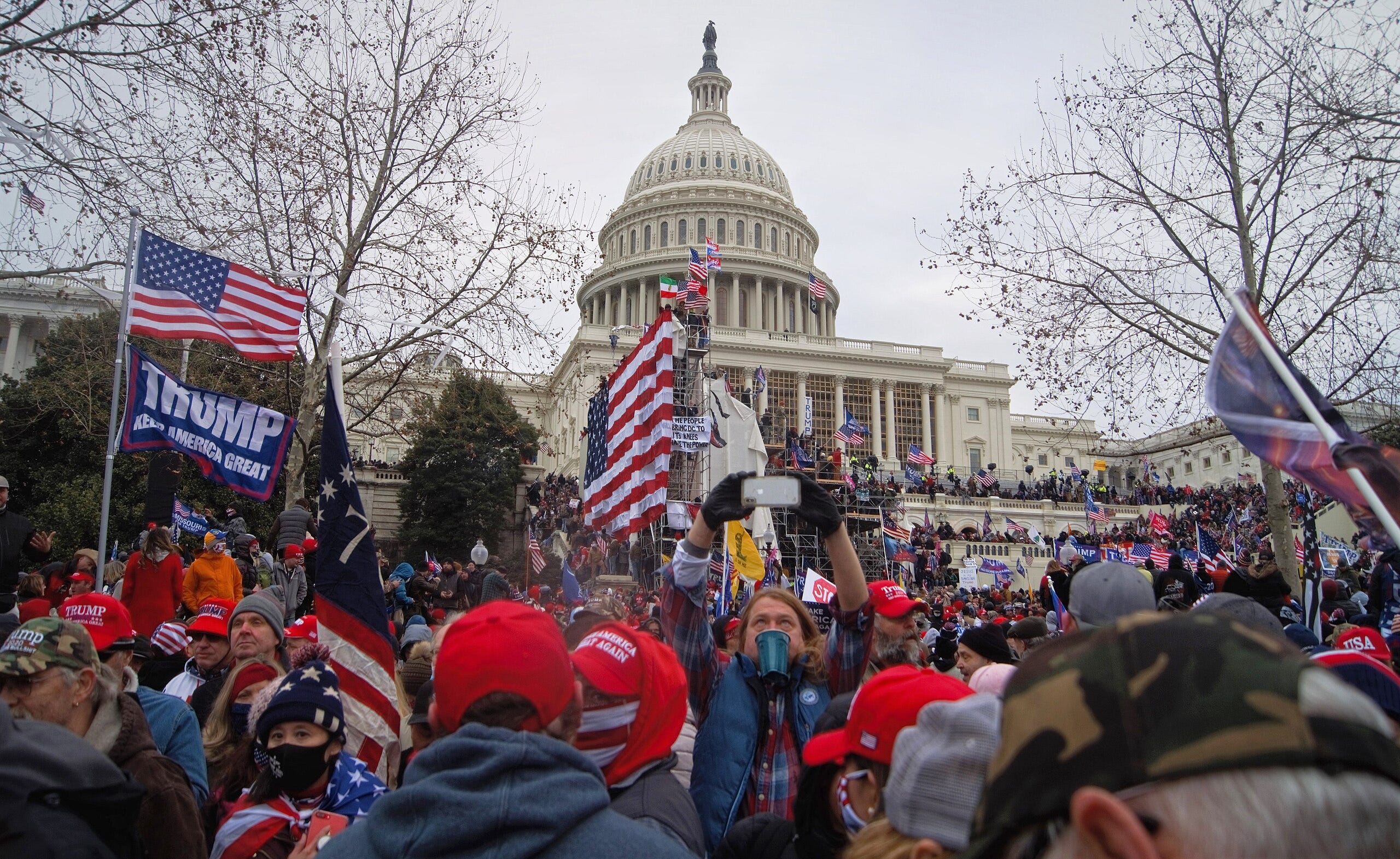
Last month, former Department of Justice special counsel Jack Smith, who prosecuted Donald Trump for his alleged role in the January 6 Capitol riot, defended his restrictive view of free speech to the House Judiciary Committee. Though sympathetic to Smith’s case, the Washington Post editorial board says his “exception” to the First Amendment would all but eliminate it:
Smith’s August 2023 Trump indictment focused on Trump’s repeated claims that the 2020 election was stolen in the run-up to the Capitol riot on Jan. 6, 2021. Put simply, the indictment accused Trump of lying so pervasively about the election that he committed criminal fraud.
The committee’s Republican majority, led by Chairman Jim Jordan (R-Ohio), pressed Smith on whether that theory of the case was constitutional: Wouldn’t Trump’s statements be protected by the First Amendment?
Smith replied: “Absolutely not. If they are made to target a lawful government function and they are made with knowing falsity, no, they are not. That was my point about fraud not being protected by the First Amendment.”
That’s a bold claim by the prosecutor. Political speech — including speech about elections, no matter how odious — is strongly protected by the First Amendment. It’s not unusual for politicians to take factual liberties. The main check on such misdirection is public scrutiny, not criminal prosecution.
Of course fraud is a crime. But that almost always involves dissembling for money, not political advantage. Smith’s attempt to distinguish speech that targets “a lawful government function” doesn’t work. Most political speech is aimed at influencing government functions.
Smith might think his First Amendment exception applies only to brazen and destructive falsehoods like the ones Trump told after losing the 2020 election. But once an exception is created to the First Amendment, it will inevitably be exploited by prosecutors with different priorities. Imagine what kind of oppositional speech the Trump Justice Department would claim belongs in Smith’s unprotected category.
Around X
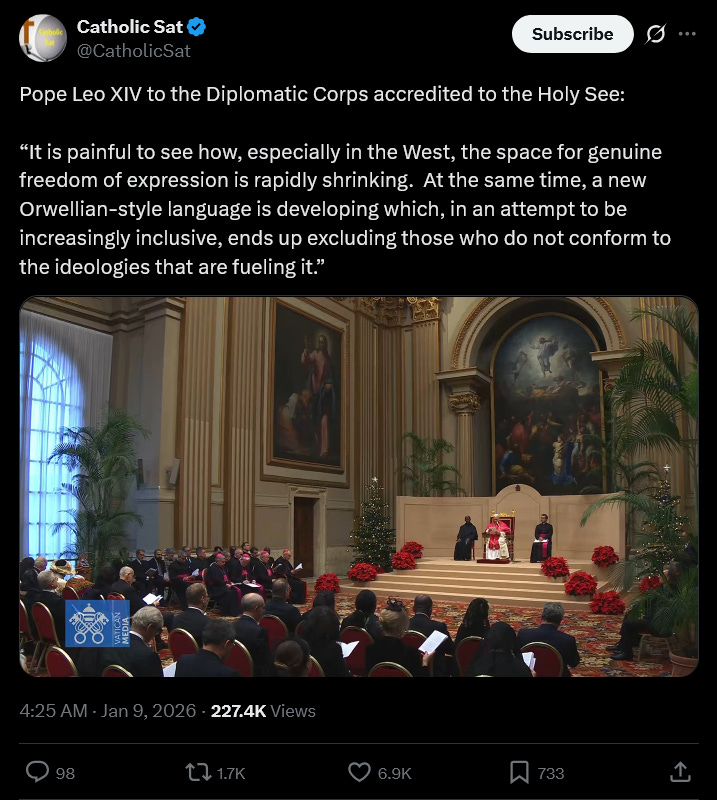
Doing the Lord’s work, Pope Leo XIV slams the West for replacing free speech with an ideological substitute that punishes heterodox perspectives.
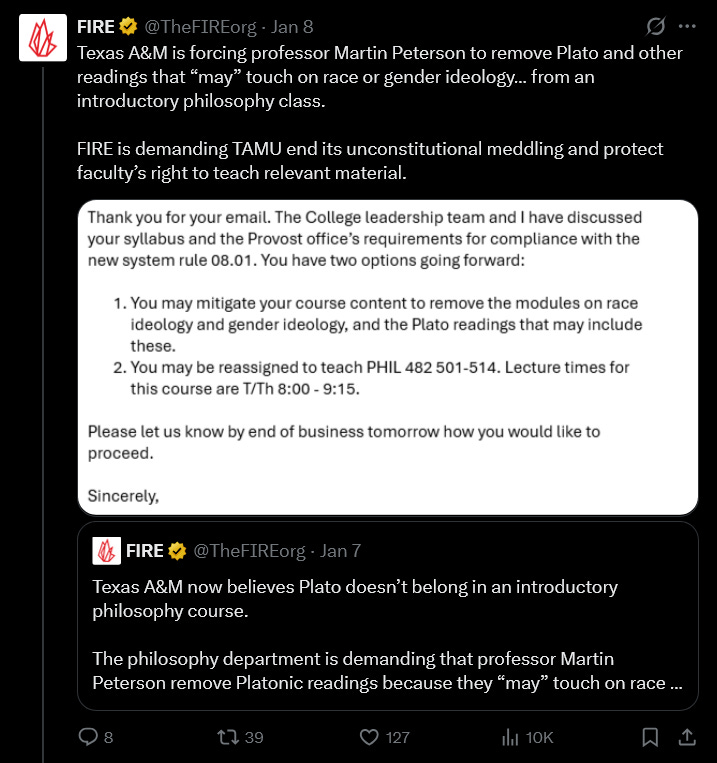
The Foundations for Individual Rights and Expression (FIRE) goes to bat for a a Texas A&M professor who’s been pressured to remove Plato from his intro to philosophy course.
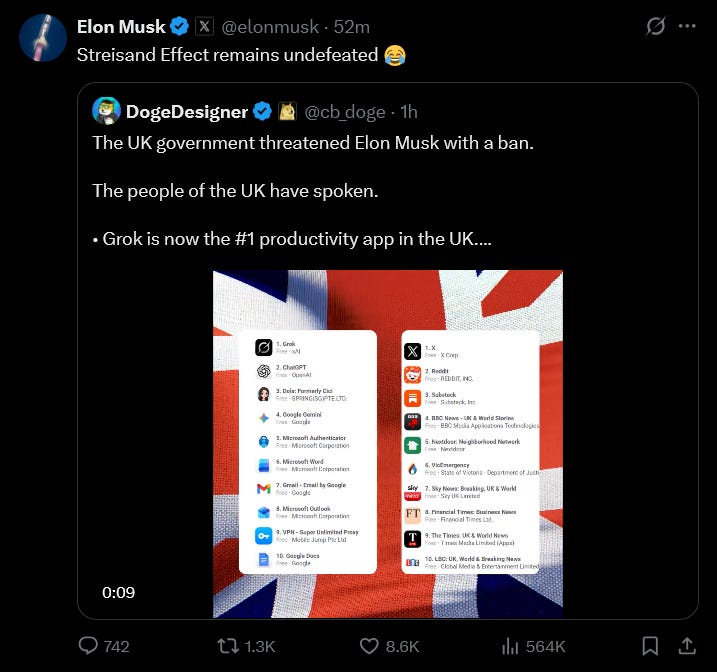
The UK threatened to ban X. The British public was less than thrilled by their government’s proposal, as Elon Musk was happy to point out.